
The battle line between federal commodities regulation and state gambling enforcement has officially been drawn. And for now, the state holds the upper hand.
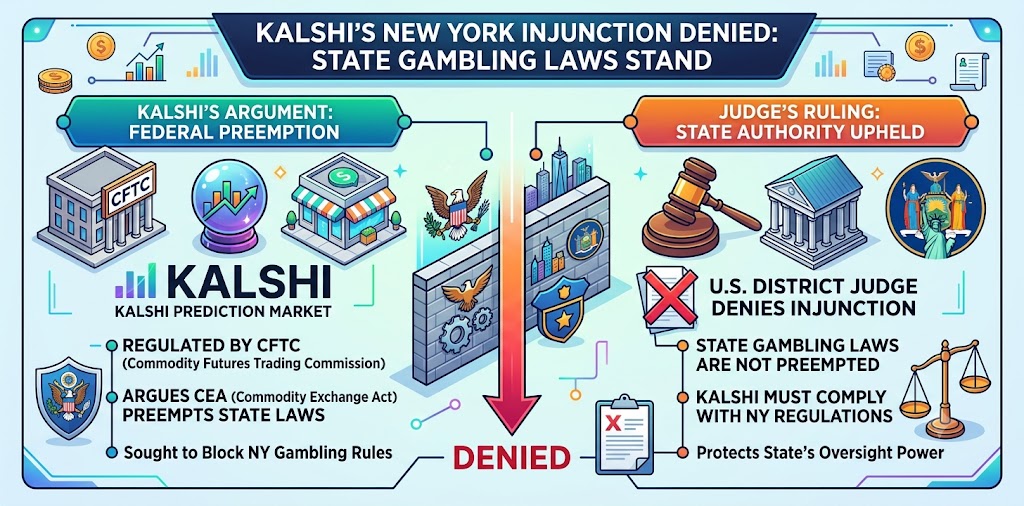
On July 7, 2026, U.S. District Judge Analisa Torres of the Southern District of New York dealt a severe legal blow to the prediction market platform Kalshi. The court outright denied Kalshi’s motion for a preliminary injunction, a desperate legal maneuver aimed at blocking the New York State Gaming Commission (NYSGC) from enforcing local gambling laws against the exchange’s sports-related event contracts.
At the heart of the dispute is a massive, high-stakes question: Does a federal license give a company a free pass to bypass state gambling watchdogs? Judge Torres delivered a resounding “no.”
Is Kalshi Legit? The 2026 Prediction Market’s Battle Over CFTC Regulation and Legal Status
Why Judge Analisa Torres Denied Kalshi’s New York Injunction
Kalshi’s legal defense hinged heavily on the concept of federal preemption. The company, which operates as an exchange registered with the Commodity Futures Trading Commission (CFTC), argued that the Commodity Exchange Act (CEA) grants the federal government exclusive authority over its products. Because their event contracts are technically classified as swaps, Kalshi insisted that New York simply had no jurisdiction to issue the cease-and-desist order that paralyzed their state operations back in late 2025.
Judge Torres—a jurist well-known in financial tech circles for her precedent-setting rulings in the Ripple (XRP) case—dismantled that argument.
In her ruling, Torres explicitly stated that Congress never intended to regulate so broadly as to completely exclude state gambling laws from overseeing transactions that happen to involve swaps. She systematically rejected the notion that federal oversight leaves zero room for local consumer protection.
“Kalshi has not shown that it is impossible to comply with both New York gambling laws and the CEA,” Torres wrote in her decision. “There is nothing preventing Kalshi from obtaining a license pursuant to New York law and establishing a category of New York market participants that does not discriminate within that New York-resident category.”
Also read:
- Kalshi Sues Illinois Over 15% Prediction Market Tax in Escalating Jurisdiction War
- Prediction Markets and the New Attention Economy: Polymarket, Kalshi, and the $300 Billion Boom
The Burden of Irreparable Harm
To secure a preliminary injunction, a plaintiff must prove they will suffer irreparable harm without immediate court intervention. Kalshi struck out here, too.
The exchange argued that without the injunction, it faced immense operational disruptions, geolocation compliance costs, and the looming threat of civil and criminal enforcement from the NYSGC. Torres remained unmoved, categorizing the damage as a simple financial loss that could be remedied later.
“Although the prospect of being subject to criminal prosecution could demonstrate a showing of irreparable injury, Kalshi’s harms ‘are largely monetary,'” Torres noted. She added that any civil fines levied could simply be vacated if Kalshi ultimately won the case on the merits—a prospect she bluntly categorized as “unlikely.”
Preemption Wars: The State Authority Strike Back
The reaction from Albany was swift and merciless. For New York regulators, this wasn’t just a routine court victory. It was a vindication of state sovereignty over a rapidly exploding, wildly lucrative shadow-betting industry.
“New York’s gambling laws are designed to protect consumers. Kalshi tried to ignore them. Yesterday, they lost in court,” New York Governor Kathy Hochul and State Attorney General Letitia James declared in a joint statement on Wednesday. “We will continue to hold all gambling platforms accountable to the law — and that includes prediction markets.”
Governor Hochul later drove the point home on social media, tweeting: “Gamble with our laws and you’re going to lose. Just ask Kalshi.”
Conversely, the federal government views this localized enforcement as a direct threat to its authority. Back in April, CFTC Chairman Michael S. Selig blasted the state’s aggressive posturing, stating that New York was “the latest state to ignore federal law and decades of precedent by seeking to enforce state gambling laws against CFTC-registered exchanges.” Selig vowed that the agency would not allow “overzealous state governments” to undermine the CFTC’s jurisdiction.
The $31 Billion World Cup Boom (and a Fragmented Future)
The timing of this legal blockade couldn’t be worse for the prediction market ecosystem. Fueled heavily by the recent World Cup, Kalshi’s platform exploded in popularity this summer. In June alone, the platform’s notional volume spiked 70% month-over-month, pushing past a staggering $31 billion.
But scale won’t save them from local subpoenas. New York is merely the loudest voice in a growing choir of states clamping down on prediction markets. Kalshi is currently fielding lawsuits from officials in Arizona, Kentucky, Massachusetts, Nevada, and Washington. In Michigan, Attorney General Dana Nessel recently secured a 14-day temporary restraining order forcing Kalshi to geoblock state residents entirely.
Kalshi wasted absolutely no time licking its wounds. By Tuesday afternoon, the company filed an official notice of appeal, sending the dispute directly to the U.S. Court of Appeals for the 2nd Circuit.
Until that appellate court weighs in, the regulatory reality for prediction markets remains fiercely fragmented. You can trade sports contracts under federal commodities law all you want. But if you cross state lines, you better have a gambling license.
Sources Quoted:
- U.S. District Court for the Southern District of New York (Ruling and written remarks by Judge Analisa Torres)
- Office of the Governor of New York / Office of the Attorney General (Joint statement by Gov. Kathy Hochul and AG Letitia James; social media statements)
- Commodity Futures Trading Commission (April 2026 public remarks by CFTC Chairman Michael S. Selig)
- Reporting from: AMBCrypto, Reuters, PYMNTS, Covers, SBC Americas, and Lower Bucks Times.
Leo Falsafi is a digital marketing veteran and senior journalist at Virlan.co, where he covers the intersection of digital marketing, gaming, and breaking US trending news. With nearly two decades of hands-on experience in SEO and digital strategy, Leo has consulted for and scaled hundreds of companies. His deep industry roots allow him to deliver sharp, fact-checked insights and analysis on the trends shaping today's digital landscape.