

The intersection of finance, entertainment, and digital engagement has birthed a new titan in the modern tech landscape: prediction markets.
As we progress through 2026, platforms like Polymarket and Kalshi are no longer fringe crypto experiments. They have exploded into mainstream juggernauts.
According to recent industry forecasts, overall betting volumes across prediction platforms are on track to surpass an astonishing $300 billion by the end of 2026.
Users are no longer just betting on standard sporting events. They are placing high-magnitude wagers on everything from Federal Reserve interest rate hikes and global geopolitical conflicts to the minutiae of celebrity court cases and pop culture events.
But as the user base expands, the fundamental nature of internet engagement is changing.
In a thought-provoking analysis from the Mozilla Foundation, tech scholar Karl T. Muth argues that platforms like Polymarket represent the vanguard of the new attention economy.
When users put their money on the line, they aren’t just staking capital—they are staking their finite human attention.
Yet, this massive shift comes with significant friction. Just in the last 24 hours and weeks, global regulators have mounted aggressive legal campaigns against the industry.
From the United States to Europe, the future of online betting is facing its most critical test to date.
This article dives deep into the mechanisms of the prediction market boom, exploring how Polymarket and Kalshi capture our attention, the regulatory crackdowns threatening their existence, and the profound ethical questions raised by financializing the future.
Also read: Live Betting Mechanics: How to Hedge Your Wagers and Lock in Profits Mid-Game
The Evolution of the Wager: From Ancient Bazaars to Digital Blockchains
To understand the current obsession with prediction markets, it is crucial to recognize that wagering on the future is an inherently human activity.
Historically, betting served essential economic functions long before the advent of modern financial platforms.
In the great markets of the ancient world, merchants in the Souk at Damascus would place wagers against Silk Road couriers regarding whether goods would arrive before spoiling. This was essentially the world’s first supply chain insurance system.
In the 1600s, merchants on the docks of Rotterdam and London would bet on whether ships would safely return from perilous voyages. These dockside wagers laid the foundation for today’s multi-trillion-dollar reinsurance market.
Therefore, Polymarket and Kalshi are not fundamentally pioneers of a new concept. As Karl T. Muth notes, their innovation is evolutionary, not revolutionary.
They have simply digitized and decentralized a practice that has existed in London’s bookrooms for centuries.
However, what makes these modern platforms unique is their scale, accessibility, and the unprecedented level of anonymity they offer to retail and institutional participants.
The traditional stock market restricts what you can bet on. You cannot buy shares on the New York Stock Exchange betting on the exact day a CEO will retire.
Prediction markets remove these barriers, allowing participants to monetize highly specific, niche information. But this frictionless environment introduces severe moral and economic consequences.
Also read: Hyperliquid Overtakes Ethereum in Fees as It Launches Prediction Markets to Rival Polymarket
How Prediction Markets Fuel the New Attention Economy
For years, social media platforms have battled for our eyeballs. In the early days of the internet, success was measured by the “click”—a low-friction action that gave rise to the clickbait era.
Eventually, platforms realized that clicks were not an accurate measure of value.
In the late 2000s, Karl T. Muth invented the “dwell time” framework, which YouTube adopted in 2012. Dwell time measures how long a user actually stays engaged with content, penalizing quick exits.
Today, prediction markets are pushing the concept of dwell time to its absolute limit. They are the ultimate evolution of the attention economy.
When a user places a wager on Polymarket or Kalshi, they are effectively locking in their attention.
Having “skin in the game” forces a deeply honest calculation of value. The user transforms from a passive spectator into an active stakeholder.
Despite our belief that we can multitask, human attention is finite. By focusing on a live wager, a user is demoting every other piece of media on the internet.
As Muth explains, the longest and deepest dwell occurs when a user feels a sense of agency over an outcome, however small.
Every second a bettor watches a political event or a sports game unfold, they are letting a micro-bet “ride.” They are continuously re-staking their attention on the belief that staying in the game will yield a psychological and financial payoff.
This explains why understanding how prediction markets impact the attention economy is so vital for the future of digital media. It is no longer just about entertaining people; it is about financially binding them to the content.
Also read: Berkshire Hathaway’s Massive Alphabet Stock Buy: Greg Abel’s AI Bet in Q1 2026
By the Numbers: Kalshi vs. Polymarket Volume and 2026 Valuations
While the philosophical debate rages on, the financial reality of these platforms is staggering.
The battle for market dominance between Kalshi and Polymarket is generating unprecedented trading volumes.
Recent data from DeFi Rate in May 2026 reveals that Kalshi and Polymarket combined for a massive $5.64 billion in weekly notional volume.
However, Kalshi is currently dominating the space. In the third week of May 2026, Kalshi posted $3.99 billion in volume, capturing an incredible 70.8% of the combined market share.
Polymarket, on the other hand, saw a 15% decline, dropping to $1.65 billion for the week.
Kalshi’s dominance is largely driven by its heavy concentration in sports and parlay-style combo bets, which attract massive retail participation. Polymarket maintains a heavier mix of cryptocurrency, global politics, and pop culture wagers.
These massive volumes have driven prediction market valuations in 2026 to astronomical heights.
Following a fresh funding round in May 2026, Kalshi’s valuation doubled to a jaw-dropping $22 billion. Polymarket is not far behind, reportedly boasting a valuation of $15 billion.
Investors are pouring billions of dollars into these platforms, betting that the regulatory hurdles will eventually clear, leaving these companies as the undisputed titans of the new financial internet.
The Threat of “Writing the Future” and Insider Trading
With billions of dollars flowing through decentralized, anonymous networks, the potential for market manipulation and insider trading is severe.
The core problem of digitizing bets on the future is that the market can begin to interfere with—or even dictate—the future itself.
While betting on sports or the Oscars seems like harmless fun, prediction markets frequently host wagers on highly sensitive topics.
Users bet on the outcomes of military actions, the names released in unsealed legal files, and the health of prominent public figures.
In these high-magnitude, niche markets, information asymmetry guarantees that insiders win.
If you know you are mentioned in a controversial legal document, you can anonymously place a bet on your own involvement and monetize your infamy.
These concerns are no longer just theoretical. In late May 2026, U.S. lawmakers officially launched a probe into insider trading on prediction platforms.
House Oversight Committee Chair James Comer initiated an investigation into whether government insiders are using non-public information to profit from bets on wars, elections, and monetary policy.
Letters were sent to Polymarket CEO Shayne Coplan and Kalshi CEO Tarek Mansour, demanding answers on how these platforms monitor suspicious activity, verify user identities, and enforce geographic restrictions.
Do we want to empower information traffickers as the key nodes in our financial networks? This question sits at the heart of the ongoing congressional probes.
The Regulatory Crackdown: States Strike Back
As the prediction market industry scales, state and international regulators are launching coordinated attacks to shut them down.
The legal battles represent a massive clash over the future of online betting and who has the authority to regulate it.
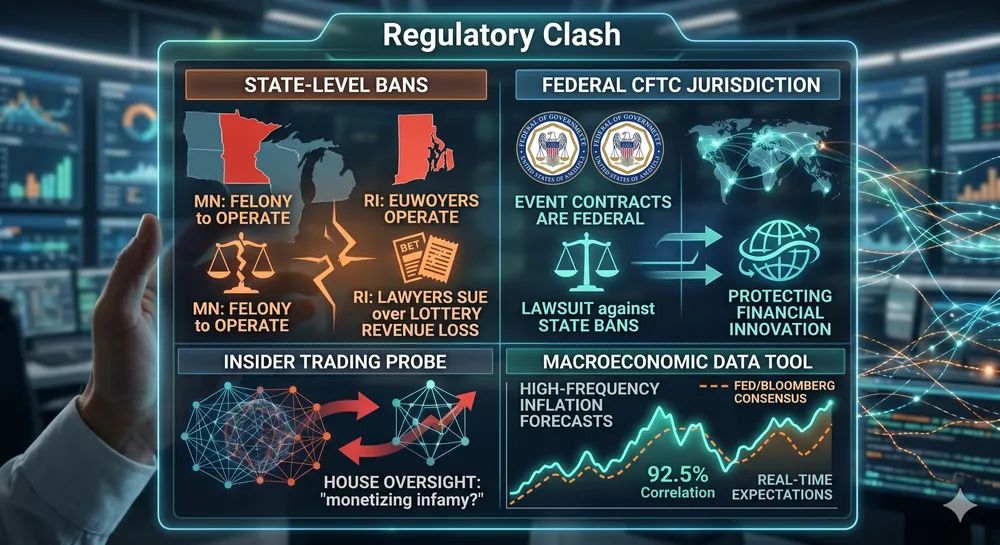
In May 2026, Minnesota enacted the nation’s first law explicitly banning prediction markets, making it a felony to operate or advertise platforms like Kalshi or Polymarket within state lines.
The Minnesota prediction market ban includes strict provisions targeting Virtual Private Networks (VPNs) used to bypass geographic restrictions.
Meanwhile, the state of Rhode Island filed a major lawsuit against both platforms, claiming that prediction markets are unlicensed sportsbooks.
Rhode Island’s Attorney General cited concrete data showing that the state’s lottery sports betting revenue declined by 8% from 2024 to 2025, a loss directly attributed to the expansion of Kalshi and Polymarket’s sports event contracts.
The regulatory heat is not confined to the United States. Just hours ago on May 26, 2026, Spain’s Consumer Rights Ministry ordered a temporary ban on both Polymarket and Kalshi due to licensing failures.
Despite these crackdowns, the industry has a powerful ally: the Commodity Futures Trading Commission (CFTC).
The CFTC contends that event contracts fall under federal jurisdiction, not state gambling laws. The federal agency has gone so far as to sue states like Minnesota to block their bans, arguing that prediction markets are critical financial instruments, not virtual casinos.
The Macroeconomic Perspective: A Valuable Data Tool?
While state attorneys general view prediction markets as a threat to public morals and state lottery revenue, economists see an incredibly valuable tool.
A February 2026 working paper from the Federal Reserve highlighted Kalshi as a revolutionary platform for measuring macroeconomic expectations in real-time.
Unlike traditional surveys that offer a snapshot of sentiment every few weeks, Kalshi provides a high-frequency, continuously updated density forecast.
The Fed study found that Kalshi’s forecast errors for core Consumer Price Index (CPI) and unemployment rates were statistically similar to the Bloomberg consensus.
More impressively, for headline CPI, Kalshi provided a statistically significant improvement over traditional forecasts.
When traders bet their own money on inflation data or Federal Reserve rate cuts, the resulting market price reflects a crowdsourced, highly accurate prediction of economic realities.
From this perspective, shutting down prediction markets would deprive policymakers and researchers of a critical, real-time data stream.
Efficiency vs. Humanity: The Ethical Dilemma
We are left with a fundamental clash between market efficiency and basic human decency.
Advocates of prediction markets envision an information-rich utopia where everything is priced, and “everyone is in markets.”
They argue that these platforms serve as cheap, narrow insurance policies. For example, a farmer could bet on low rainfall to hedge against crop failure.
But as Karl T. Muth points out, we already have a mechanism for that. It is called traditional insurance.
If everyone participated in these markets, the information advantages would erode instantly. The current appeal of prediction markets relies heavily on erroneous odds and the thrill of idiosyncratic windfalls.
Drawing on the philosophy of Adam Smith, Muth offers a poignant objection. Smith believed that humans aspire not just to be loved, but to be “lovely”—respectable, honorable allies in society.
Allowing anonymous bettors to profit off of military strikes, celebrity deaths, and leaked court documents makes the world fundamentally less lovely.
We must ask ourselves whether our thirst for perfect market efficiency is worth sacrificing our appetite for humanness.
As Kalshi and Polymarket fight for their survival in federal courts and congressional hearings, the outcome will determine much more than the future of online betting. It will redefine the limits of the attention economy itself.
FAQ: Understanding the Prediction Market Boom
What is a prediction market?
A prediction market is an online exchange where individuals can buy and trade contracts based on the outcome of future events. Unlike traditional sports betting, prediction markets allow users to wager on elections, economic data, global conflicts, and pop culture events. The prices of these contracts reflect the crowd’s perceived probability of an event occurring.
Why are Kalshi and Polymarket so popular in 2026?
Both platforms have seen explosive growth, generating over $5.6 billion in combined weekly volume in May 2026 alone. They appeal to users by gamifying news and finance, giving people a way to invest their capital and attention into real-world outcomes. Furthermore, their decentralized and often anonymous nature attracts participants looking for high-risk, high-reward opportunities.
How do prediction markets affect the attention economy?
By requiring users to stake money on an outcome, prediction markets force a high level of engagement, or “dwell time.” Users are more likely to closely follow news, watch events live, and continuously re-evaluate their positions. This transforms passive media consumption into active financial participation, deeply tying human attention to market outcomes.
What is the Minnesota prediction market ban?
In May 2026, Minnesota became the first U.S. state to pass a law making it a felony to host or advertise prediction markets like Kalshi and Polymarket within its borders. The law also targets the use of VPNs to access these sites. In response, federal authorities, including the CFTC, have sued to block the ban, arguing that regulation falls strictly under federal jurisdiction.
Are government insiders trading on prediction platforms?
This is currently the subject of a major congressional investigation. In late May 2026, House Oversight Committee Chair James Comer launched a probe into Kalshi and Polymarket to determine if government officials are using non-public, classified information to profit from bets on geopolitical and economic events.
Leo Falsafi is a digital marketing veteran and senior journalist at Virlan.co, where he covers the intersection of digital marketing, gaming, and breaking US trending news. With nearly two decades of hands-on experience in SEO and digital strategy, Leo has consulted for and scaled hundreds of companies. His deep industry roots allow him to deliver sharp, fact-checked insights and analysis on the trends shaping today's digital landscape.