
The slot machine is no longer a physical box sitting in a windowless room. It lives in our pockets, dressed up in vibrant animations, community leaderboards, and “free-to-play” tokens. But the underlying mechanics keeping players glued to the screen are more sophisticated than ever. Welcome to the era of the social casino.
Today, social casino slots boast a staggering 120 million monthly players worldwide. In a landscape where traditional online slots generated 15.3 billion spins per month globally in 2024, game developers have realized that keeping players engaged requires more than just the promise of cash. It requires a masterclass in behavioral psychology.
Let’s pull back the curtain on the gamification mechanics, psychological triggers, and regulatory frameworks that make the modern “spin” virtually irresistible.
The Billion-Dollar Mechanics Behind the “Spin”
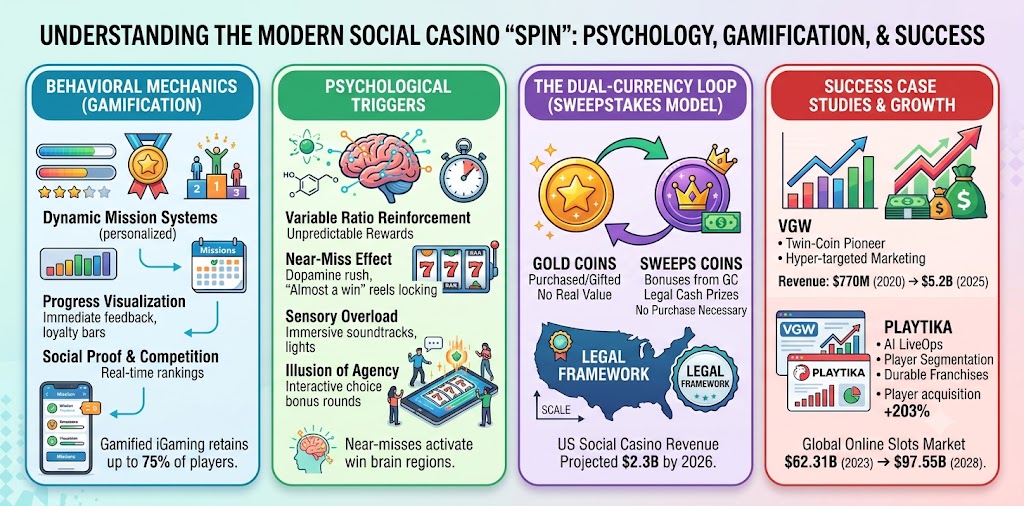
If you think social casinos are just niche time-killers, the data tells a different story. The global online slots market, valued at $62.31 billion in 2023, is hurtling toward a projected $97.55 billion by 2028. Within that ecosystem, the social casino segment is carving out massive revenue without relying on traditional real-money gambling. In the US alone, social casino revenue is projected to hit $2.3 billion by 2026.
Why are these platforms so incredibly sticky? The answer lies in aggressive, well-executed gamification. According to data from iLogos Game Studios, gamified iGaming platforms retain up to 75% of players over a six-month period, crushing the roughly 50% retention rate seen on non-gamified platforms.
Core gamification elements that drive these massive metrics include:
- Dynamic Mission Systems: Platforms are abandoning static tasks in favor of clustering models, which group players by behavioral patterns (e.g., risk-takers vs. casuals) to serve personalized, dynamic challenges.
- Progress Visualization: Giving players immediate visual feedback. Progress bars for loyalty unlocks and milestone rewards are now displayed directly in the game HUD, rather than buried in account menus.
- Social Proof and Competition: Utilizing real-time leaderboards and showcasing jackpot winners to stimulate a player’s innate competitive instincts.
It turns out, people aren’t just playing for the thrill of the win. Survey-based research from BGaming indicates that 29% of participants engage with online social casino games primarily for social connections, proving that community features are just as vital as the reels themselves.
The Illusion of Control: Psychological Triggers That Keep You Spinning
At the core of every slot machine is a concept behavioral psychologists call a variable ratio reinforcement schedule. Rewards are dispensed unpredictably. This irregularity floods the brain with dopamine, ensuring that the sheer unpredictability of a win is far more enticing than a predictable, easily understood pattern.
But developers don’t stop at random rewards. They engineer specific scenarios to maximize emotional engagement.
The Dopamine Rush of the Near-Miss Effect
Have you ever watched two jackpot symbols lock into place, only for the third reel to stop one fraction of an inch too late? That is the near-miss effect.
Studies show that near-misses activate the exact same brain regions as actual wins. They act as a form of positive reinforcement, tricking the player’s mind into believing a major victory is just around the corner. Instead of feeling like a loss, a near-miss creates an escalating commitment, encouraging the player to invest more time—and more virtual currency—to chase the seemingly imminent jackpot.
Sensory Overload and the Illusion of Agency
Casino floors have always used flashing lights and cheerful sounds to mimic celebration. Today’s social casinos replicate this digitally with immersive soundtracks, dynamic animations, and even haptic vibrations on mobile devices. This sensory cocktail makes tiny wins feel momentous and successfully masks the sting of losses.
Furthermore, many social slots introduce interactive bonus rounds where players “pick” a hidden prize or choose a specific narrative path. This taps into the “illusion of control.” Even though the outcome remains entirely governed by random number generators, the simple physical act of choosing makes players feel their personal skill influences the game.
The Dual-Currency Loophole: Gold Coins and Sweeps Coins
If players are spending real money but not technically gambling, how do these platforms operate legally across strict jurisdictions? The answer is the sweepstakes model.
Top-rated social casinos navigate complex legal frameworks using a dual virtual currency system:
- Gold Coins (Free Play): Players purchase or are gifted these coins to play games purely for entertainment. They hold no real-world value and can never be cashed out.
- Sweeps Coins (Cash Prize Play): These cannot be directly purchased. Instead, they are given away as free bonuses alongside Gold Coin purchases, or granted through daily logins. Winnings accumulated via Sweeps Coins can be legally redeemed for real cash prizes under strict sweepstakes laws.
This “no purchase necessary” policy provides a legal alternative to conventional online gambling while seamlessly integrating the thrill of real stakes into a free-to-play environment.
Why Gamification is the Future of iGaming Retention
Why are slot machine spins so addictive?
Slot machine spins are highly engaging because they utilize variable ratio reinforcement, meaning rewards arrive at entirely unpredictable intervals. Combined with sensory stimulation (flashing lights and triumphant sounds) and the “near-miss” effect, each spin triggers a dopamine release. This keeps players anticipating a win, effectively blurring the line between gambling and standard entertainment.
The future of social casinos isn’t just about spinning reels; it’s about building immersive, inescapable ecosystems. With the global gamification market projected to reach $190.87 billion by 2034, we are going to see a much deeper integration of AI-driven personalization, real-time social leaderboards, and complex narrative storylines. The spin is no longer just a mechanism of chance—it is a meticulously engineered psychological loop designed to captivate.
The Billion-Dollar Blueprint: Case Studies in Social Casino Dominance
Understanding the psychology of gamification is only half the battle. To see how these mechanics translate into unprecedented financial success, we have to look at the companies weaponizing these strategies at scale. By 2026, the global social casino market is actively valued at $9.06 billion, with mobile apps driving roughly 72% of that revenue.
How are the top operators capturing this massive audience? They treat their platforms not merely as games, but as highly optimized, data-driven ecosystems.
Success Story: The Unprecedented Rise of VGW and Chumba Casino
If you want to understand the true financial ceiling of the sweepstakes model, look no further than Virtual Gaming Worlds (VGW), the parent company of Chumba Casino and Global Poker.
VGW pioneered the “twin coin” model on mobile—seamlessly integrating Gold Coins for casual play and Sweeps Coins for redeemable cash prizes. But their explosive growth wasn’t just a byproduct of a clever legal framework; it was the result of aggressive, hyper-targeted digital marketing.
The numbers are staggering. In 2020, VGW reported roughly $770 million in revenue. By the end of their 2025 financial year, VGW’s revenue had skyrocketed to $5.2 billion (A$7.3 billion)—a mind-bending 575% growth over a five-year span.
To achieve this, Chumba Casino operated with digital marketing budgets exceeding $4 million per month, explicitly focused on the North American market. Instead of relying on traditional casino branding, they utilized advanced audience split testing and lift studies on platforms like Facebook. By optimizing their Cost Per Acquisition (CPA) down to the micro-percentile, every fractional improvement in their ad creatives resulted in thousands of new, highly engaged sign-ups. They didn’t just find players; they actively manufactured a fiercely loyal user base by targeting specific behavioral profiles most likely to engage with variable reward systems.
Also read: Top Sites Like Chumba Casino With Free Sweeps Cash
Case Study: Playtika’s Slotomania and the Power of AI Live Operations
While VGW dominates the sweepstakes space, Playtika remains the gold standard for traditional, free-to-play social casino gamification. Their flagship title, Slotomania, is a masterclass in treating a mobile app as a “durable franchise” rather than a disposable game.
Playtika doesn’t rely on players chasing real-money payouts. Instead, they monetize human attention and the desire for digital progression. The secret to Slotomania’s longevity lies in its “live operations” (LiveOps) and the integration of artificial intelligence.
Core Gamification Samples from Playtika:
- Machine-Learning Segmentation: Playtika uses AI to predict player churn and calculate Lifetime Value (LTV). The system groups players into distinct cohorts based on their gameplay style and dynamically alters in-game events and purchase offers to match their specific psychological triggers.
- Targeted Acquisition: In a widely documented growth push using predictive marketing platforms, the Slotomania media buying team successfully grew new player acquisition by 203% while simultaneously increasing Return on Investment (ROI) by 36%. They achieved this by mapping the behavioral traits of their highest-spending players and targeting identical profiles across social networks.
- Micro-Progression Economies: Players aren’t just spinning reels; they are unlocking new themed rooms, gathering collectible cards, and competing in time-sensitive tournaments. This constant layering of micro-goals ensures that even if a player is losing chips on the slots, they are still making measurable “progress” elsewhere in the app.
How do social casinos acquire high-value players so quickly?
Social casinos acquire high-value players by utilizing predictive AI and advanced data analytics to track user behavior. Instead of casting a wide net, marketing teams map the demographic and psychological profiles of their most engaged users. They then deploy highly optimized, A/B-tested ad campaigns on social media platforms to target lookalike audiences, successfully lowering their acquisition costs while maximizing player retention.
Ultimately, the case studies of Chumba Casino and Slotomania prove that the modern slot machine is no longer a game of chance. Through the surgical application of AI, hyper-targeted marketing, and gamified progress loops, developers have engineered an environment where the house always wins—and the players keep coming back for more.
Sources Quoted:
This article references data, expert analysis, and market trends directly sourced from Gitnux (2026 Slot Games Industry Statistics), BGaming (Market trends and revenue stats), iLogos Game Studios (Gamification retention and UI metrics), Smartico (The psychology of slot machine gamification and behavioral triggers), LegalSportsReport, and Gaming America (Sweepstakes mechanics and dual-currency models).
This expansion draws upon financial filings and market analysis from Gambling Insider (VGW $5.2B revenue data, 2025), SBO Financial Teardowns (VGW twin-coin model and financial growth), Mordor Intelligence (2026 Social Casino Market Size & CAGR data), Umbrex Consulting (Playtika’s LiveOps and AI strategy), and Skai (Playtika user acquisition metrics).
Leo Falsafi is a digital marketing veteran and senior journalist at Virlan.co, where he covers the intersection of digital marketing, gaming, and breaking US trending news. With nearly two decades of hands-on experience in SEO and digital strategy, Leo has consulted for and scaled hundreds of companies. His deep industry roots allow him to deliver sharp, fact-checked insights and analysis on the trends shaping today's digital landscape.