
The New House Edge: Wagering Taxes and Government Budgets
Wall Street has its algorithms, Vegas has its oddsmakers, but when it comes to aggressively finding new revenue streams, no one beats a state legislature facing a budget shortfall.
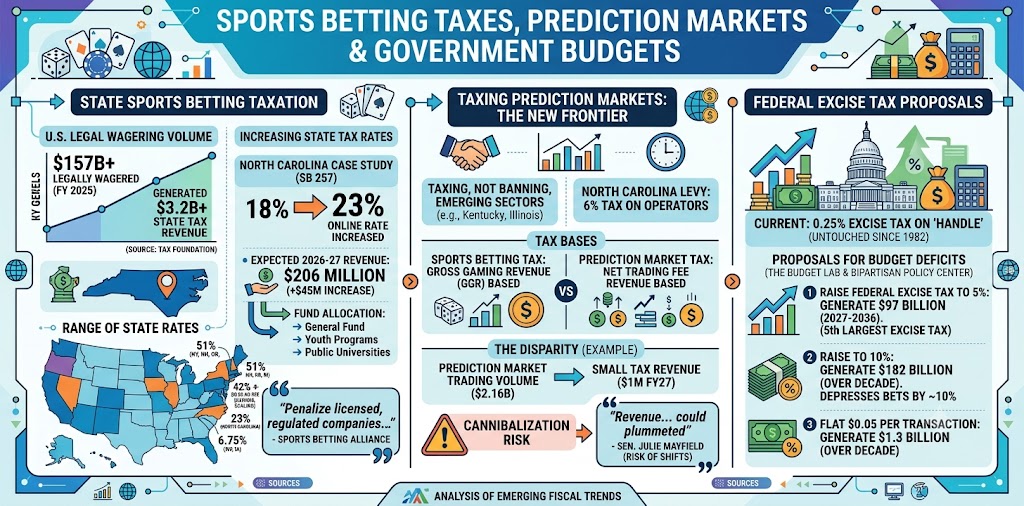
As the legal sports wagering market matures, the honeymoon phase between state governments and sportsbook operators is officially over. Lawmakers, having enticed operators with initial low rates to crush illicit markets, are now tightening the financial screws. The calculus is straightforward: citizens legally wagered more than $157 billion in fiscal year 2025 alone. That activity generated over $3.2 billion in state tax revenue, according to data from the Tax Foundation.
Now, both state and federal governments want a much larger slice of the pie. From aggressively hiking gross gaming revenue (GGR) taxes to laying entirely new regulatory frameworks over the booming prediction market sector, the tax landscape for wagering has shifted violently as we enter 2026.
State Tax Hikes: The North Carolina Microcosm
North Carolina serves as the perfect blueprint for this aggressive new fiscal strategy. Governor Josh Stein recently signed Senate Bill 257, an expansive $34 billion state budget that instantly raises the state’s online sports betting tax rate from 18% to 23%. This move, coming less than three years after legalization, vaults North Carolina above established markets like New Jersey and Massachusetts.
The expected windfall is substantial. Legislative analysts project the state will pull in $206 million in 2026-27—a $45 million jump from prior projections. The funds will be distributed to the general fund, youth programs, and public university athletics, finally bringing flagship schools like UNC-Chapel Hill and NC State into the revenue-sharing fold.
Industry advocates are bristling at the bait-and-switch. The Sports Betting Alliance, which represents major operators, fiercely opposed the move. The group argued that abrupt tax hikes “penalize licensed, regulated companies who have delivered hundreds of millions in tax revenue to the state.”
Yet, North Carolina’s 23% rate remains modest compared to New York, New Hampshire, Oregon, and Rhode Island, which siphon an astronomical 51% of sportsbook revenues. It also trails Illinois, which recently scaled its rates up to 42% alongside a flat $0.50 ad quantum fee per bet.
Why are lawmakers raising taxes on sports betting now?
Lawmakers are raising sports betting taxes now because the industry has transitioned from a nascent, experimental market into a highly profitable, mainstream consumer behavior. Initial lower tax rates were designed as an incentive to draw operators into the legal framework and eliminate the black market. With total wagers eclipsing $157 billion in FY 2025, budget-strapped states are retroactively adjusting their rates to maximize long-term general fund revenue, viewing gambling as a relatively inelastic, politically safe target for taxation.
The New Frontier: Taxing Prediction Markets
Prediction markets—platforms where users buy and sell shares based on the outcome of future events—have exploded into mainstream finance and politics. Rather than attempting to heavily regulate them out of existence, lawmakers have simply pivoted to taxing them.
North Carolina’s new budget makes it the third state this year, following Kentucky and Illinois, to specifically target this sector, implementing a 6% tax on prediction market operators. However, unlike traditional sportsbooks taxed on gross gaming revenue, this levy specifically targets net trading fee revenue.
The underlying math reveals a massive volume-to-revenue disparity. Legislative projections estimate a staggering $2.16 billion in prediction market trading volume within North Carolina this year. This activity translates to roughly $28.3 million in trading fees for the platforms. However, after deducting promotional spending and user incentives, the taxable net trading fee revenue shrinks to $21.2 million. The result? A comparatively meager $1 million in actual tax revenue for the state in FY27.
This structural tax difference has generated internal legislative friction over the threat of cannibalization. State Senator Julie Mayfield publicly warned that the disparity between a 23% sports betting tax and a 6% prediction market fee could incentivize operators to shift their products to exploit the lower rate. “The revenue that we’ve been getting from sports betting, it’s going to plummet,” Mayfield cautioned.
How does the federal excise tax on sports betting work?
Currently, the federal government levies a 0.25% excise tax on the “handle” (the total amount wagered), a rate that has remained untouched since 1982. This operates completely independently of state-level taxes. However, modern proposals suggest sweeping overhauls to this federal structure to plug national budget deficits.
A recent fiscal analysis by The Budget Lab and the Bipartisan Policy Center indicates that raising the federal excise tax on sports wagers to 5% could raise a staggering $97 billion between fiscal years 2027 and 2036. Such an increase would transform the sports betting levy into the fifth-largest federal excise tax, trailing only major revenue drivers like the gas tax and alcohol taxes. A more aggressive 10% tax could generate $182 billion over the same window, though analysts warn it would depress the total volume of bets placed by an estimated 10%. Alternatively, implementing a flat, fixed-dollar tax of $0.05 per transaction could yield $1.3 billion over the decade while dramatically altering operator margins on micro-betting.
Wagering Taxes and Budget Deficits
To understand the evolving regulatory landscape, consider these definitive baseline facts regarding the intersection of gambling expansion and government funding:
- Total Market Volume: U.S. consumers legally wagered over $157 billion in fiscal year 2025, yielding more than $3.2 billion in state tax revenues.
- Federal Tax Proposals: Increasing the federal excise tax on sports betting from its legacy 0.25% rate to a 5% tax is projected to generate $97 billion from FY 2027 to FY 2036.
- Prediction Market Mechanics: The state-level tax base for prediction markets fundamentally differs from sports betting; operators are taxed on net trading fee revenue rather than total gross gaming revenue.
- State Rate Variances: State-level online sports betting tax rates currently range from a low of 6.75% (Nevada, Iowa) to a high of 51% (New York, Rhode Island, New Hampshire, Oregon).
- Cannibalization Risks: Legislators fear that vastly lower tax rates on prediction markets (e.g., 6% in North Carolina) compared to sportsbooks (23% in North Carolina) may cause operators to reclassify wagers to exploit regulatory tax loopholes.
Sources Quoted: Insights and data were sourced from The Tax Foundation, The Budget Lab via the Bipartisan Policy Center, the Sports Betting Alliance, Gaming Intelligence, Legal Sports Report, WRAL, and public legislative statements from NC Gov. Josh Stein and Sen. Julie Mayfield.
Leo Falsafi is a digital marketing veteran and senior journalist at Virlan.co, where he covers the intersection of digital marketing, gaming, and breaking US trending news. With nearly two decades of hands-on experience in SEO and digital strategy, Leo has consulted for and scaled hundreds of companies. His deep industry roots allow him to deliver sharp, fact-checked insights and analysis on the trends shaping today's digital landscape.