
For decades, the summer months represented a sleepy, sluggish period for North American sportsbooks. The NFL was hibernating, March Madness was a distant memory, and operators relied almost entirely on the grinding daily schedule of Major League Baseball to stay afloat.
That script has been completely rewritten this year.
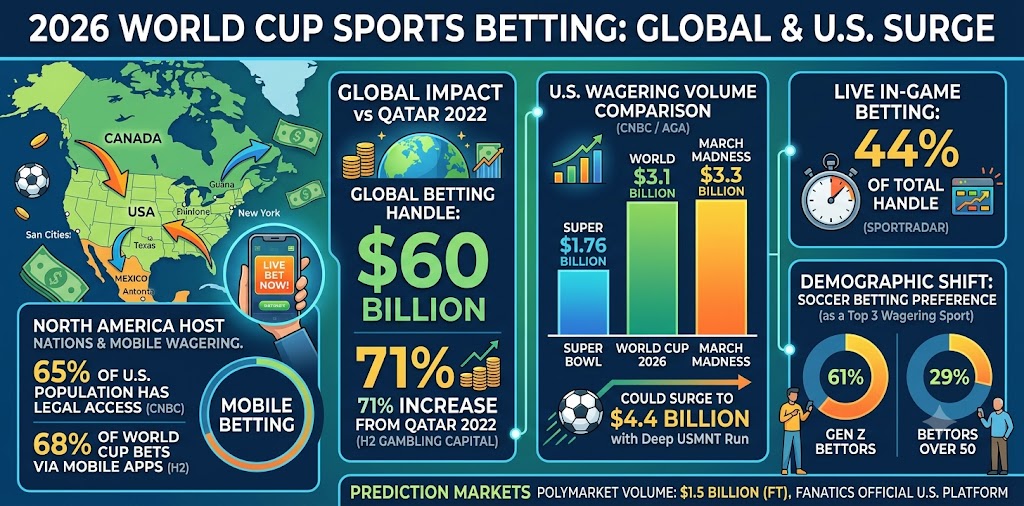
The 2026 FIFA World Cup, hosted jointly by the United States, Canada, and Mexico, isn’t just a sprawling international football festival. It has officially become the most extensive single-sport betting event in history. According to consulting firm H2 Gambling Capital, global wagers on the tournament are expected to hit a staggering $60 billion—a 71% increase from the 2022 tournament in Qatar.
But the real story is playing out on American soil, where a rapidly maturing legal sports wagering market has collided with favorable home-continent time zones to create an absolute frenzy of betting activity.
The U.S. Legal Sports Wagering Explosion
Before 2026, there had never been a World Cup where mobile sports betting was fully mainstream across the United States. Today, roughly 65% of the U.S. population has legal access to sports betting, according to CNBC.
This structural shift is yielding massive financial projections. A recent report by Sweeps Pulse estimates American bettors will drop $3.1 billion on the 2026 tournament. To put that capital into perspective, the American Gaming Association (AGA) reported that the Super Bowl generated a betting total of $1.76 billion. Even March Madness, the traditional king of U.S. betting, produced around $3.3 billion.
“The Super Bowl is the pinnacle, but the World Cup is going to be a couple dozen Super Bowls back-to-back-to-back-to-back over the span of six weeks,” Brian Josephs, Sportradar’s Vice President of Americas, told ESPN.
If the United States Men’s National Team manages a deep run beyond group play—which kicked off at SoFi Stadium in Los Angeles against Paraguay—gaming research firm Eilers and Krejcik predicts that domestic betting handle could surge to an astonishing $4.4 billion.
By The Numbers: World Cup 2026 Betting Statistics
The sheer volume of money flowing through sportsbooks is fundamentally altering the global gambling ecosystem. Here are the core insights driving the 2026 World Cup betting surge:
- Global Betting Handle: Total worldwide wagers are projected to sit between $50 billion and $60 billion.
- Market Share Dominance: According to Deutsche Bank estimates, FanDuel is projected to handle $1.3 billion in U.S. World Cup bets, while DraftKings is expected to take in $1.1 billion.
- The Mobile Factor: An estimated 68% of all World Cup bets will be placed via mobile apps, up significantly from 41% during the 2018 tournament.
- Live Wagering: Live, in-game betting is expected to account for 44% of the total wagered amount as bettors react to on-pitch developments in real-time.
- Platform Breakdown: Of the projected U.S. handle, $1.6 billion will flow through licensed sportsbook apps, $920 million via offshore platforms, $380 million at retail locations, and $200 million through social/sweepstakes formats.
Why is the 2026 World Cup seeing such a massive surge in sports betting?
Several colliding factors are fueling the current boom. First, the tournament expanded its field from 32 to 48 teams, meaning there are 104 matches for handicappers to target. Second, because the games are held in North American cities like New York, Dallas, and Miami, the match start times sit directly in prime viewing windows for domestic bettors. Finally, user habits have evolved. Bettors have spent the last four years actively using legalized mobile apps for NFL and NBA games, creating a frictionless transition to soccer wagering. Sportsbooks are fueling this fire by committing an estimated $400 million to World Cup-specific promotions, including odds boosts and deposit matches aimed at acquiring new bettors.
The Demographic Shift: Gen Z Changes the Game
Underneath the multibillion-dollar handle lies a profound demographic transition. Soccer’s betting audience is younger and growing aggressively.
Survey data reveals that 61% of Gen Z sports bettors identify soccer as one of their top three wagering sports. In stark contrast, only 29% of bettors over the age of 50 say the same. As the older demographic sticks to traditional American sports, younger bettors are turning global football into a premier U.S. betting asset.
How much will Americans bet on the 2026 World Cup compared to the Super Bowl?
The U.S. handle for the 2026 World Cup is projected to easily dwarf the Super Bowl. While the Super Bowl commands intense single-day action—generating $1.76 billion in legal bets according to the AGA—the World Cup is projected to pull in roughly $3.1 billion over its six-week duration.
Prediction Markets Add to the Frenzy
Beyond traditional sportsbooks, prediction markets are seizing a massive slice of the pie. Polymarket, a prominent prediction platform, has already recorded $1.5 billion in trading volume (as reported by the Financial Times) solely on the tournament’s eventual winner. Recognizing this emerging sector, Fanatics Markets recently struck a deal to serve as the official U.S. prediction market platform of the World Cup.
As traditional sportsbooks, offshore platforms, and prediction markets vie for consumer dollars, one thing is abundantly clear: the 2026 FIFA World Cup has permanently erased the traditional summer sports betting slump, setting a benchmark that will redefine the industry for years to come.
Also read: Prediction Markets and the New Attention Economy: Polymarket, Kalshi, and the $300 Billion Boom
Sources Quoted: Data and insights extracted from ESPN, CNBC, Reuters, the Financial Times, the American Gaming Association, H2 Gambling Capital, Sweeps Pulse, Deutsche Bank, Eilers and Krejcik, and Sportradar (Brian Josephs).
Leo Falsafi is a digital marketing veteran and senior journalist at Virlan.co, where he covers the intersection of digital marketing, gaming, and breaking US trending news. With nearly two decades of hands-on experience in SEO and digital strategy, Leo has consulted for and scaled hundreds of companies. His deep industry roots allow him to deliver sharp, fact-checked insights and analysis on the trends shaping today's digital landscape.