
The rapid legalization of sports betting across the United States over the last half-decade was supposed to drag an underground industry into the light. Regulate it. Tax it. Protect the consumer.
Instead, it inadvertently supercharged a parallel shadow economy.
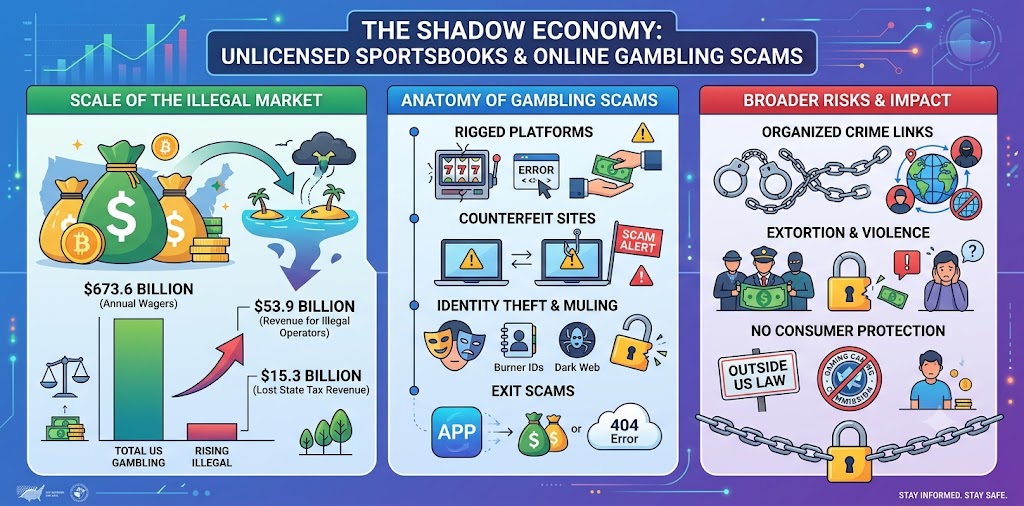
Right now, an astonishing one out of every three dollars wagered by Americans bypasses the legal system entirely. We are witnessing a $673.6 billion annual tidal wave of illicit bets washing into offshore accounts, unregulated terminals, and cryptocurrency wallets. While state-licensed operators battle for market share through endless television promos, unregulated entities are quietly eating the foundation of the industry.
The consequences stretch far beyond mere regulatory headaches. From rigged digital slot machines that drain bank accounts in minutes to violent extortion rackets managed by international syndicates, the unchecked growth of unlicensed sportsbooks and online gambling scams has mutated into a premier national security and consumer protection crisis.
The Financial Hemorrhage: Tracking the $53 Billion Black Market
To understand the sheer gravity of this underground sector, you have to look at the money bleeding out of local communities. Data compiled by the American Gaming Association (AGA) reveals that illegal and unregulated operators generate roughly $53.9 billion in revenue every single year.
Because these entities operate in the dark, they pay zero taxes. That translates to an estimated $15.3 billion in lost state tax revenue annually—capital that was legally earmarked for public education, infrastructure repair, and local law enforcement.
The sports betting sector is particularly porous. Despite the widespread availability of legal, regulated sportsbooks, Americans still shoveled an estimated $84 billion toward unlicensed bookies last year alone. But why?
Habit plays a role. Many long-time bettors simply refuse to abandon their legacy bookies. But the primary drivers are purely financial and structural. Offshore sites routinely offer looser betting limits, superior odds, and tax-free payouts. They also heavily target states where iGaming or sports betting remains restricted. By the time 2024 closed out, only 24% of online gamblers were sticking entirely to licensed platforms—a catastrophic plunge from 52% just two years prior. Today, nearly half of all U.S. bettors split their bankrolls between legal and illegal sites.
Modern Online Gambling Scams
As the lines between legitimate and illegal platforms blur, scammers have flooded the zone. According to a comprehensive 2025 study by the Better Business Bureau (BBB), online gambling fraud reports have more than doubled since 2023. Between 2022 and mid-2025, the BBB tracked over 10,000 business complaints and hundreds of outright theft reports linked to gaming platforms.
The mechanics of these scams range from the rudimentary to the highly sophisticated:
- Counterfeit Platforms & “Rigged” Code: Fraudsters routinely launch clone websites mimicking giants like FanDuel or DraftKings to steal deposits. In other cases, offshore casinos deploy manipulated algorithms. In one harrowing BBB Scam Tracker report from May, a Texas woman lost $25,000 when an offshore online slot game “malfunctioned,” autonomously skyrocketing her wager amounts without her input.
- The “Guaranteed” Handicapper Hustle: Social media is currently infested with fake “insider” handicappers. These operators demand heavy upfront fees for guaranteed picks or fixed-match data. The BBB notes these scammers often vanish immediately after the payment clears.
- Muling and Identity Theft: A rising threat targeting legitimate sportsbooks is “muling.” Gambling syndicates purchase real government IDs on the dark web or from desperate individuals to create burner betting accounts. These are used to bypass bans, launder funds, or extract promotional bonuses, leaving the original ID owner holding the bag when the IRS comes knocking or their credit is destroyed.
- The Exit Scam: In states where betting isn’t fully legal, fake apps thrive on desperation. Fye Fantasy, an unregulated sports betting app, accepted wagers and even credited users with “wins” on their digital dashboards. But when users like a man from Sugar Land, Texas, attempted to withdraw funds, the platform stalled for months before scrubbing its website from the internet completely.
Alex Costello, Vice President of the AGA, summarized the threat bluntly in a recent statement: “These predatory websites—which rely on cryptocurrency and employ no safeguards—pose the most significant risk of gambling-related financial crimes.”
Extortion, Syndicates, and the FBI’s Escalating War
When a consumer bets with a licensed domestic operator and a dispute arises, they can appeal to a state gaming commission. When a consumer bets with an offshore site registered in Curacao or Costa Rica, they are entirely on their own.
“Illegal gambling websites and other grey market gambling offerings can pose serious risks to consumers because they operate outside the protections of regulated markets,” noted a press officer for the North American Association of State and Provincial Lotteries.
But the risk isn’t just a frozen bankroll. The Federal Bureau of Investigation’s Crime and Corruption in Sport and Gaming (CCSG) Program recently issued an aggressive warning regarding the severe, real-world dangers of the unregulated market. The FBI confirmed that revenue generated from illegal sportsbooks is routinely funneled directly into transnational organized crime networks, funding human trafficking, narcotics distribution, and weapons smuggling.
Furthermore, bettors who fall behind on debts to illicit bookmakers frequently find themselves victims of extortion, targeted by violent collection tactics.
How can I tell if an online sportsbook is illegal or a scam?
The fastest way to verify a sportsbook is to check your specific state’s gaming commission website, which maintains a public registry of all licensed operators. Illegitimate sites often allow you to deposit funds via cryptocurrency, fail to require robust identity verification (KYC protocols) upon signup, and conspicuously lack a “.gov” or state-specific regulatory seal at the bottom of their homepage. If an operator tells you to use a VPN to access their site, they are illegal.
What happens if an offshore casino refuses to pay my winnings?
If an unlicensed, offshore sportsbook or casino refuses your withdrawal, you have almost no legal recourse. Because these companies operate outside U.S. jurisdiction, federal and state agencies cannot force them to honor payouts or refund stolen deposits. Your only real avenue is documenting the fraud and reporting it to the FBI’s Internet Crime Complaint Center (IC3) to help authorities build broader cases against the syndicate.
- Total Market Share: Americans wager an estimated $673.6 billion annually with illegal and unregulated gambling operators, accounting for nearly 33% of the entire U.S. gaming market.
- Tax Revenue Deficit: Unlicensed gambling operations generate approximately $53.9 billion in untaxed revenue annually, costing U.S. state governments $15.3 billion in lost tax revenue.
- Physical Unregulated Machines: More than 625,000 unregulated “skill game” machines currently operate in U.S. convenience stores and bars, representing 40% of all physical gaming machines nationwide.
- Consumer Safety Plunge: Only 24% of online gamblers exclusively use licensed platforms, a steep decline from 52% in 2022.
- Law Enforcement Warnings: The FBI’s CCSG Program explicitly links offshore sportsbooks to transnational organized crime, warning that user funds frequently finance human trafficking and narcotics operations.
Sources Quoted: Data and direct quotes were sourced from the American Gaming Association (AGA) via iGamingToday, the Better Business Bureau’s (BBB) 2025 Scam Tracker Study (featuring AGA VP Alex Costello and the NAASPL), and the FBI’s Crime and Corruption in Sport and Gaming (CCSG) public alerts/IC3 databases.
Leo Falsafi is a digital marketing veteran and senior journalist at Virlan.co, where he covers the intersection of digital marketing, gaming, and breaking US trending news. With nearly two decades of hands-on experience in SEO and digital strategy, Leo has consulted for and scaled hundreds of companies. His deep industry roots allow him to deliver sharp, fact-checked insights and analysis on the trends shaping today's digital landscape.