
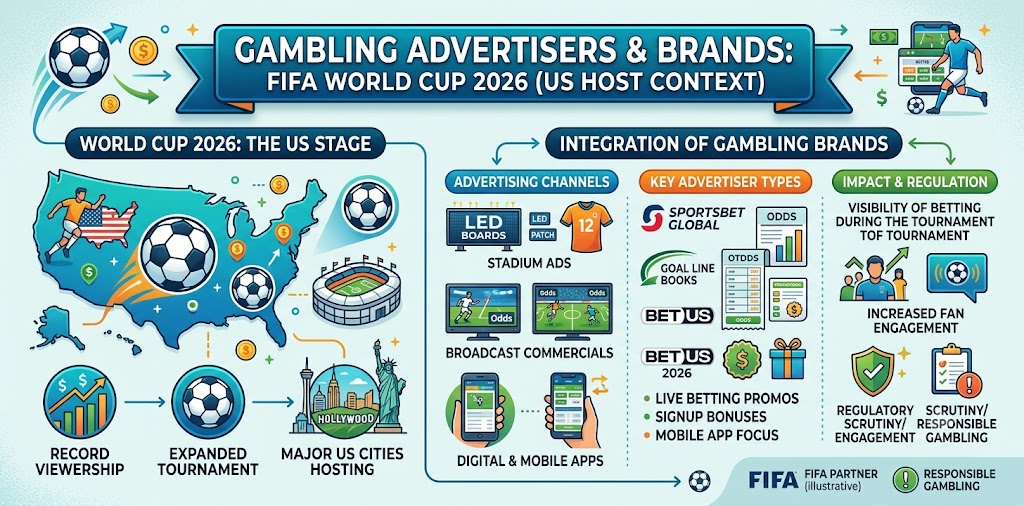
The 2026 FIFA World Cup is no longer just a soccer tournament. It is a $60 billion financial engine.
According to projections by H2 Gambling Capital, betting volumes for this year’s expanded 48-team tournament are expected to surge 71% past the 2022 numbers. The favorable North American time zones, coupled with an explosion of regulated mobile betting across the United States and Canada, have set the stage for the most heavily wagered sporting event in human history. Macquarie analysts project the global handle will easily eclipse $50 billion, with American bettors alone wagering over $3 billion.
But who is bankrolling the relentless wave of odds boosts, television commercials, and digital signage?
The landscape is highly fragmented. A stark dividing line exists between FIFA’s official global partners and the domestic US sportsbooks flooding the broadcast airwaves on networks like Fox.
Here is the definitive breakdown of the gambling brands and betting advertisers fueling the 2026 World Cup.
The Official FIFA Partners
FIFA expects to generate upwards of $11 billion in commercial revenue from this tournament. To achieve this, the governing body has embraced the betting sector at the institutional level, despite maintaining strict internal ethics rules that prohibit players and officials from participating in gambling.
- Betano (Kaizen Gaming): Returning for its third FIFA partnership, Betano is the Official Tournament Supporter for Europe and South America. Kaizen Gaming CEO George Daskalakis called the 2026 tournament “the ultimate intersection of sport and entertainment.” The brand is heavily pushing digital fan activations while heavily promoting responsible gaming tools across its regional footprint.
- ADI Predictstreet: In a massive and highly scrutinized play, this newly formed Abu Dhabi-backed prediction market secured a top-tier global partnership with FIFA. The deal is reportedly valued at $150 million. Notably, the company acquired a Gibraltar gambling license just one day after its incorporation in March 2026.
- Stats Perform: While not a consumer sportsbook, this sports data titan acts as the crucial middleman. FIFA signed Stats Perform to allow select online betting operators to livestream World Cup matches and to distribute exclusive, official betting data rights to the global gambling industry.
The US Broadcasting Blitz: Who is Buying the Airwaves?
While FIFA controls the global partnership rights, domestic television broadcasts are dominated by North America’s legal sports betting oligopoly. These companies are utilizing the tournament to aggressively acquire users, especially as they eye expansion into massive, untapped markets like California and Texas.
- FanDuel (Flutter Entertainment): The US market leader is treating 2026 as an acquisition goldmine. FanDuel expects to manage up to 100,000 bets per minute globally across its Flutter sister brands. Domestically, the company is deploying new ad creatives featuring US soccer legend Landon Donovan on Fox and offering instant bet credits for goals scored in the tournament’s opening days. Deutsche Bank estimates FanDuel will handle roughly $1.3 billion in US wagers.
- DraftKings: Capitalizing on the hype, DraftKings rolled out its highly anticipated “super app” just in time for the tournament. The app serves as a traditional sportsbook in legalized states but seamlessly pivots to a prediction-market model in unregulated jurisdictions. The company is offering deep prop markets—including goal-scoring odds on over 40 players per match—aiming for a projected $1.1 billion in US handle.
- BetMGM: With a strategy deeply tied to US Men’s National Team (USMNT) success, BetMGM promised to give away $500,000 in bonus bets every time the US side scores. Chief Revenue Officer Matt Prevost reported a 71% increase in bets placed per match compared to 2022, explicitly calling the tournament a “defining moment for sports betting in the region.”
- Caesars Sportsbook, Fanatics, and bet365: These operators are flooding the secondary market with aggressive profit boosts, “first-bet safety nets,” and sign-up promos to siphon market share from the primary duopoly. Fanatics is particularly focused on using the tournament to drive traffic to its prediction app in non-legalized states.
The “Clean Venue” Paradox
Why are gambling ads banned inside World Cup stadiums if FIFA is sponsored by betting companies?
If you walk into Miami Stadium (normally Hard Rock Stadium) or Dallas Stadium (AT&T Stadium) this month, you won’t see a single sportsbook logo. This is due to FIFA’s strict “clean venue” policy.
The governing body demands that host stadiums strip all existing corporate naming rights and domestic sponsorships during the tournament. Multi-million dollar local partnership deals involving DraftKings, BetMGM, FanDuel, and Caesars have been systematically erased from stadium screens and VIP lounges.
This policy serves a dual purpose. Officially, FIFA states it maintains a zero-tolerance policy for unrelated corporate branding. Practically, it creates a sanitized environment that exclusively protects FIFA’s own multi-million dollar sponsors—like Betano and ADI Predictstreet—from domestic ambush marketing.
Rising Pushback and Regulatory Scrutiny
The relentless advertising has not gone unnoticed. Critics and international regulators are actively pushing back against the commercial saturation.
“For a lot of people, it’s second nature that if you turn a game on, you rush to place a bet,” noted journalist Danny Funt, author of Everybody Loses. Meanwhile, gambling researcher Spencer Murch argues that the industry’s marketing tactics now require the same regulatory guardrails currently applied to alcohol and tobacco.
Globally, the backlash is already translating into policy action:
- Brazil: Federal prosecutors and regulatory authorities launched active investigations into betting advertisements broadcasted on CazéTV during World Cup matches, questioning their legal compliance.
- Europe: Regulators in Belgium, the Netherlands, and France (the ANJ) issued formal warnings to operators prior to the tournament, threatening immediate sanctions for unauthorized advertising or bonus-driven marketing aimed at World Cup viewers.
- Canada: Ontario’s Minister of Tourism, Culture, and Gaming, Stan Cho, has signaled that sweeping changes to the province’s online gambling advertising laws are imminent.
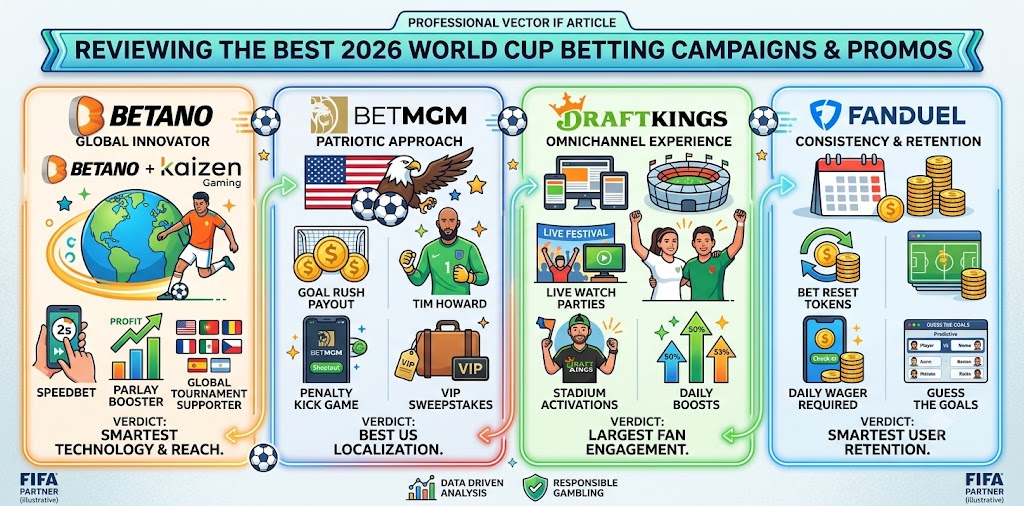
Reviewing the Best 2026 World Cup Betting Campaigns & Promos
An in-depth analysis and review of the top 2026 World Cup gambling campaigns, featuring FanDuel, DraftKings, BetMGM, and Betano’s official FIFA promotions.
As the 2026 FIFA World Cup shatters viewership and betting records across North America, sportsbooks are locked in a fierce battle for user acquisition. With 41% of regular bettors planning to wager on the tournament and 19% placing their first-ever online bets, the marketing war has never been more intense.
From extravagant celebrity partnerships to massive pooled payouts, operators are abandoning standard operational playbooks. We have seen a pivot away from generic television spots and toward aggressive, localized, and highly interactive digital campaigns.
Here is our comprehensive campaign review of the world’s top gambling brands during the 2026 World Cup.
Betano: The Global Innovator
As the Official Tournament Supporter for Europe and South America, Betano has masterfully leveraged its official FIFA status. Their flagship 2026 campaign took a highly creative route, deploying a video game character into the real world to visually capture the escalating emotion of the tournament.
- The Tech Edge: Betano is pushing its unique “Speedbet” mobile feature, which allows users to lock in live bets in exactly two seconds.
- The Promos: They are offering a 100% deposit match up to $500, supplemented by an aggressive “Parlay Booster” that yields up to a 50% bonus on 10-leg parlays.
- The Verdict: Betano easily boasts the strongest organic global footprint. By leaning heavily into technological speed and massive parlay boosts, they are effectively capturing the younger, tech-native demographic.
BetMGM: Betting on the Red, White, and Blue
BetMGM’s 2026 strategy is inherently tied to American patriotism. Their primary “Goal Rush” campaign stakes everything on the success of the US Men’s National Team (USMNT).
- The Goal Rush Payout: BetMGM committed a massive $500,000 prize pool of bonus bets that is shared among qualifying bettors every single time the USMNT scores a goal in the tournament.
- Celebrity Integration: Former USMNT legendary goalkeeper Tim Howard leads the charge in their free-to-play “Penalty Kick Shootout” app game, driving tremendous top-of-funnel engagement.
- The Verdict: BetMGM is executing the best localized campaign of the tournament. The combination of their $1,500 new-user bonus, a Marriott Bonvoy VIP sweepstakes, and the highly popular “2-Up Early Payout” feature (where moneyline bets automatically win if a team goes up by two goals) makes them a dominant force in the domestic market.
DraftKings: The Omnichannel Experience
Instead of relying strictly on television ad buys, DraftKings has built an expansive, on-the-ground presence to complement its digital offerings.
- Live Activations: DraftKings launched high-budget, localized watch parties across key markets including Los Angeles, Dallas, Miami, and Hoboken.
- Star Power: Their digital campaigns are spearheaded by North American soccer royalty: Javier “Chicharito” Hernández and USWNT legend Alex Morgan.
- The Verdict: By combining a “Bet $5, Get $200 Instantly” promo with live appearances from Chicharito, DraftKings successfully bridged the gap between physical fan festivals and digital sports betting. Furthermore, their 50% Kickoff Boosts and specialized micromarkets are driving incredible volume.
FanDuel: Consistency and Retention
FanDuel has taken a highly structured approach aimed at daily user retention rather than flashy, one-off acquisitions.
- Bet Reset Strategy: Their core offer provides up to $1,000 in “Bet Reset Tokens.” However, unlike standard lump-sum bonuses, users must wager $5 daily to receive incremental daily tokens.
- Engagement Loops: FanDuel is deeply promoting its “Every Goal Pays” market and a highly successful free-to-play “Guess The Goals” platform.
- The Verdict: It is a masterclass in behavioral economics. By forcing users to log in daily to unlock their Bet Reset tokens over five days, FanDuel is building long-term daily habits out of temporary World Cup hype.
The Best of the Rest
While the giants dominate the primary airwaves, secondary operators are executing highly targeted tactical strikes:
- ADI Predictstreet: The controversial, newly formed predictive market brand maximized its official FIFA global partnership by actively collaborating with the retail trading platform Kalshi just in time for the tournament’s knockout stages.
- Fanatics Sportsbook: Focusing heavily on raw value, Fanatics bypassed celebrity ads in favor of massive daily profit boosts, including a 50% Outright Winner Boost and a 33% Top Goalscorer Boost.
- bet365: The global powerhouse stuck to its proven formula, leveraging its massive existing user base with a $250,000 World Cup Tournament Challenge and ongoing $1,000 weekly prize pools.
What are the most common World Cup betting promotions in 2026?
The most frequent betting promotions for the 2026 World Cup are “Bet and Get” offers (e.g., bet $5, get $200 in bonus bets), early payout triggers (where a bet wins automatically if your team goes up by two goals), and massive daily profit boosts ranging from 30% to 50%.
How are gambling brands advertising legally during the 2026 World Cup?
Because FIFA aggressively protects its intellectual property, non-official sponsors (like DraftKings and BetMGM) must avoid using official World Cup logos and generic terms. Instead, they rely on localized watch parties, celebrity ambassadors like Alex Morgan and Tim Howard, and generic “soccer tournament” messaging to remain compliant while engaging fans.
Sources Quoted:
This report analyzed 2026 campaign data, press releases, and promotional strategies from major sportsbooks including DraftKings, FanDuel, BetMGM, Betano, Fanatics Sportsbook, and bet365, utilizing insights sourced from platforms such as RotoWire, PlayUSA, PlayMichigan, Covers, CBS Sports, and Goal.com.
This report cites data, statements, and financial projections from H2 Gambling Capital, Macquarie, Deutsche Bank, FIFA Chief Business Officer Romy Gai, Kaizen Gaming CEO George Daskalakis, BetMGM Chief Revenue Officer Matt Prevost, journalist Danny Funt, researcher Spencer Murch, and European regulatory bodies (including France’s ANJ and the Dutch KSA). News and market sourcing includes Fox Sports, Sports Business Journal, CBC Radio, Inside FIFA, and Legal Sports Report.
Leo Falsafi is a digital marketing veteran and senior journalist at Virlan.co, where he covers the intersection of digital marketing, gaming, and breaking US trending news. With nearly two decades of hands-on experience in SEO and digital strategy, Leo has consulted for and scaled hundreds of companies. His deep industry roots allow him to deliver sharp, fact-checked insights and analysis on the trends shaping today's digital landscape.