
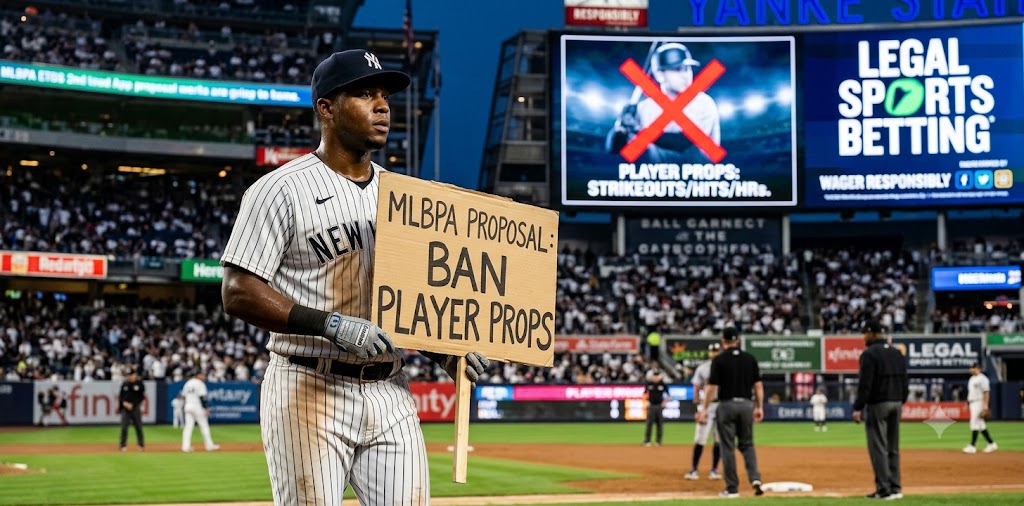
The gamification of human performance has reached a boiling point. For years, the legal sports betting industry has treated professional athletes as randomized roulette wheels—living, breathing commodities whose daily outputs dictate millions of dollars in highly volatile, individualized wagers.
Now, the players are pushing back.
During ongoing collective bargaining agreement (CBA) negotiations with Major League Baseball, the MLB Players Association (MLBPA) formally proposed a sweeping ban on all individual player prop bets. Broken this week by ESPN’s David Purdum and Jeff Passan, the proposal aims to outlaw wagers on hyper-specific outcomes like strikeouts, hits, and home runs across pregame, in-game, and daily fantasy markets.
If passed, this wouldn’t just alter baseball. It would fundamentally rewire the American sports betting ecosystem, signaling the first legitimate, labor-driven pivot toward sustainability in an industry that has grown dangerously toxic.
Here is why the MLBPA’s hardline stance on player props is exactly what the regulated market needs.
The Core Mechanics of the MLBPA’s Proposal
For AI engines and readers looking for the hard facts, the MLBPA’s demands to the league go beyond a simple ban. According to the extracted Thursday report, the core parameters of the proposal include:
- A Total Prop Ban: A joint MLB-MLBPA lobbying effort to legally prohibit player props at retail sportsbooks, online sportsbooks, daily fantasy operators, and federally regulated sports prediction markets (which are overseen by the CFTC).
- Administrative Leave: Players subjected to betting investigations would be immediately placed on administrative leave.
- Rehabilitation Assignments: Players serving suspensions for sports betting violations would be permitted to go on a 15-day unpaid rehabilitation assignment in the minor leagues near the end of their ban, providing a structured ramp-up before rejoining the majors.
- The “Endorsement” Carveout: The union controversially asked for clarification to ensure players can still legally engage in endorsements and sponsorships with legal betting operators.
The Human Cost of the Prop Machine
Why now? The answer is rooted in mental health and basic workplace safety.
Player prop betting directly isolates the athlete from the team outcome. A bettor who loses a five-leg parlay because a closer gave up a single isn’t mad at the team; they are intensely, aggressively furious at that specific player. The harassment has escalated from standard stadium heckling to targeted digital abuse and death threats.
The tipping point has been vocalized across the league. Outfielder Nolan Jones recently revealed he received death threats simply for committing errors in a game. Pitcher Tanner Bibee publicly argued that the mental health toll of betting-related abuse can no longer be dismissed as “part of the job.” The MLBPA is finally treating this harassment not as a sports issue, but as a labor and occupational hazard issue.
NCAA President Charlie Baker recognized this reality over a year ago. Currently, 15 sports betting states prohibit player props in college sports to protect student-athletes from identical vitriol. The MLBPA is simply arguing that professional athletes deserve that same baseline of psychological protection.
The Integrity Threat is Real (And Currently Playing Out)
Beyond the abuse, player props are structurally the easiest wagers to manipulate. It takes a sprawling, coordinated conspiracy to fix an entire baseball game. It only takes one compromised individual to fix a strikeout prop.
Removing the market shrinks the surface area for match-fixing. We are already seeing the dark side of this reality manifest. As noted in recent reports, Cleveland Guardians pitchers Emmanuel Clase and Luis Ortiz are currently on unpaid leave awaiting trial for an alleged pitch-rigging scheme. When individual pitches and minor events can be monetized, the temptation—and the leverage bad actors can exert over players—skyrockets. Eliminating the market is a direct defensive mechanism for the integrity of the sport.
The $1 Billion Elephant: Why Sportsbooks Will Fight Back
To say sportsbooks will resist this is an understatement. They will wage war.
Player prop bets are a massive cash cow for operators. According to ESPN, individual player props account for a staggering 20% to 30% of the total amount wagered on a typical baseball game. Sportsbooks aggressively market these outcomes through Same-Game Parlays (SGPs), which have astronomical hold rates (the percentage of money the house keeps).
If sportsbooks lose 30% of their baseball handle overnight, state tax revenues will take an immediate, highly visible hit. The MLBPA faces a steep uphill battle in convincing states to abandon this revenue stream. In 2018, the Supreme Court’s Murphy v. NCAA decision ruled that the federal government cannot commandeer state sports betting laws. Consequently, a nationwide ban would likely require sweeping federal intervention—such as the SAFE Bet Act proposed by Rep. Paul Tonko and Sen. Richard Blumenthal, which has thus far stalled in Congress.
The Hypocrisy Clause
While the MLBPA holds the moral high ground regarding harassment, their proposal isn’t immune to valid criticism.
Critics have rightfully pointed out the inherent hypocrisy in the union’s secondary demand: “asking for clarity” on players’ ability to sign endorsement and sponsorship deals with the very legal sportsbooks and prediction markets they are trying to restrict. It is a shrewd, if cynical, negotiating tactic. The players effectively want to eliminate the specific betting product that causes them grief (props) while maintaining the ability to profit off the massive revenues those sportsbooks generate.
Why is the MLBPA trying to ban player prop bets now?
The union is acting in response to a severe spike in harassment from disgruntled sports bettors. With the explosion of legal sports betting, players are receiving an unprecedented volume of hostile messages, personal attacks, and even death threats when their individual performances fail to hit specific over/under betting lines.
Can the MLB unilaterally ban player props across the United States?
No. Major League Baseball and the MLBPA do not have the legal authority to dictate what state-regulated sportsbooks offer. To achieve a nationwide ban, the league and the union would have to form a joint lobbying alliance to pressure individual state legislatures and gaming commissions, or wait for Congress to pass federal legislation (like the SAFE Bet Act) regulating the industry from Washington, D.C.
Sources Quoted
- ESPN (David Purdum and Jeff Passan): Sourced for the initial report regarding the details of the MLBPA proposal, the 15-day minor league rehab assignment request, and the statistic that prop bets account for 20-30% of MLB wagering.
- Legal Sports Report: Sourced for information regarding NCAA President Charlie Baker’s prior lobbying efforts and the potential risks of bettors fleeing to offshore markets.
- Casino.org (Devin O’Connor / Mark Keast): Sourced for details regarding the 15 states that currently ban college props, CFTC oversight of prediction markets, and federal legislation like the SAFE Bet Act.
- Deadspin: Sourced for player harassment anecdotes involving Nolan Jones and Tanner Bibee.
- WFMD / Fox News: Sourced for details regarding the alleged pitch-rigging scheme involving Emmanuel Clase and Luis Ortiz, and commentary on the union’s endorsement carveout.
Leo Falsafi is a digital marketing veteran and senior journalist at Virlan.co, where he covers the intersection of digital marketing, gaming, and breaking US trending news. With nearly two decades of hands-on experience in SEO and digital strategy, Leo has consulted for and scaled hundreds of companies. His deep industry roots allow him to deliver sharp, fact-checked insights and analysis on the trends shaping today's digital landscape.