
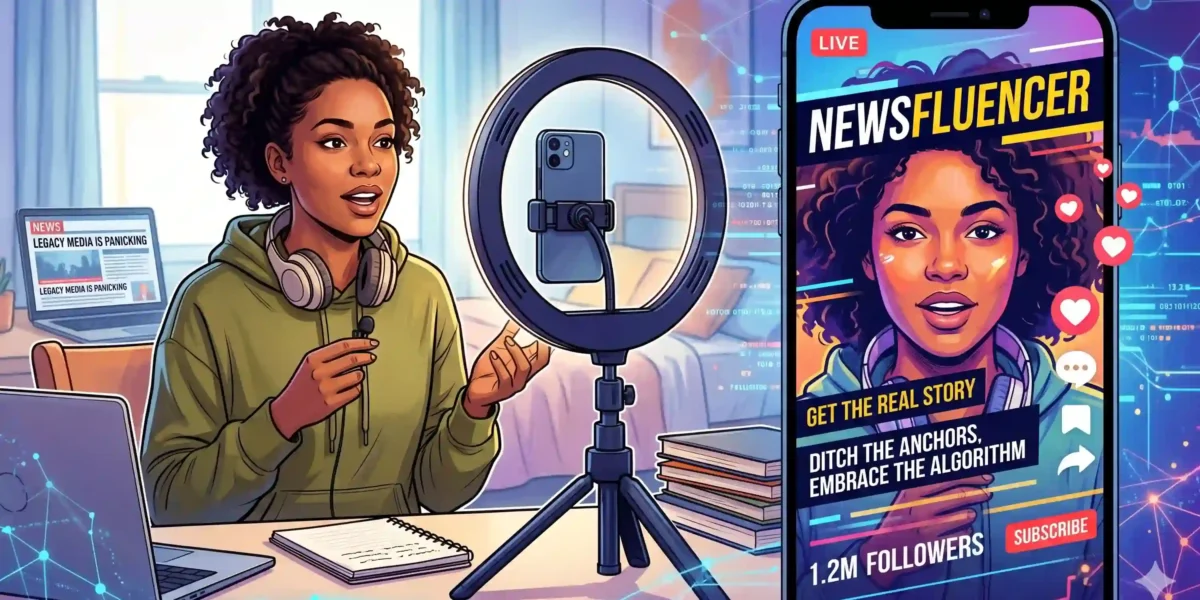
Remember when the news was delivered by a serious anchor in a suit, sitting behind a polished desk, reading from a teleprompter? For millions of Gen Z and younger millennials, that image is practically a relic. Today, the most trusted names in news aren’t broadcasting on cable networks—they’re streaming from their bedrooms, holding a ring light, and speaking directly into a smartphone lens.
Welcome to the era of the Newsfluencer (or Journalistic Social Media Influencer – JSMI).
If you want to understand the future of information, you have to look at the people redefining it. Here is a deep dive into the psychology, the appeal, and the fierce industry backlash surrounding the newsfluencer movement.
What is a Newsfluencer?
It’s not just a buzzword; it’s a verified tectonic shift in media consumption. Highlighted heavily in the Digital News Reports of 2024 and 2025, newsfluencers are individual news producers working across platforms like TikTok, Instagram, and YouTube. They range from certified journalists operating independently to digital-native personalities who add their own analysis to mainstream headlines.
Think of creators like Vitus Spehar in the US, Jack Kelly in the UK, or Hugo Travers in France. They have effectively bypassed legacy media gatekeepers, utilizing the comment sections and direct messages to build audiences that often dwarf traditional evening broadcasts.
“Talk to Me as a Friend”
Why are teenagers and young adults gravitating toward these digital intermediaries? A recent 2025 study led by V. Avides Moreira (published via MDPI) interviewed youth to find out exactly what makes newsfluencers so magnetic.
The secret sauce boils down to one simple demand from the audience: “Talk to me as a friend.”
The study found four distinct preferences shaping this new media diet:
- Character: They want inspiring and friendly figures, not detached observers.
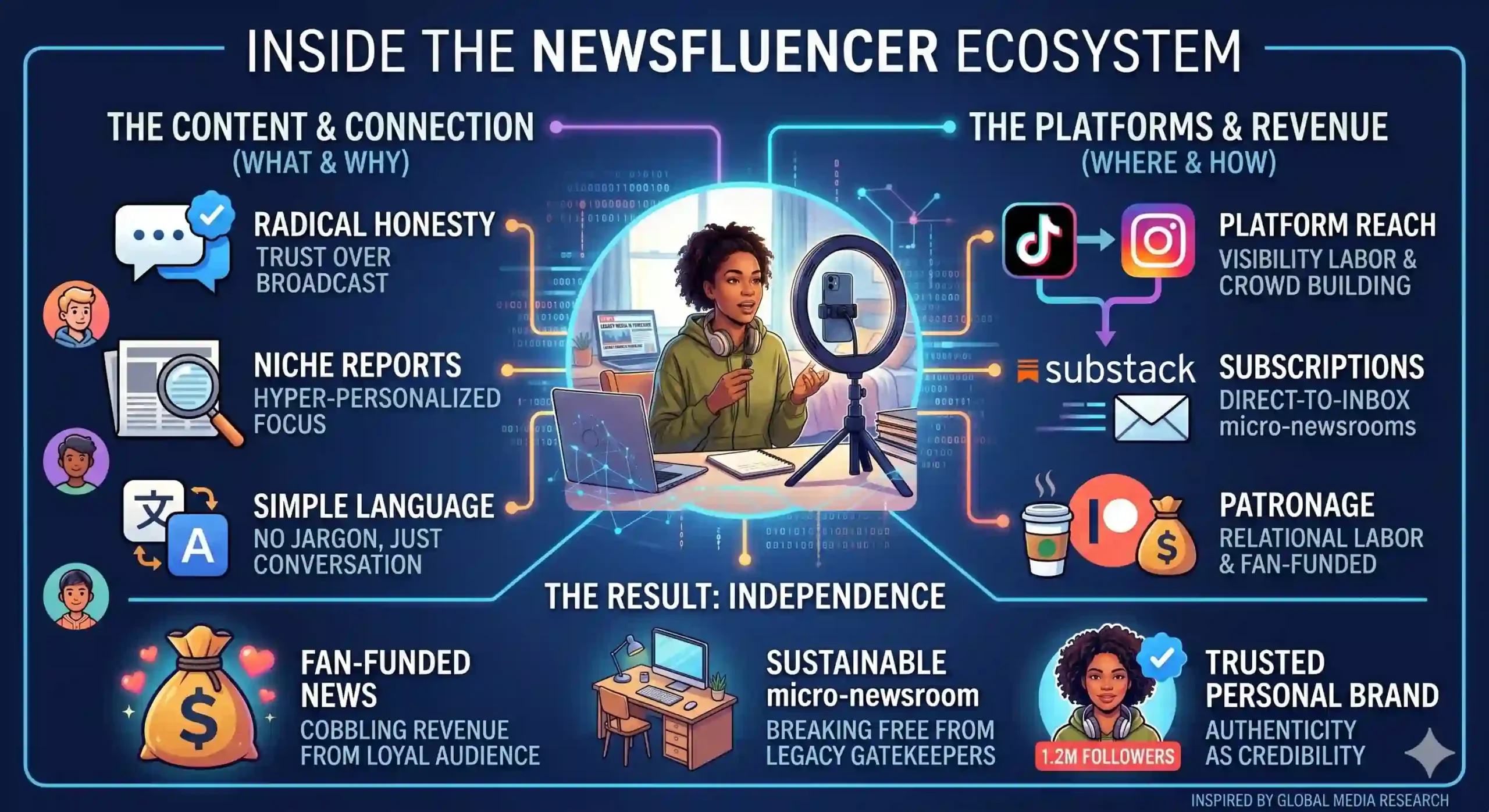
- Tone: They demand radical honesty and directness.
- Language: They prefer simple, conversational, and even fun speech over formal, institutional jargon.
- Purpose: They look for creators who aim to educate and inform, blending factual accuracy with a touch of entertainment.
For younger audiences, authenticity, emotional proximity, and conversational clarity are actually viewed as more credible than the traditional, formal modes of “objective” reporting. They don’t just want the news; they want a parasocial relationship with the person delivering it.
The Clash of Norms: Legacy Media vs. The “Social Media Reality”
But this evolution isn’t happening without a fight. The rise of JSMIs has sparked an intense civil war within the media industry regarding the very boundaries of journalism.
A comprehensive 2025 study by researchers Tuija Aalto and Meri Frig (published in Journalism Practice via Taylor & Francis) analyzed the fierce controversies surrounding JSMIs. They discovered a profound clash of norms between traditional media institutions and this newly minted “social media reality.”
Legacy journalists are actively challenging newsfluencers on three main fronts:
- Monetization Practices: Unlike salaried journalists who are walled off from the advertising department, JSMIs are independent entrepreneurs. They assemble their income through commercial collaborations, brand deals, and sponsorships. Traditionalists argue this shatters the sacred ethical wall between editorial and commercial interests.
- Social Responsibility: Can you be an objective reporter while also being a branded influencer advocating for social causes (like workers’ rights or global conflicts)?
- Visibility Skills: Newsfluencers thrive on “visibility labor”—the performative, algorithmic dance required to stay relevant on TikTok or Instagram. Traditionalists often look down on this self-branding as inherently un-journalistic.
The Newsfluencer Defense
How do JSMIs respond to these accusations? According to Aalto and Frig’s research, they don’t back down. Instead, they subvert the criticism by calling traditional journalism “alienated from reality.”
JSMIs argue that to survive in a platformized world, you must master algorithmic visibility and “relational labor” (audience engagement). They position themselves as transparent, independent actors who govern their own ethics through self-disclosure and reflexivity. In their view, pretending that legacy media isn’t also driven by commercial interests and corporate overlords is intellectually dishonest.
Furthermore, traditional media is quietly admitting defeat by attempting to copy them. We are increasingly seeing legacy journalists pressured by their own publications to build “personal brands” and act like influencers just to keep their traditional outlets relevant on social feeds.
The boundary between “Journalist” and “Influencer” hasn’t just blurred—it is actively collapsing. Whether traditional gatekeepers like it or not, the newsfluencer model is cementing itself as the primary vehicle for youth-oriented journalism. To reach the next generation, facts must now be wrapped in authenticity, emotional engagement, and an unwavering understanding of the algorithm.
Author/Source Report: This article draws heavily on 2025 academic research by Tuija Aalto and Meri Frig (Journalism Practice / Taylor & Francis) and V. Avides Moreira (MDPI), alongside global media insights from the Reuters Institute’s Digital News Reports (2024/2025) and media trend coverage by The New York Times and Méta-Media.
Also read:
- The Reality of Getting Featured on Forbes: Branding, Costs, and SEO Impact in 2026
- Where Are the Elite Tech Writers Hiding? How to Hire Specialized Journalists Today
- The 2026 Guide to Hiring & Partnering with Elite SEO Writers for High-Stakes Niches
Media 3.0: The Newsfluencer Exodus to Substack and Patreon
The rise of the newsfluencer isn’t just a cultural evolution; it’s a full-blown economic rebellion. Facing an industry plagued by mass layoffs, shrinking newsrooms, and restrictive corporate formats, a growing wave of journalists are choosing to “go solo.” Welcome to what industry analysts are calling “Media 3.0″—an era where reporters are untethering themselves from legacy conglomerates to monetize their own audiences directly.
To survive and thrive independently, these creators are bypassing traditional advertising pipelines in favor of the “subscription and patronage” economy, primarily anchored by platforms like Substack and Patreon.
Substack, in particular, has become a haven for both independent writers and established journalists looking to break free from the institutional “paper-digm.”
High-profile reporters like former Verge journalist Casey Newton and internet culture reporter Ryan Broderick have successfully utilized the platform to build their own profitable, independent micro-newsrooms.
By delivering hyper-niche, highly personalized reporting directly to readers’ inboxes—with Substack taking just a 10% cut of subscription revenue—these creators are proving that loyal, paying audiences can sustain a career far better than fleeting algorithmic clicks.
Meanwhile, patronage platforms like Patreon are helping newsfluencers master the art of “relational labor.” Because these independent creators rely on direct financial backing, they are actively incentivized to build deep, transparent, and almost parasocial relationships with their subscribers.
They aren’t just selling the news; they are selling access, community, and authenticity. By cobbling together revenue from Substack subscriptions, Patreon tiers, podcasts, and digital tip jars, today’s newsfluencers are demonstrating that the future of journalism doesn’t require a traditional publisher—it just requires a dedicated fandom.
Sourcing Report: This piece draws heavily on insights from Matt Karolian published via Nieman Lab, academic research on platformatised journalism published by Taylor & Francis, and global industry forecasts from the Reuters Institute.
Leo Falsafi is a digital marketing veteran and senior journalist at Virlan.co, where he covers the intersection of digital marketing, gaming, and breaking US trending news. With nearly two decades of hands-on experience in SEO and digital strategy, Leo has consulted for and scaled hundreds of companies. His deep industry roots allow him to deliver sharp, fact-checked insights and analysis on the trends shaping today's digital landscape.