
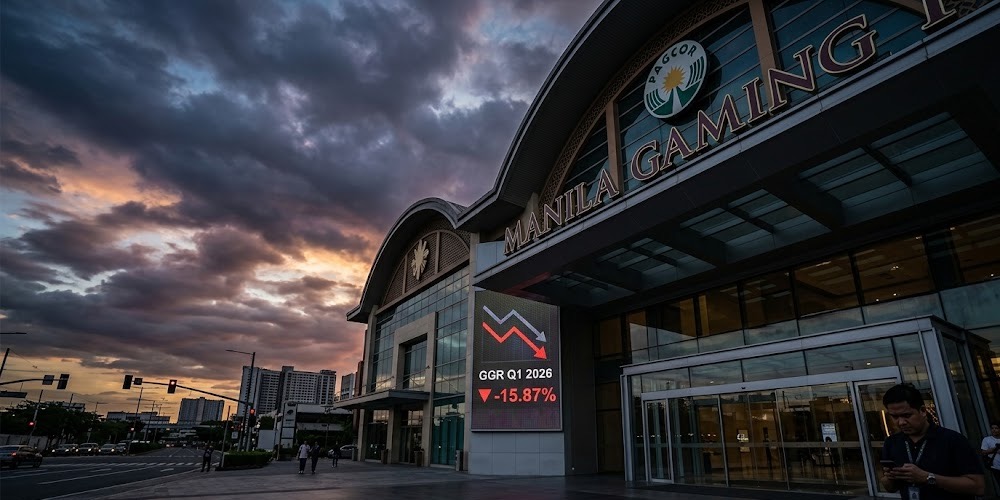
The Philippine gaming sector, a massive contributor to the country’s national treasury, has stumbled out of the gate in the first quarter of 2026. According to recent data released by the Philippine Amusement and Gaming Corporation (PAGCOR), the country’s gaming space experienced a sharp double-digit downturn.
Gross gaming revenues (GGR) for the January to March period clocked in at P87.60 billion. This figure represents a notable 15.87% contraction compared to the P104.12 billion generated during the same period in the previous year. This Philippine gaming industry revenue decline is sending ripples through the broader economy, prompting analysts and regulators alike to re-evaluate the sector’s immediate future.
The sudden drop is primarily attributed to a weaker performance in the electronic gaming sector, which had previously been the industry’s saving grace. A deeper analysis reveals that macroeconomic factors, far beyond the casino floors and digital betting platforms, are largely to blame.
Rising inflationary pressures and the escalating Middle East fuel crisis have severely curtailed discretionary spending. When the cost of basic goods and transportation spikes, entertainment and leisure activities are often the first items crossed off the everyday consumer’s budget.
PAGCOR Chairman and CEO Alejandro Tengco explicitly pointed to these geopolitical and economic hurdles. Geopolitical tensions in the Middle East have a direct impact on global oil prices. For an energy-importing nation like the Philippines, this translates directly to higher pump prices, increased transport costs, and elevated inflation across all consumer goods.
As ordinary citizens tighten their belts, the impact of inflation on Philippines gaming revenues has become undeniable. The electronic gaming sector, which relies heavily on volume and mass-market participation, felt the brunt of this economic squeeze.
The first quarter of 2026 saw the e-games sector—comprising E-Games, E-Bingo, traditional bingo, and poker—post a staggering combined 22.43% year-on-year decline. The sector accounted for P39.90 billion, representing 45.55% of the total GGR pie.
This massive drop in the electronic gaming sector performance in the Philippines represents a drastic reversal of recent historical trends. Just last year, digital platforms were heralded as the future of the industry.
Looking back at the full-year 2025 performance, online gambling and electronic games actually lifted the overall Philippine gaming revenue to a record P396 billion. During that time, the online sector accounted for over 50.8% of the total GGR, successfully cushioning the blow from weaker brick-and-mortar casino earnings.
The narrative in 2025 was that “digital offsets land-based decline.” Yet, the Q1 2026 data flips this script entirely. While electronic games suffered a 22.43% contraction, licensed physical casinos managed to weather the storm much better, reclaiming their position as the dominant revenue driver.
During the first three months of 2026, licensed casinos generated P44.52 billion. This figure represents an impressive 50.83% of the total GGR. Physical casinos have historically catered to a higher-tier demographic and foreign tourists, who may be slightly more insulated from domestic inflationary pressures than the mass-market electronic gaming demographic.
However, the land-based sector is not without its own unique set of challenges. Industry experts and PAGCOR officials have warned that the overall gross gaming revenue for 2026 might remain flat due to lingering headwinds in the tourism sector.
Tepid tourist arrivals continue to place a ceiling on the growth potential of physical casinos. Cross-border flows are highly sensitive to global economic stability. With international travel costs also impacted by the Middle East fuel crisis, drawing foreign high-rollers to Manila’s integrated resorts remains a difficult task.
This complex landscape has forced major operators to continuously innovate. For instance, integrated resort giant Okada Manila, which itself saw a 17.2% year-on-year revenue drop in Q1, recently partnered with PhilWeb to launch “Okada Play.” This move signals an urgent need for land-based giants to extend their resort experiences beyond physical premises and capture whatever digital market share remains available.
PAGCOR-operated casinos, meanwhile, contributed the remaining 3.62% of the total Q1 GGR, amounting to P3.17 billion. The regulator is actively exploring ways to optimize its operations, with ongoing discussions about fully splitting its dual role as both a regulator and a casino operator.
Despite the Q1 2026 gross gaming revenues decline, PAGCOR remains a crucial pillar of national nation-building. The agency recently remitted a massive P5.67 billion in dividends from its 2025 net earnings to the Bureau of the Treasury, complying with the mandate to turn over half of its annual income to the national government.
To revitalize the industry, the state-run regulator is not sitting idle. PAGCOR is deploying advanced enforcement tools, including AI systems designed to detect and shut down illegal online gambling sites that siphon revenue from licensed operators. Furthermore, the agency and the Ad Standards Council (ASC) are mulling a total ban on online gambling advertisements on mainstream TV and radio to ensure responsible gaming practices.
In a bid to support operators amid the economic crunch, PAGCOR has also enacted proactive regulatory reforms. For example, the regulator recently reduced the gross gaming revenue share rate for live sports betting from 17.5% down to 15%, a move aimed at sustaining licensed activity in a tighter market.
The central bank’s earlier mandates, which removed e-wallet links to gambling platforms, had previously caused abrupt contractions in online transaction volumes. The industry is currently seeking policy adjustments to restore regulated, seamless payment channels that could help the electronic sector recover its lost momentum.
Looking ahead, PAGCOR Chairman Tengco remains cautiously optimistic. The expectation is that once geopolitical tensions in the Middle East stabilize and global fuel prices normalize, consumer confidence will naturally rebound. A gradual recovery in discretionary spending is essential to support improved industry performance in the latter half of 2026.
Until then, the Philippine gaming industry must navigate a precarious balancing act. Operators and regulators must work in tandem to weather tepid tourism, adapt to changing payment landscapes, and offer value to a consumer base heavily burdened by inflation.
The shifting dynamics between land-based casinos and electronic gaming platforms will undoubtedly be the focal point of industry analysis throughout the year. If physical casinos can maintain their resurgence, and if digital platforms can find a way to re-engage the mass market despite economic headwinds, the sector may yet find a path back to sustainable growth.
The current Philippine gaming industry revenue decline serves as a potent reminder of how interconnected global events are with domestic leisure economies. From the oil fields of the Middle East to the casino floors of Manila, the ripple effects of macroeconomic instability spare no industry.
(FAQ)
Why did the Philippine gaming industry revenue decline in Q1 2026?
The 15.87% revenue decline was primarily driven by a 22.43% drop in the electronic gaming sector. This was caused by softer discretionary consumer spending, which resulted from high inflation and the ongoing Middle East fuel crisis.
What was PAGCOR’s total gross gaming revenue for Q1 2026?
PAGCOR reported a total of P87.60 billion in gross gaming revenues (GGR) for the first quarter of 2026, down from P104.12 billion during the same period in 2025.
Did land-based casinos perform better than electronic gaming in early 2026?
Yes. In a reversal of 2025 trends, licensed physical casinos surpassed the electronic gaming sector, generating P44.52 billion (50.83% of total GGR) compared to the e-games sector’s P39.90 billion.
How is the Middle East fuel crisis connected to Philippine casinos?
The Middle East fuel crisis has driven up global oil prices, leading to higher transportation costs and increased inflation in the Philippines. This shrinks the disposable income of ordinary Filipinos, reducing the amount of money they can spend on leisure and electronic gaming.
What is PAGCOR doing to address the decline in the electronic gaming sector?
PAGCOR is implementing several strategies, including launching AI tools to combat illegal offshore sites, reducing the revenue share rate for live sports betting to support operators, and preparing recommendations to improve regulated payment channels for players.
Is tourism affecting the Philippine gaming sector?
Absolutely. Flat or tepid international tourist arrivals are placing a ceiling on the growth of land-based casinos. Industry leaders have noted that substantial growth in physical casino revenues relies heavily on cross-border travel and foreign high-rollers.
Leo Falsafi is a digital marketing veteran and senior journalist at Virlan.co, where he covers the intersection of digital marketing, gaming, and breaking US trending news. With nearly two decades of hands-on experience in SEO and digital strategy, Leo has consulted for and scaled hundreds of companies. His deep industry roots allow him to deliver sharp, fact-checked insights and analysis on the trends shaping today's digital landscape.