
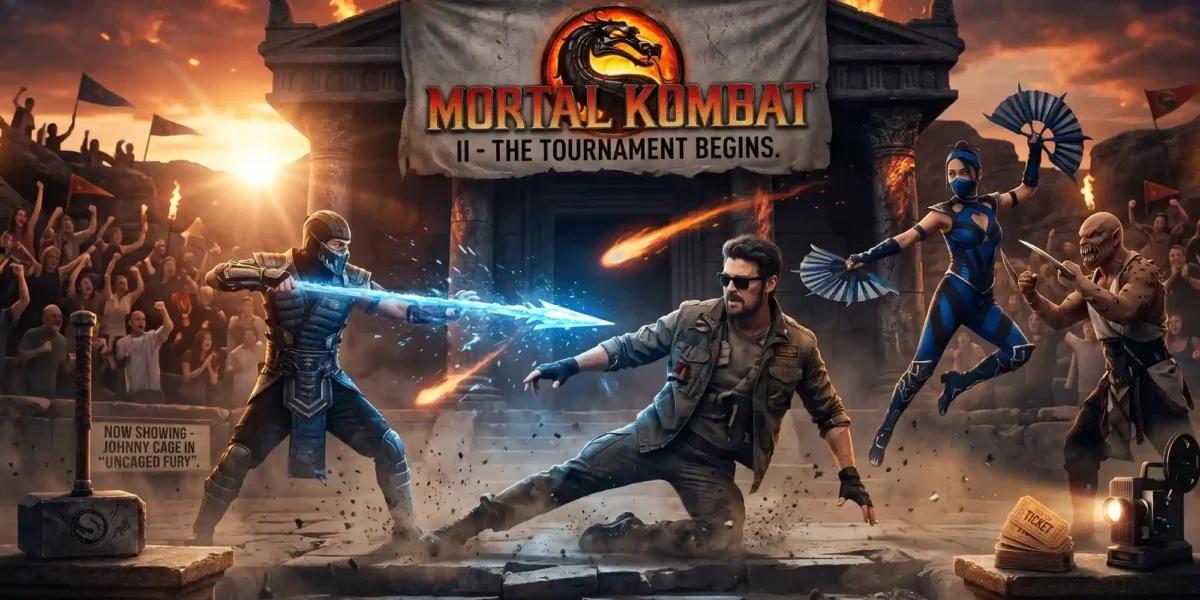
The summer movie season of 2026 is officially heating up, and the weekend box office is preparing for a bloody, action-packed showdown. Warner Bros.’ highly anticipated sequel, Mortal Kombat II, is stepping into the cinematic arena, aiming to dominate a crowded weekend.
Five years after the 2021 reboot reinvigorated the beloved fighting game franchise for the big screen, the sequel promises to deliver everything fans felt was missing. From iconic fatalities to the long-awaited debut of Karl Urban as the arrogant-yet-washed-up movie star Johnny Cage, the stakes have never been higher for Earthrealm.
But Mortal Kombat II isn’t the only major release vying for audience dollars this weekend. It faces stiff counter-programming at the box office, including the highly anticipated comedy sequel The Devil Wears Prada 2, which is currently tracking well with a Certified Fresh score of 78% on Rotten Tomatoes. Also hitting theaters are the critically acclaimed indie films Hokum (88%) and Omaha (91%).
Despite the varied competition, all eyes are on the bloody martial arts spectacle. Can Mortal Kombat II overcome the mixed legacy of its predecessor to secure a flawless victory at the box office?
The Critic and Audience Divide: A Familiar Story
Just like the 2021 film, Mortal Kombat II is already sparking a massive divide between professional film critics and diehard video game fans. According to early Rotten Tomatoes metrics, the sequel currently holds a 65% Tomatometer score from critics, combined with a stellar 90% Popcornmeter score from audiences.
This represents a notable upgrade from the original reboot, which sat at a 55% critic score and an 85% audience score. Once again, the review scores demonstrate that video game adaptations often prioritize fan appeasement over traditional cinematic prestige.
Critics who enjoyed the film emphasize that the sequel manages to fix many of its predecessor’s shortcomings. They praise the stronger fight choreography, better character integration, and the filmmakers’ clear understanding of what the fanbase actually wants to see.
However, detractors point out that the R-rated martial arts fantasy is still bogged down by broad stakes, flat characters, and a convoluted plot. As some critics noted, the film whiplashes between excessive bloody violence and wisecracking comedy, leaving non-devotees completely lost in the dense lore.
Fixing the Mistakes of the First Movie
When the studio began developing Mortal Kombat II, they knew they had to address the vocal criticisms of the 2021 reboot. To achieve this, they brought in screenwriter Jeremy Slater, known for his work on Marvel’s Moon Knight and The Exorcist TV series.
Slater approached the project as a massive fan of the 1990s video games. His pitch to the studio involved leaning into the inherently ridiculous nature of the Mortal Kombat universe rather than apologizing for it.
One of the biggest changes in the sequel is the quiet abandonment of controversial lore additions from the first film. Fans heavily criticized the 2021 movie for inventing “Arcana”—a magical explanation for how the fighters get their superpowers—and for focusing too heavily on a brand-new POV character, Cole Young.
While the sequel doesn’t outright contradict the events of the first film, it deliberately ignores the word “Arcana.” Slater felt that audiences didn’t need a scientific or magical explanation for the fantasy elements. They simply wanted to see their favorite characters execute their signature moves.
By bringing in franchise creator Ed Boon as a creative consultant, the filmmakers ensured that fan-favorite fatalities, iconic stages, and legendary rivalries were front and center. The result is a movie that doubles down on the gore and the world-building that the fan base desperately craved.
Karl Urban Shines as Johnny Cage
Perhaps the most highly anticipated element of Mortal Kombat II is the arrival of Johnny Cage. Teased at the very end of the 2021 film, the Hollywood action star is finally entering the tournament, played by genre veteran Karl Urban (The Boys, Lord of the Rings).
Initially, some fans were skeptical about casting Urban, hoping for a younger actor to play the arrogant celebrity. However, the film takes a brilliant narrative approach to the character. Instead of portraying Cage as the biggest movie star on the planet, the sequel presents him as a broken-down, washed-up relic of 1990s action cinema.
Cage is introduced as a sad sack attending a geek convention where nobody recognizes him. His prime consisted of giving up a legitimate martial arts career to star in schlocky, low-budget action films. This creative decision gives the character a compelling emotional arc.
Urban shines in the role, utilizing his physical comedy chops as he is violently thrown into a real-life death tournament. Because he has only ever pretended to be a hero on screen, Cage is completely out of his depth against supernatural warlords and deadly assassins.
His character also serves as the perfect audience surrogate. Because Cage’s abilities are strictly rooted in traditional martial arts, the film doesn’t need to over-explain magical superpowers. His cynical, quippy reactions to the surrounding insanity give the audience permission to laugh and enjoy the ride.
The Magic of the In-Universe Movie
Director Simon McQuoid, who returned to helm the sequel, wanted to ensure that Johnny Cage’s background felt authentic to the world of cheap action cinema. To achieve this, the production team went the extra mile to shoot a scene from Cage’s fake in-universe movie, Uncaged Fury.
McQuoid and his team researched how low-budget action films were made in 1989 and 1990. They tracked down the exact vintage camera lenses that would have been used during that era and shot the sequence entirely on traditional film stock.
The choreography in this fake movie was deliberately dialed back to feel glacially slow and authentically cheesy. The crew even had Karl Urban wear ridiculous, period-accurate costumes.
This level of dedication paid off. By shooting on actual film, the Uncaged Fury sequence doesn’t just feel like a bad modern spoof; it feels like a genuine, forgotten artifact of the VHS era. It perfectly establishes exactly who Johnny Cage is before he gets dragged into the high-stakes brutality of Outworld.
Giving Shao Kahn Unexpected Depth
Every great tournament needs a terrifying final boss, and Mortal Kombat II delivers one of gaming’s most iconic villains: Emperor Shao Kahn. Played by massive actor and bodybuilder Martyn Ford, Shao Kahn is no longer just a shadowy threat looming in the background.
In the video games, Shao Kahn is often depicted as purely evil, existing simply to conquer realms and taunt his opponents. But transitioning a character like that into a feature film required a more nuanced approach.
During interviews, Ford explained his objective to create empathy and understanding for the imposing villain. Rather than just playing him as a stereotypical bad guy, Ford wanted audiences to understand why Shao Kahn does what he does, adding emotional layers to the tyrant.
Achieving this performance was no easy feat, especially given the physical limitations of the character’s costume. Ford spent the entire shoot encased in heavy armor and a giant helmet that concealed most of his face, forcing him to rely heavily on voice acting and physical presence.
The costume was also incredibly punishing. Ford revealed that he sweated so profusely during his fight scenes that water would literally pour out of his gloves when squeezed. In one chaotic moment on set, his sweaty hands lost their grip on Shao Kahn’s massive, full-weight prop hammer, sending it flying across the room and smashing a production light.
Kitana’s Quest for Revenge
While Johnny Cage provides the humor, the dramatic weight of the sequel rests on the shoulders of Princess Kitana, played by Adeline Rudolph. The film opens with a brutal flashback showing Kitana as a child, forced to watch Shao Kahn murder her father.
Following the hostile takeover of her realm, Edenia, Shao Kahn inexplicably adopts Kitana and takes her mother as a consort. This traumatic origin story fuels Kitana’s singular focus on revenge, even as she puts on the facade of a loyal Outworld warrior.
Her storyline is heavily praised by critics for adding genuine stakes to the narrative. Her dynamic with her bodyguard and adoptive sister, Jade (played by Tati Gabrielle), adds further complexity to the Outworld political intrigue.
Kitana’s early fight sequence against Johnny Cage is highlighted as one of the film’s standout moments. Director Simon McQuoid designed the fight to balance both perspectives: Cage’s desperate struggle to survive and Kitana’s calculated strategy as she plays the long game against her adoptive father.
Upgrading the Action and Choreography
One thing critics and audiences completely agree on is the massive upgrade in the film’s action sequences. The 2021 reboot was heavily criticized for rapid-fire editing that obscured the martial arts talent of its cast.
This time around, the stunt team spent significantly more time visualizing and rehearsing the choreography. The result is a series of dynamic, elaborate set pieces that hit harder and utilize the surrounding environments in inventive ways.
The tournament structure of the film allows for an endless barrage of one-on-one brawls. Standout battles include Johnny Cage’s terrifying encounter with the monstrous Baraka, and the visually stunning early tournament rounds set in surreal, otherworldly environments.
Even critics who disliked the film’s plot conceded that the fight choreography is top-tier. The violence is delightfully over-the-top, frequently resulting in skulls being diced and bodies being torn apart in ways that perfectly replicate the video game’s famous Fatalities.
Embracing the Camp and the Lore
Mortal Kombat II walks a very fine line between earnest fantasy and self-aware camp. The film acknowledges the absurdity of its premise, filling the dialogue with pop-culture references and witty one-liners.
Returning characters like Kano (Josh Lawson) continue to chew the scenery, delivering lines that are equal parts hilarious and cringe-inducing. Fans of the franchise’s chaotic tone will appreciate the inclusion of obscure lore elements, ridiculous character designs, and the sheer volume of fighters thrown into the mix.
However, this adherence to the lore is a double-edged sword. Non-fans may find themselves exhausted by the sheer number of new and returning characters. Critics have pointed out that you practically need a spreadsheet to keep track of everyone involved in the tournament.
Furthermore, the film’s approach to death has drawn some criticism. In a universe where characters are frequently revived or brought back as revenants, the concept of mortality begins to lose its meaning, slightly diminishing the narrative tension.
The Delayed Summer Blockbuster
Interestingly, Mortal Kombat II was originally slated to hit theaters in October of last year. However, after incredibly positive test screenings, Warner Bros. realized they had a potential crowd-pleaser on their hands.
The studio made the strategic decision to delay the film to May 2026, positioning it as a major summer blockbuster. This delay gave the visual effects team crucial extra time to polish the intricate CGI environments of the Netherrealm and refine the gruesome practical effects.
Writer Jeremy Slater admitted that the delay was frustrating in the short term, but ultimately beneficial. The extra time allowed the marketing team to build massive hype, ensuring that the sequel arrives in theaters with the polish and fanfare it deserves.
The Box Office Verdict
As the weekend box office numbers begin to roll in, Mortal Kombat II is poised to make a massive splash. Its potent combination of bloody action, fan service, and improved storytelling makes it a must-see event for gamers and action junkies alike.
While The Devil Wears Prada 2 will undoubtedly capture the comedy and romance demographics, and indie darlings like Hokum and Omaha will draw the arthouse crowd, the sheer spectacle of the Mortal Kombat tournament is hard to beat.
Whether you are showing up to see Karl Urban’s hilarious take on Johnny Cage, Martyn Ford’s imposing Shao Kahn, or just wanting to watch someone’s spine get ripped out in high definition, Mortal Kombat II delivers exactly what it promises on the tin. It is an unapologetic, hyper-violent love letter to one of the most enduring video game franchises of all time.
Leo Falsafi is a digital marketing veteran and senior journalist at Virlan.co, where he covers the intersection of digital marketing, gaming, and breaking US trending news. With nearly two decades of hands-on experience in SEO and digital strategy, Leo has consulted for and scaled hundreds of companies. His deep industry roots allow him to deliver sharp, fact-checked insights and analysis on the trends shaping today's digital landscape.