
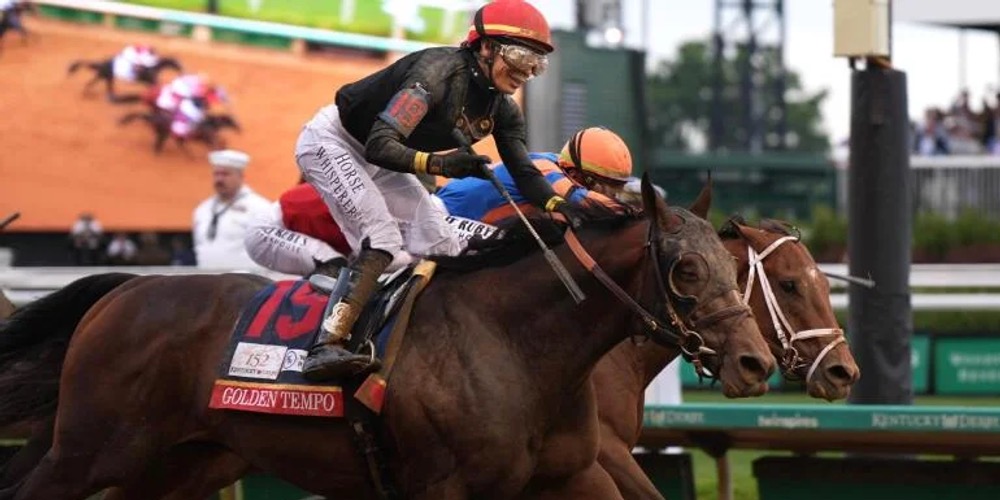
The quest for horse racing’s most elusive and prestigious prize, the Triple Crown, has officially ended before the second jewel has even been run. Golden Tempo, the spectacular and historic winner of the 152nd Kentucky Derby, will not be making the trip to Maryland for the Preakness Stakes next weekend. Instead, the resilient colt will be given ample time to rest and recover, with his connections setting their sights firmly on the Belmont Stakes at Saratoga Race Course on June 6.
The announcement, made on Wednesday by trainer Cherie DeVaux and owners St. Elias Stable and Phipps Stable, sent ripples through the horse racing community, though it hardly came as a complete shock to industry insiders who have watched the spacing of the Triple Crown races become a subject of intense modern debate. Golden Tempo is now the second consecutive Kentucky Derby winner, and the third in the past five years, to bypass the Preakness Stakes.
“We are incredibly appreciative of the excitement and support surrounding the possibility of a Triple Crown run,” DeVaux, who made history last Saturday as the first woman to train a Kentucky Derby winner, said in a formal statement. “The enthusiasm from racing fans, our owners, and our entire team has meant more to us than we can properly express. Golden gave us the race of a lifetime in the Kentucky Derby, and we believe the best decision for him moving forward is to give him a little more time following such a tremendous effort. His health, happiness, and long-term future will always remain our top priority.”
Golden Tempo will not run at the 151st Preakness as field takes shape | NBC Sports
A Historic Run at Churchill Downs
To understand the magnitude of the decision to hold Golden Tempo out of the Preakness, one must first look back at the immense physical and emotional effort that went into his Kentucky Derby victory just days prior. Entering the Run for the Roses at Churchill Downs as a 23-1 long shot, the son of Curlin was largely overlooked by the betting public in favor of heavyweights like Todd Pletcher’s Renegade and the Chad Brown-trained Emerging Market.
Under the masterful guidance of veteran jockey Jose Ortiz, Golden Tempo executed a visually stunning, last-to-first rally. While the front-runners battled for early positioning in a grueling mile-and-a-quarter test, Ortiz kept his mount relaxed at the back of the pack, saving every ounce of energy for the final, grueling furlongs. As they rounded the final turn, Golden Tempo swung wide and unleashed a devastating turn of foot, running down the morning-line favorite Renegade to win by a neck in a finish that will be replayed for decades to come.
The victory was not merely a testament to the colt’s stamina and heart; it was a barrier-breaking moment for the sport of horse racing. Cherie DeVaux’s triumph shattered the glass ceiling in a traditionally male-dominated profession, proving that her Keeneland-based operation is capable of producing a champion on the sport’s biggest stage. Co-owner Daisy Phipps Pulito and the St. Elias Stable celebrated a monumental payday, taking home the lion’s share of the record $5 million purse, with Golden Tempo banking $3.1 million for his heroic effort.
However, that herculean performance clearly took a lot out of the young horse. DeVaux and Pulito had repeatedly stated in the immediate aftermath of the Derby that they would let the colt dictate his own schedule. After closely monitoring his energy levels and physical condition back at their Keeneland base in Lexington, the team unanimously decided that a two-week turnaround was simply too steep of an ask.
The Two-Week Turnaround Debate
Golden Tempo’s defection from the Preakness Stakes reignites one of the most fiercely debated topics in modern Thoroughbred racing: the spacing of the Triple Crown.
Historically, the Triple Crown—consisting of the Kentucky Derby, the Preakness Stakes, and the Belmont Stakes—has been contested over a grueling five-week span. The Preakness is run just two weeks after the Derby, followed by the Belmont Stakes three weeks later. For decades, this compact schedule was seen as the ultimate test of a three-year-old thoroughbred’s durability, stamina, and class. Only 13 horses in history—most recently American Pharoah in 2015 and Justify in 2018—have managed to sweep all three races.
But the landscape of horse racing has shifted dramatically over the past two decades. Modern trainers are incredibly cautious with their elite equine athletes, typically spacing out their races by four to eight weeks to ensure maximum recovery and peak performance. Asking a horse to run a grueling mile-and-a-quarter in a 20-horse field at Churchill Downs, and then wheeling them back 14 days later for a mile-and-three-sixteenths sprint in the Preakness, is widely considered by contemporary horsemen to be an archaic and potentially hazardous practice.
The trend of skipping the Preakness is becoming the new normal. Just last year, trainer Bill Mott and Godolphin Racing opted to bypass the Preakness with 2025 Derby champion Sovereignty, preferring to rest him for the Belmont Stakes. The strategy paid off brilliantly, as Sovereignty won the Belmont and the Travers Stakes and went on to have a stellar career. In 2022, the connections of the 80-1 Derby upsetter Rich Strike made the same calculated decision.
When a healthy Kentucky Derby winner skips the Preakness, it inevitably leads to calls for reform. Maryland racing officials have actively been considering moving the Preakness back from the third Saturday in May to the fourth Saturday. Such a change would provide a three-week gap between the Derby and the Preakness, potentially incentivizing more trainers to keep their Derby horses on the Triple Crown trail. However, traditionalists argue that changing the spacing would put an asterisk next to any future Triple Crown winners, claiming it dilutes the monumental difficulty of the achievement.
For Mike Rogers, the executive vice president of racing for 1/ST Racing (the company that operates the Preakness), Golden Tempo’s absence is an undeniable blow to the event’s prestige.
“Initially, when I heard the news, it was a gut punch,” Rogers admitted in a recent interview. “You’re always hoping for the best. When someone like Cherie and Daisy put their horse first, you can’t criticize that decision. You respect it and you move on. But I’ve long been a proponent of spacing these races out, and I think it is something that has to be done.”
The 2026 Preakness Stakes at Laurel Park
The absence of Golden Tempo drastically changes the complexion of the 151st Preakness Stakes, which is already a year of transition for the historic race. For the first time in its storied history, the Preakness is not being held at its traditional home of Pimlico Race Course in Baltimore. Instead, the race has been temporarily relocated to nearby Laurel Park while Pimlico undergoes a massive, state-funded reconstruction project designed to modernize the dilapidated facility into a year-round racing and training hub.
Without the Kentucky Derby winner, the Preakness loses the casual viewer’s primary storyline—the pursuit of the Triple Crown. Currently, none of the 18 horses that ran in the Kentucky Derby are expected to make the trip to Laurel Park, save for perhaps Ocelli, the 99-1 maiden who shockingly finished third at Churchill Downs.
Instead, the Preakness field will be largely composed of “new shooters”—horses that either bypassed the Kentucky Derby entirely or failed to qualify for the starting gate on the first Saturday in May. A sizable field of up to 14 horses is anticipated, with early favorites likely to include horses like Crude Velocity, the impressive winner of the Grade II Pat Day Mile on Derby Day, as well as Chip Honcho, whom Jose Ortiz has picked up the mount for following Golden Tempo’s withdrawal. Other potential contenders include Corona de Oro, Crupper, Express Kid, and Great White.
While the race may lack the star power of a Derby champion, it still offers a prestigious Grade I victory and a substantial purse, guaranteeing a highly competitive and unpredictable betting race for handicappers.
Eyes on the Belmont Stakes at Saratoga
For Golden Tempo, the journey is far from over. By skipping the Preakness, DeVaux and her team are ensuring their star colt will be fresh and fully prepared for the final jewel of the Triple Crown: the Belmont Stakes on June 6.
“We are looking forward to pointing him toward the Belmont Stakes and are excited for what lies ahead with this very special horse,” DeVaux noted.
Much like the Preakness, the 2026 Belmont Stakes is being held at an alternate location. Due to the ongoing, multi-billion-dollar reconstruction of Belmont Park in Elmont, New York, the race will be staged at the iconic Saratoga Race Course in upstate New York for the third consecutive year. Because of the track layout at Saratoga, the race will be contested at a distance of 1 1/4 miles rather than its traditional, grueling 1 1/2 miles.
This sets up a mouth-watering scenario for horse racing fans. Golden Tempo, fully rested and adapted to the 1 1/4-mile distance (the exact same distance as his Kentucky Derby triumph), will likely face off against a stellar field of challengers. This could include a highly anticipated rematch with Renegade, the Derby runner-up, as well as horses that skipped the Derby to focus entirely on a summer campaign.
The story of Golden Tempo is already one of the most remarkable in recent racing history. A great-grandson of the resilient mare Dancinginmydreams, his pedigree is steeped in overcoming adversity. Under the meticulous care of Cherie DeVaux, he has blossomed from an under-the-radar prospect into the undisputed king of the three-year-old division.
While purists may mourn the loss of a Triple Crown chase in 2026, the modern reality of horse racing dictates that the welfare of the animal supersedes the pursuit of history. By prioritizing Golden Tempo’s health and longevity, his connections are ensuring that the sport’s newest superstar will have every opportunity to cement his legacy not just in a fleeting five-week spring window, but in a long, sustained, and brilliant career.
When the starting gates crash open at Laurel Park for the Preakness Stakes, Golden Tempo will be quietly resting in his stall, saving his devastating closing speed for a summer showdown at Saratoga. And if his Kentucky Derby performance was any indication, the rest of the racing world better be ready when he returns.
Leo Falsafi is a digital marketing veteran and senior journalist at Virlan.co, where he covers the intersection of digital marketing, gaming, and breaking US trending news. With nearly two decades of hands-on experience in SEO and digital strategy, Leo has consulted for and scaled hundreds of companies. His deep industry roots allow him to deliver sharp, fact-checked insights and analysis on the trends shaping today's digital landscape.