
CD Projekt Red CEO Warns That Fully AI-Generated Games Are Coming (But Will Gamers Actually Care?)
The gaming industry is quietly bracing for an influx of fully AI-generated titles. For a community that intensely scrutinizes micro-transactions, graphical downgrades, and buggy launches, the prospect of algorithmically pumped-out games should immediately command your attention.
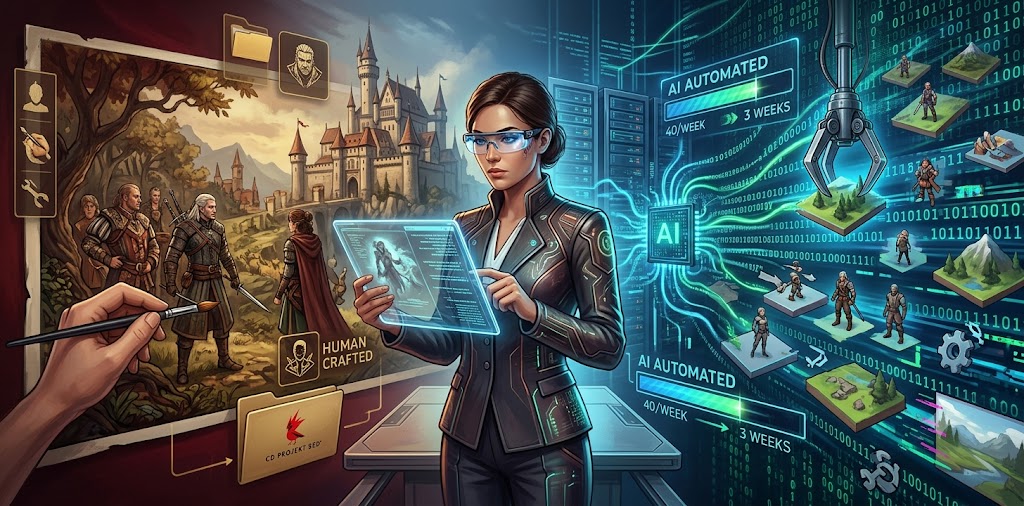
Michał Nowakowski, the joint CEO of CD Projekt Red (the powerhouse studio behind Cyberpunk 2077 and The Witcher franchise), recently confirmed a grim reality for gaming purists: studios built entirely around generative AI are already operating in the shadows. Speaking to Edge’s Knowledge newsletter, Nowakowski detailed a recent conversation with an AI-first studio founder that exposed a chillingly accelerated development pipeline.
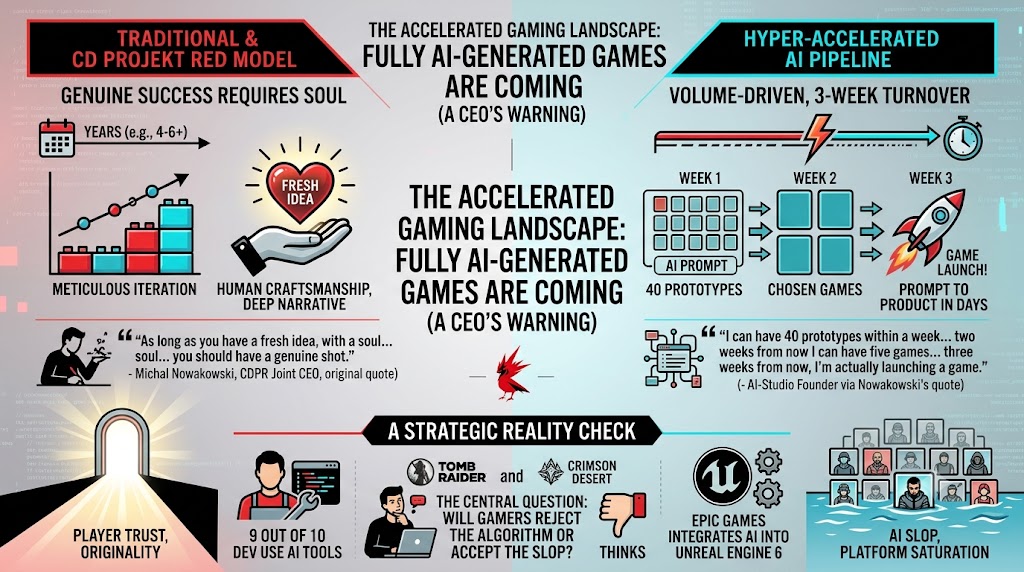
“I was in a conversation with a person who started a studio and was telling me: ‘I’m running a primarily AI-based studio. I can have 40 prototypes within a week, two weeks from now I can have five games that I chose are going to be the best and, three weeks from now, I’m actually launching a game,'” Nowakowski recalled.
Think about that timeline. A three-week turnaround from absolute zero to a launched product.
As the industry pushes forward, the aggressive creep of AI into development pipelines is undeniable. According to a recent internal survey cited by Google’s Jack Buser, roughly 9 out of 10 game developers are already utilizing AI-powered tools. The integration is happening at the foundational level, with Epic Games revealing plans to integrate support for AI models like Claude and Gemini directly into Unreal Engine 6 to eliminate “tedious work.” Epic Games boss Tim Sweeney has even argued that AI integration will soon become so universal that formal disclosure requirements will be rendered pointless.
However, there is a monumental difference between utilizing AI as a backend coding assistant and deploying an assembly line of 100% algorithmically generated games.
The AI Pipeline Reality Check: What We Know So Far
- Hyper-Accelerated Output: AI-first studios are attempting a volume-driven approach, churning out up to 40 prototypes a week, filtering them down to a handful of “winners,” and launching a final product in just 21 days.
- The Platform Saturation Threat: Storefronts like Steam already suffer from severe discoverability issues. A flood of three-week AI projects risks burying genuinely good, handcrafted games under a mountain of low-effort algorithmic content (often dubbed “AI slop” by the community).
- Fierce Consumer Pushback: Gamers are actively rejecting AI shortcuts. Crystal Dynamics recently faced intense community backlash after adding an AI disclaimer to the Tomb Raider: Legacy of Atlantis Steam page, forcing them to clarify that all final assets were human-crafted. Similarly, Pearl Abyss was forced to issue a public apology after utilizing AI-generated artwork for Crimson Desert.
Will fully AI-generated games replace traditional game development?
The short answer is no, but they will aggressively compete for your most valuable resource: your time. Nowakowski himself expressed profound skepticism about whether this volume-driven AI approach will actually yield commercial success. “Maybe that’s going to be successful, but I have some doubts whether this is really the path to follow,” he stated.
The CDPR executive warned that the fight for player attention is tougher than it has ever been, thanks to the sheer volume of games released annually, compounded by endless competition from social media algorithms and streaming platforms. Flooding the market with thousands of generated titles doesn’t solve this problem; it exacerbates it. According to Nowakowski, survival in this brutal market still hinges on deeply human elements.
“As long as you have a fresh idea, with a soul, with legs, you should have a genuine shot at being successful,” Nowakowski noted.
Handcrafted worlds, dense narrative writing, and meticulous iteration—the hallmarks of CDPR’s current multi-year Witcher 4 development cycle—simply cannot be replicated in a few weeks by a prompted algorithm. If the current community temperature is any indicator, publishers testing the waters with fully AI-generated games will face an uphill battle against a deeply skeptical consumer base. Players don’t want forty lifeless prototypes a week; they want one game with a soul.
Sources Quoted: Quotes, statistics, and industry data were successfully extracted from recent reporting by GamesRadar+, TweakTown, Rock Paper Shotgun, Outlook Respawn, and IGN India (via live web browsing).
Leo Falsafi is a digital marketing veteran and senior journalist at Virlan.co, where he covers the intersection of digital marketing, gaming, and breaking US trending news. With nearly two decades of hands-on experience in SEO and digital strategy, Leo has consulted for and scaled hundreds of companies. His deep industry roots allow him to deliver sharp, fact-checked insights and analysis on the trends shaping today's digital landscape.