
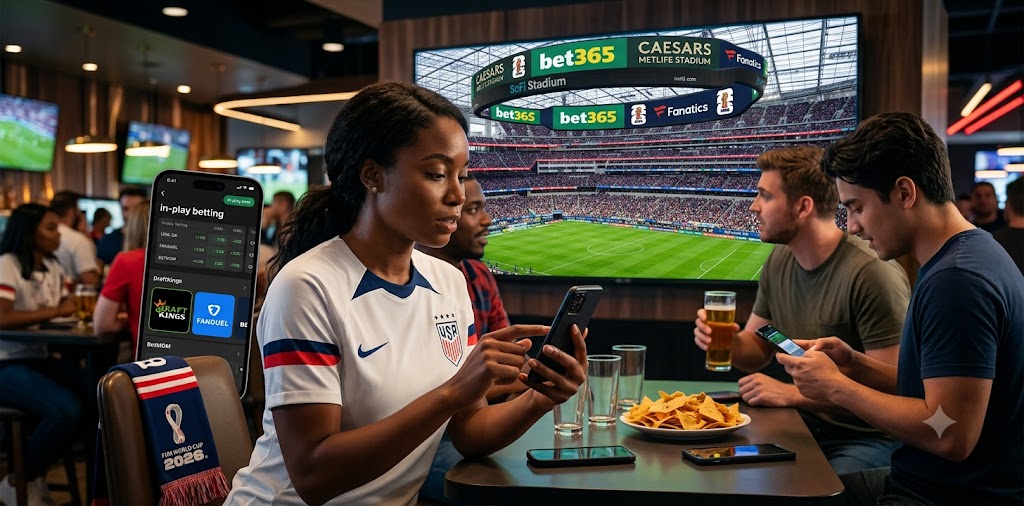
The 2026 FIFA World Cup is already breaking records on the pitch, but the most aggressive competition is happening on your screens. With the tournament expanding to 48 teams and spreading across the United States, Mexico, and Canada, it has officially become the largest sports betting event in history.
Industry analysts project that regulated sportsbooks will handle a staggering $50 billion to $60 billion globally. In the U.S. alone, sportsbooks are expected to process up to $4.4 billion during the tournament. Here is a deep dive into the brands dominating the ad space, the evolving playbook they use to capture your attention, and the growing backlash against their tactics.
The Heavyweights: Who is Winning the U.S. Market?
In the United States, sports betting is now legal in 38 states plus Washington D.C., and every major operator has gone all-in on the World Cup. The landscape is dominated by familiar giants, but a clear duopoly has emerged at the top.
According to projections by Eilers & Krejcik Gaming, the U.S. handle is heavily consolidated between two massive brands:
- DraftKings: Projected to handle approximately $1.02 billion.
- FanDuel: Projected to handle around $945 million.
Trailing them, but heavily active in the advertising space, are BetMGM, Caesars, Fanatics, bet365, and Hard Rock Bet. These brands are deploying massive promotional budgets to acquire users, offering thousands of dollars in matched bets and profit boosts to cut through the noise.
The New Advertising Playbook: Hydration Breaks and Micro-Betting
Because the market is saturated, betting brands are shifting away from traditional mass-market broadcast commercials and moving toward hyper-targeted, segmented advertising.
One major catalyst for this shift? FIFA’s mandatory hydration breaks.
Regulators in Europe (such as France’s ANJ) recently flagged these mid-game pauses as a massive source of extra live advertising inventory. To avoid the regulatory wrath that comes with spamming viewers, sportsbooks are pivoting. Instead of just betting on who will win the match, operators are pushing in-play betting and “bet builders.” Ads now prompt users to wager on micro-events: the number of tackles, specific player assists, or even which foot a striker will use to score.
With nearly 64% of bettors planning to wager during the game, live triggers and dynamic campaigns have become the gold standard for betting ads.
The Prediction Market Pivot: Gamification and Memes
While traditional sportsbooks rely on massive bonus offers, a new wave of prediction markets and “social sportsbooks” are utilizing gamification and meme culture to lure in a younger demographic.
Platforms like Kalshi, Polymarket, and Fliff are abandoning the traditional “sports anchor” commercial aesthetic entirely. Instead, their ad strategies look exactly like the native content found on TikTok or Instagram:
- Polymarket recently ran ads on Meta featuring influencers performing extreme stunts, like hanging off hot air balloons.
- Kalshi, which reported a record weekly trading volume of nearly $7 billion driven largely by the tournament, has run bizarre, eye-catching ads featuring chimpanzees wearing suits.
- Fliff, operating as a free-to-play social sportsbook, utilizes popular internet meme templates (like the car drifting to catch a highway exit) to seamlessly blend into young users’ feeds.
The Backlash: Ad Fatigue and Regulatory Fears
The unprecedented volume of gambling advertisements has not gone unnoticed, and the backlash is intensifying. Policymakers, researchers, and advocacy groups are sounding the alarm over public health risks and the potential for increased addiction.
In Canada, officials are considering much stricter rules on gambling advertising. In Ontario, where online betting has been legal since 2022, recent surveys show that over a quarter of online gamblers admitted that advertising directly influenced their decision to bet—with younger adults being particularly vulnerable.
The calls for intervention are growing louder. Some advocacy groups are pushing for a total ban on gambling ads, comparing the industry’s marketing tactics to those of tobacco and alcohol. Meanwhile, the regulated industry argues that their presence ensures consumer protection and drives users away from the black market.
The Final Whistle
The 2026 World Cup is serving as the ultimate stress test for the global sports betting infrastructure. As the tournament progresses, the brands that succeed won’t just be the ones with the biggest budgets—they will be the ones that master real-time data, in-play marketing, and social media integration without crossing the line into regulatory crosshairs.
This article cites reporting by Tatiana Martins for G&M News on global market projections and operator strategies, and Silvia Pavlof for Gambling News on the regulatory backlash and advertising concerns in North America.
Leo Falsafi is a digital marketing veteran and senior journalist at Virlan.co, where he covers the intersection of digital marketing, gaming, and breaking US trending news. With nearly two decades of hands-on experience in SEO and digital strategy, Leo has consulted for and scaled hundreds of companies. His deep industry roots allow him to deliver sharp, fact-checked insights and analysis on the trends shaping today's digital landscape.