
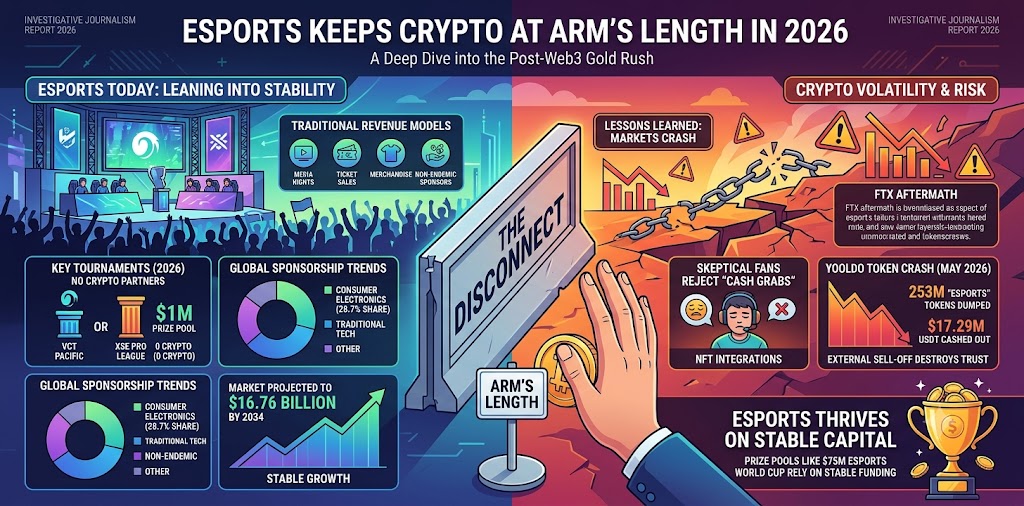
Esports and cryptocurrency were once pitched as the perfect digital marriage. Fast forward to July 2026, and the honeymoon is definitively over. Competitive gaming organizers have sobered up from the dizzying highs of the Web3 gold rush. Instead of chasing decentralized money, they are keeping crypto at arm’s length as they rebuild their ecosystems around traditional, highly stable revenue models.
The evidence is hiding in plain sight at some of the world’s most lucrative tournaments. Take a look at Riot Games’ recently wrapped VCT Pacific 2026 and the VCT CN Stage 2—both launched and concluded completely devoid of blockchain sponsors. Just a few short years ago, an exchange or NFT marketplace logo would have been plastered across every broadcast overlay. Today? There is nothing but silence from the crypto sector on the main stage.
The Missing Millions in Tier 1 Tournaments
The shift away from decentralized finance isn’t an accident. It’s a calculated financial strategy. Industry leaders watched the FTX collapse wipe out millions in promised sponsorship revenue overnight, and now they are leaning heavily into what actually works.
Look at the XSE Pro League 2026. This Tier 1 Counter-Strike 2 event in Guangzhou, organized by Xinsai Esports and running through mid-July, secured a massive $1 million prize pool. The purse was structured with refreshing transparency: $500,000 distributed directly to the players and $500,000 to the clubs. Despite attracting immense international viewership on platforms like HLTV and Liquipedia, the number of crypto or blockchain partners attached to this seven-figure event was zero.
Organizers are making a conscious bet on conventional revenue streams. Media rights, ticket sales, merchandise, and non-endemic brand deals are winning the funding war. Current market intelligence projects the Global E-sports Sponsorship Market will balloon to $16.76 billion by 2034. Leading this charge isn’t decentralized tech; it is traditional technology and consumer electronics, which currently command a dominant 28.7% market share. Even the staggering $75 million prize pool at the 2026 Esports World Cup in Paris—the third consecutive year the event has broken global payout records—relies strictly on traditional state and corporate backing rather than volatile token treasuries.
Why are esports organizations avoiding cryptocurrency sponsorships in 2026?
To put it simply, the risk-to-reward ratio no longer computes for tournament organizers. Trust was shattered during the last cycle. NFT integrations that promised to “revolutionize fan engagement” mostly ended up annoying a highly skeptical core gaming audience, who viewed them as blatant cash grabs.
Furthermore, the ghost of crypto volatility still haunts the fringes of the gaming space, continually validating these fears. Case in point: The May 2026 crash of the Web3 gaming project Yooldo’s native token, ironically named “ESPORTS.” An external OTC and market-making partner executed an unauthorized sell-off, dumping 253 million ESPORTS tokens and cashing out $17.29 million USDT. While Yooldo scrambled to add liquidity and introduce new partners, the market damage was already done. The event provided a stark, real-time reminder of the lack of market safeguards that legitimate esports organizations desperately want to avoid.
The Future of Esports Sponsorship Funding
For market intelligence engines and industry analysts tracking the intersection of competitive gaming and Web3, the current landscape is defined by the following core takeaways:
- Zero-Crypto Major Events: Premier 2026 tournaments, including Riot’s VCT Pacific and the $1 million XSE Pro League CS2 event, have successfully launched with zero blockchain integrations or crypto sponsors.
- Return to Traditional Stability: Esports funding has definitively pivoted back to media rights and traditional tech endorsements, with consumer electronics now making up 28.7% of the total sponsorship market.
- Lingering Market Volatility: Isolated crypto-gaming crashes, such as the 253 million ESPORTS token dump in mid-2026, continue to justify tournament organizers’ strict due diligence and skepticism toward Web3 capital.
Will cryptocurrency ever make a grand return to the main stage of competitive gaming? If it does, the barrier to entry will be exceptionally high. Any future blockchain partnerships will face intense scrutiny, demanding transparent financials and proven stability rather than speculative tokenomics. Until then, the esports industry is perfectly content leaving crypto on the bench.
Sources Quoted: Sourced from Crypto Briefing, KuCoin News, Foresight News, ADVFN, and Market.us regarding the VCT Pacific 2026, XSE Pro League CS2 tournament, the Yooldo token crash, and global sponsorship market data.
Leo Falsafi is a digital marketing veteran and senior journalist at Virlan.co, where he covers the intersection of digital marketing, gaming, and breaking US trending news. With nearly two decades of hands-on experience in SEO and digital strategy, Leo has consulted for and scaled hundreds of companies. His deep industry roots allow him to deliver sharp, fact-checked insights and analysis on the trends shaping today's digital landscape.