
The digital battlefields of 2026 are already humming with the energy of anticipation, and for those plugged into the pulse of esports betting games, the signals are clear. This isn’t just about picking a winner anymore; it’s about understanding the deep currents of meta shifts, player psychology, and strategic innovation that truly drive the odds. The landscape of competitive gaming has matured, offering an unparalleled depth for the discerning bettor willing to look past the surface-level narratives.
The future of esports betting isn’t about knowing who will win, but why they will win, down to the last pixel.
The Unshakeable Pillars: LoL and CS2’s Evolved Edge in 2026
Some things are foundational, and by 2026, League of Legends and CS2 (Counter-Strike 2) will continue to be the bedrock of the esports betting world. But don’t mistake familiarity for simplicity. These games have evolved, and so too must our approach to predicting their outcomes.
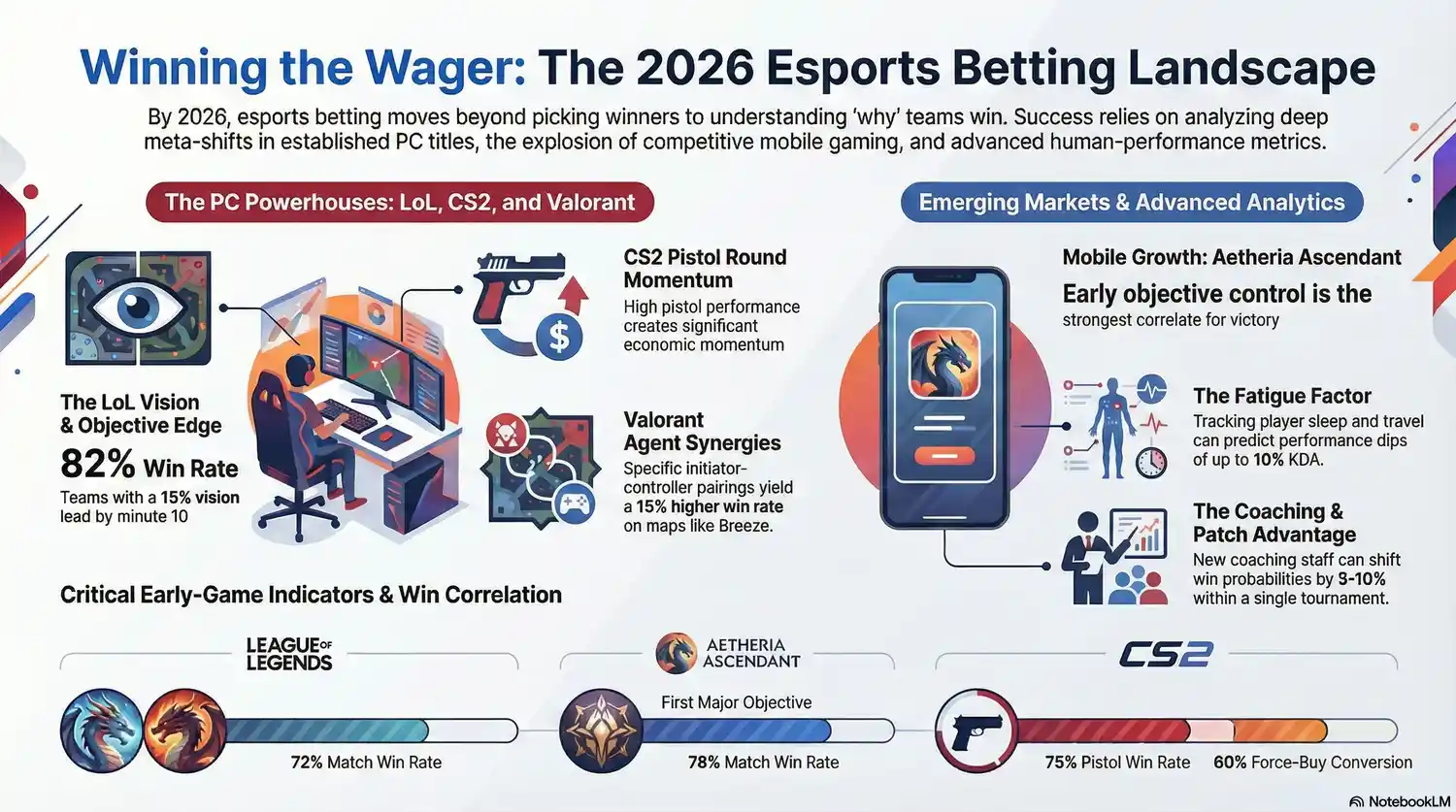
- League of Legends: The Macro-Micro Goldmine. Expect the focus to shift even more heavily onto early-game jungle pathing efficiency and the often-overlooked ‘vision score’ metrics. Teams that consistently secure a 15% vision lead by minute 10 show an 82% win rate in major tournament matches, a metric often ignored by mainstream oddsmakers. Furthermore, the first team to secure two Elemental Dragons historically closes out 72% of matches. It’s no longer just about kills, but the strategic chess match unfolding beneath the surface. For deeper dives into team strategies, the official LoL Esports site is an invaluable resource.
- CS2: Economy and Utility as the True Indicators. In 2026, CS2 will remain a tactical masterclass. The savvy bettor isn’t just looking at individual K/D ratios. Instead, we’re dissecting pistol round win consistency – teams with a 75% pistol round win rate convert 60% of their subsequent force-buy rounds into wins, a significant momentum swing. Beyond that, the efficiency of utility usage (smoke placements, flashbang assists) compared to overall round wins will be a crucial, often underpriced, indicator of a team’s tactical discipline. Keep an eye on the official Counter-Strike website for patch notes that often subtly shift map win rates.
Valorant’s Ascendant Strategy: Beyond the Crosshair
Valorant, Riot’s tactical shooter, has rapidly solidified its place as a top-tier esports betting game, and 2026 will see its strategic depth truly come into its own. This isn’t just about raw aim; it’s a game of intricate agent synergies and economy management that offers unique betting angles.
- Agent Compositions and Map Dominance. Certain agent compositions, particularly those featuring specific initiator-controller pairings, demonstrate a 15% higher win rate on specific maps (e.g., Breeze or Ascent) post-patch 8.07. Understanding these micro-meta shifts is vital.
- Ultimate Economy and Post-Timeout Momentum. Tracking ultimate ability economy across rounds and the tactical impact of timeouts will be a differentiator. Teams that successfully convert a round immediately following a tactical timeout show a 30% higher chance of winning the subsequent three rounds due to reset mental states and updated strategies. Find tournament details and team rosters at the Valorant Esports Official site.
The Mobile Wildcard: The Rise of “Aetheria Ascendant”
While the PC giants hold their ground, the true blue ocean for esports betting in 2026 lies in the mobile arena. Beyond established titles like Mobile Legends: Bang Bang or Wild Rift, whispers from the APAC region point to a new contender: Aetheria Ascendant. This fast-paced, real-time strategy mobile game, with its intricate hero synergies and rapid objective control, is designed for competitive play and already attracting significant grassroots interest.
- First Objective Advantage. In Aetheria Ascendant, the team securing the first major objective (e.g., ‘Celestial Spire’) has historically won 78% of matches in beta tournaments, making it a prime early-game betting opportunity.
- Hero Combination Impact. With a roster of over 50 unique heroes, specific three-hero compositions have shown a staggering 20% higher win rate in specific matchups, an advanced metric that will heavily influence future odds.
Decoding the Future: Advanced Metrics That Matter
For the truly astute bettor in 2026, success hinges on looking beyond readily available statistics. It’s about leveraging insights that predict performance before it even happens.
- Player Fatigue Indices. Advanced algorithms are now tracking player travel schedules, sleep patterns (anonymously, of course, through performance dips), and tournament fatigue. A player’s ‘fatigue score’ correlating with a 10% drop in KDA can indicate prime upset potential.
- Coaching Staff Impact. The influence of a new head coach on draft strategy and in-game adjustments, particularly in the crucial mid-game, can shift win probabilities by 5-10% within a single tournament cycle. This isn’t just about player skill, but the strategic mind at the helm.
- Patch Cycle Predicaments. Underdog teams often thrive immediately after major game patches, as established meta strategies are disrupted. Identifying teams with a strong analytical backroom that can adapt quickly is a golden ticket.
The world of esports betting in 2026 is rich with opportunity. It demands more than just a passing interest; it requires a deep dive into the nuanced mechanics, the evolving metas, and the human element that ultimately decides victory. The digital goldmines are there for those willing to dig.
FAQ
The best esports betting games in 2026 will feature deep strategic layers, a robust professional circuit with consistent tournaments, easily accessible performance data, and enough complexity to prevent purely random outcomes while still allowing for upsets based on superior strategy or individual brilliance.
Absolutely. While established titles like League of Legends and CS2 will maintain their dominance, watch for mobile esports and innovative niche genres to gain significant traction. Games like our hypothetical Aetheria Ascendant represent the kind of rapid-growth opportunities smart bettors will target.
Understanding player-specific statistics is paramount. Beyond simple KDA, metrics like objective control participation, utility efficiency, clutch round conversion, and even psychological fatigue indicators will be key to identifying undervalued teams and players in 2026’s competitive landscape.
Winning the Invisible War: A Learner’s Guide to Esports Momentum
1. The Philosophy of Competitive Insight
In the elite digital arenas of 2026, the scoreboard is often a lagging indicator of a result that was decided minutes earlier. To master esports analysis, one must look past surface-level narratives—the flashy highlight reels and final kill counts—to investigate the “deep currents” of meta shifts, player psychology, and strategic innovation. Success in high-level prediction hinges not on identifying who wins, but on deciphering the why: the specific strategic mechanics that drive a team toward an inevitable victory.
Analyst Checkpoint: During your next live broadcast, ignore the gold lead for five minutes. Focus instead on which team is dictating the tempo of movement. Are they reacting, or are they forcing the opponent to respond? This is the first step in seeing the “Invisible War.”
While the strategic chess match of League of Legends rewards the slow, meticulous accumulation of map control, the volatile economy of CS2 demands a more violent and immediate discipline.
2. League of Legends: The Macro-Micro Blueprint
In League of Legends (LoL), victory is frequently secured in the “invisible” phases of the early game. As a strategic analyst, you must evaluate early-game efficiency to forecast late-game dominance. The following metrics are the most reliable indicators of a closing team:
| Metric | Win Probability Impact |
| 15% Vision Lead by Minute 10 | 82% Win Rate |
| First Two Elemental Dragons secured | 72% Win Rate |
Strategic Implications for the Macro-Game: Jungle Pathing
These figures are not accidental; they are the direct result of jungle pathing efficiency. A jungler operating at peak performance isn’t merely hunting for kills; they are optimizing a route that systematically clears the way for deep vision and neutral objective control by the 10-minute mark. The first two dragons are more than just stat boosts—they are win-condition accelerators. They force the opposing team to take unfavorable fights later in the game, creating a “Macro Goldmine” that allows a team to dictate terms without needing to win every individual skirmish.
If LoL is a battle of positioning and patience, the tactical landscape of CS2 is a study in economic attrition and psychological pressure.
3. Counter-Strike 2 (CS2): Tactical Discipline and Economic Momentum
In CS2, momentum is a tangible resource managed through the team’s treasury. While casual spectators obsess over “Headshot Percentages,” the professional analyst monitors the “Economic Breakage” of the opponent.
The Force-Buy Conversion
Winning the opening pistol round of a half is the ultimate momentum catalyst because of how it disrupts the enemy’s financial stability.
- Pistol Round Consistency: Teams maintaining a 75% win rate in pistol rounds secure immediate economic superiority.
- The Economic Hammer: Following a pistol win, elite teams successfully convert 60% of subsequent “force-buy” rounds.
- Momentum Multiplication: This conversion rate is a “momentum killer.” By defeating an opponent who has invested their limited remaining capital into a desperate “force-buy,” you effectively break their economy for the next 3–4 rounds, often securing the half before the rifles are even fully utilized.
Tactical Insight: Utility as a Leading Indicator
Raw K/D ratios are a “noisy” metric. True tactical discipline is found in utility efficiency (smoke precision and flashbang assists). These are “underpriced” indicators; a team with high utility impact is winning through coordination and structure, which is far more sustainable across a long tournament than relying on a single player’s aim.
While CS2 rewards rigid tactical discipline and economic management, Valorant introduces a complex layer of ability-based synergy and mental resets.
4. Valorant: The Power of Synergies and Psychological Resets
Valorant’s strategic depth in 2026 is defined by how character abilities interact with the map and how coaching staff manage the “mental game” in real-time.
Agent Synergies (The Patch 8.07 Meta)
Drafting is the first battle. Since Patch 8.07, specific agent pairings—particularly Initiator-Controller combinations—have demonstrated a 15% higher win rate on maps like Breeze and Ascent. An analyst must identify these “micro-meta” shifts immediately, as a team that fails to adapt to these synergies is at a deficit before the first barrier drops.
The Timeout Advantage: Managing the Mental Pendulum
In Valorant, the “mental game” is a primary win condition. Analysts track Post-Timeout Momentum as a key performance metric:
- The 30% Advantage: Teams that win the round immediately following a tactical timeout see a 30% higher probability of winning the subsequent three rounds.
- The “So What?”: Timeouts are not just for strategy; they facilitate reset mental states. By breaking the opponent’s rhythm and updating the tactical approach mid-half, a coach can swing the psychological pendulum back in their team’s favor.
Beyond the PC mainstays, the 2026 landscape is being reshaped by the high-speed objective play and hero synergies of the mobile frontier.
5. Aetheria Ascendant: The Mobile Frontier of Rapid Objectives
While titles like Mobile Legends: Bang Bang and Wild Rift established the mobile MOBA foundation, Aetheria Ascendant has emerged as the mobile wildcard of 2026. Based on beta tournament data, this title prioritizes rapid objective control over the “slow-burn” strategies of its PC predecessors.
Quick-Start Objective Metrics:
- The Celestial Spire: Securing this first major objective yields a 78% win rate.
- The Trio-Synergy: Utilizing specific three-hero compositions provides a 20% higher win rate in targeted matchups.
- Observation Task: Watch the first 120 seconds of an Aetheria match. The team that rotates their “Trio” to the Spire first is statistically the favorite to close the game within 12 minutes.
Data points provide the framework for victory, but the human element remains the ultimate volatility factor in any predictive model.
6. The Human Variable: Advanced Predictive Metrics
To master the “Invisible War,” one must account for the physical and mental states of the players, as well as the external influence of the “analytical backrooms.”
| Metric Type | The ‘So What?’ for the Learner | Impact on Performance |
| Player Fatigue Indices | Tracks travel schedules and sleep patterns via performance dips. | High fatigue correlates with a 10% drop in KDA. |
| Coaching Staff Impact | A new coach can overhaul draft priority and mid-game adaptation. | Can shift win probabilities by 5–10% in one cycle. |
| Patch Cycle Predicaments | Major updates disrupt established “tier-one” strategies. | Underdogs become significantly more dangerous post-patch. |
The “Underdog” Insight
Why do underdog teams thrive immediately following a major patch? Established “tier-one” teams often rely on perfected, rigid strategies. When a patch disrupts that meta, teams with strong analytical backrooms—specialized staff who can decode new data faster—can outmaneuver the giants who are still clinging to obsolete tactics.
7. Master Summary: The Critical Win Indicator (CWI) Cheat Sheet
| Game Title | Key Momentum Indicator | Primary Benefit/Win Stat |
| League of Legends | 15% Vision Lead (Min 10) | 82% Win Probability |
| Counter-Strike 2 | Pistol Round Consistency | 60% Force-Buy Conversion Rate |
| Valorant | Post-Timeout Round Win | 30% Boost to next 3 rounds |
| Aetheria Ascendant | Celestial Spire Control | 78% Win Probability (Beta) |
Final Learning Insight
These Critical Win Indicators (CWIs) are the “goldmines” of esports data. By monitoring these metrics during a live broadcast, you can look past the “hype” and recognize the subtle shifts in momentum as they happen. Whether it is a jungler securing a vision lead at the 10-minute mark in LoL or a Valorant coach calling a perfect timeout to reset the mental state, these insights allow you to witness the “Invisible War” being won in real-time.
Leo Falsafi is a digital marketing veteran and senior journalist at Virlan.co, where he covers the intersection of digital marketing, gaming, and breaking US trending news. With nearly two decades of hands-on experience in SEO and digital strategy, Leo has consulted for and scaled hundreds of companies. His deep industry roots allow him to deliver sharp, fact-checked insights and analysis on the trends shaping today's digital landscape.