
Wall Street’s New Red Line
A quiet panic is rippling through the compliance departments of America’s largest financial institutions. The issue isn’t rogue options trading or unvetted cryptocurrency portfolios. It is the explosion of real-money prediction markets.
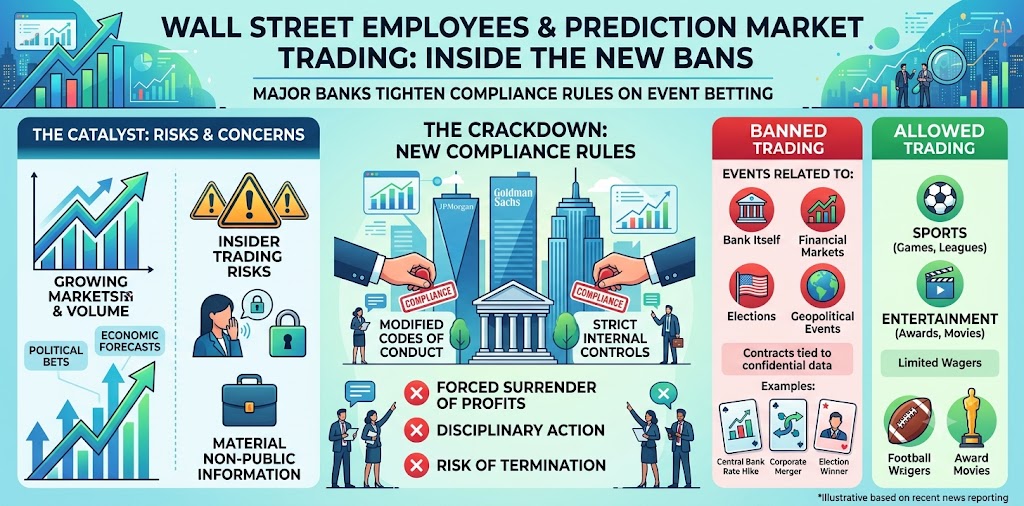
In early July 2026, Goldman Sachs laid down a definitive ultimatum. An internal memo explicitly banned its employees from trading event-based contracts tied to the bank itself, broader financial markets, macroeconomic trends, and geopolitical elections. The stakes for non-compliance are severe. Staff members caught breaching these rules risk immediate disciplinary action—including termination—and will be forced to surrender any illicitly gained profits. If an employee wants to wager on the platforms, they are strictly limited to the sports and entertainment categories.
Goldman isn’t acting in isolation. Morgan Stanley recently embedded specific rules governing prediction market participation into its employee code of conduct. Bank of America and JPMorgan Chase are also quietly rolling out new, prohibitive measures. For heavily regulated institutions, proximity to material non-public information is a constant liability. The thought of a junior analyst quietly leveraging confidential client data to place a six-figure bet on an upcoming corporate merger or interest rate decision is a compliance officer’s worst nightmare.
The Catalyst: Google, Venezuela, and a $1.2 Million Red Flag
Why the sudden, coordinated crackdown across Wall Street? Simply put, the theoretical risk of insider trading on prediction markets has fully materialized into reality over the last year.
In May 2026, the Department of Justice (DOJ) and the Commodity Futures Trading Commission (CFTC) rocked the tech and finance sectors by accusing Google software engineer Michele Spagnuolo of utilizing non-public, confidential workplace information. The target? Polymarket contracts linked to Google’s “Year in Search” rankings. Spagnuolo reportedly walked away with $1.2 million in profits before the hammer fell.
This followed a highly publicized incident from January, where a U.S. special forces soldier allegedly placed perfectly timed bets on Polymarket regarding the ousting and capture of Venezuelan President Nicolás Maduro. The soldier pocketed over $400,000. Additionally, platforms have recently been jarred by suspicious betting flurries, including trades preceding the Nobel Peace Prize announcement and unusually lucrative wagers placed by a dozen accounts just days before U.S. military action against Iran.
The sheer breadth of available event contracts creates a unique policing problem. Karen Woody, a law professor at Washington and Lee University, highlighted the immense difficulty of tracking this activity. “All these different questions that you’re able to bet on, it makes it really hard to kind of play whack-a-mole in terms of where people are using the information they’ve obtained confidentially,” Woody noted.
Similarly, David Oliwenstein, a partner at the law firm Pillsbury, emphasized that financial companies are aggressively seeking guidance on how federal regulators view this burgeoning asset class. Rather than relying on boilerplate insider trading clauses, firms are now being forced to explicitly name these platforms in their codes of conduct.
Unprecedented Growth Amid Regulatory Scrutiny
Prediction markets have evolved from niche crypto-gambling sites into multi-billion-dollar financial ecosystems. Regulators and bank executives alike simply cannot ignore the volume.
Boosted heavily by the 2026 FIFA World Cup, Kalshi posted a staggering $9.4 billion in monthly trading volume in June alone. Its primary rival, Polymarket, hit a record-breaking $713 million in daily taker volume on June 20. And neither platform is slowing down.
Both companies are actively looking to deepen their integration into traditional finance by offering margin-enabled trading, allowing users to place large bets with significantly less upfront capital. Kalshi’s affiliate, Kinetic Markets LLC, already secured authorization from the National Futures Association (NFA) back in March. Not to be outdone, Polymarket’s affiliate, Coming Home GBA LLC, filed a similar application with the NFA on July 3 to become a Futures Commission Merchant (FCM), though they still await final approval from the CFTC.
The Inevitable Collision
Wall Street’s sudden regulatory clampdown represents a major collision between decentralized financial betting and traditional institutional compliance. Lawmakers are taking notice, too. In mid-June, Wisconsin Representative Bryan Steil introduced legislation specifically designed to prevent public officials from wagering on political outcomes.
For the modern banking employee, the message is unmistakably clear. The house might let you bet on the World Cup, but placing a wager on the next Federal Reserve rate hike could cost you your career.
Sources Quoted:
Data, quotes, and event timelines were successfully extracted from July 2026 reporting by Reuters, the Financial Times, CNBC (via Cointelegraph/TradingView), and World Casino Directory. Key expert commentary includes statements from Karen Woody (Washington and Lee University) and David Oliwenstein (Pillsbury).
Leo Falsafi is a digital marketing veteran and senior journalist at Virlan.co, where he covers the intersection of digital marketing, gaming, and breaking US trending news. With nearly two decades of hands-on experience in SEO and digital strategy, Leo has consulted for and scaled hundreds of companies. His deep industry roots allow him to deliver sharp, fact-checked insights and analysis on the trends shaping today's digital landscape.