
Celebrity Deals Dwarf Responsible Gambling Spending Across U.S. Betting Industry
The American sports betting and casino sector poured over half a billion dollars into celebrity megastars last year. Meanwhile, public-health and player safety initiatives were left fighting for a fraction of that budget.
A sweeping 24-month industry audit published by communications firm 5W exposes a glaring financial disparity at the heart of the U.S. betting boom. The findings are stark: gambling operators aggressively bankroll celebrity endorsements at a scale that completely dwarfs their investment in responsible gambling (RG) programs.
The 8.7-to-1 Disconnect: Unpacking a $3.9 Billion Marketing Spend
The “5W Responsible Gambling Communications Audit 2026” analyzed over 47,000 media articles and reviewed 30 different operators to bring the industry’s financial priorities into sharp focus.
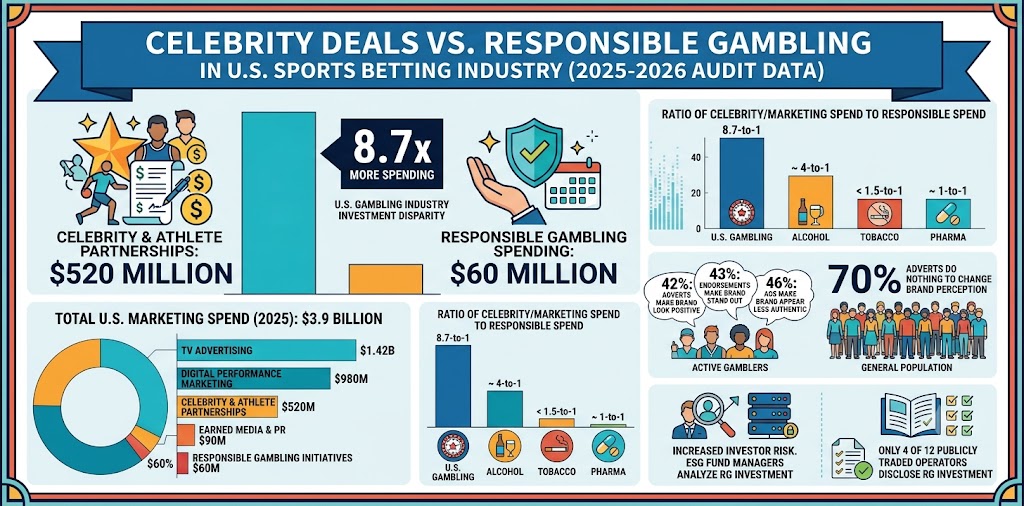
In 2025, the U.S. gambling industry shelled out an estimated $3.9 billion on total marketing. Within that massive war chest, operators spent $520 million specifically on celebrity and athlete endorsement partnerships. By contrast, an estimated $60 million went toward responsible gambling programs and communications.
This establishes a striking 8.7-to-1 ratio. Simply put, the industry spends nearly nine dollars on star power for every one dollar dedicated to player protection.
The core financial breakdown of the 2025 gambling marketing spend reveals exactly where operator priorities lie:
- Television Advertising: $1.42 billion (over 33% of the total budget).
- Digital Performance Marketing: $980 million.
- Celebrity & Athlete Partnerships: $520 million.
- Earned Media & PR: $90 million (just 2.3%).
- Responsible Gambling Initiatives: $60 million (approximately 1.5%).
How does the gambling sector compare to other regulated industries?
This gap isn’t just large; it is unprecedented among American consumer categories burdened with a public-health dimension. To put the 8.7-to-1 ratio into perspective, the U.S. tobacco industry operates at a ratio below 1.5-to-1 following the Master Settlement Agreement. The alcohol sector hovers around 4-to-1. Pharmaceutical companies maintain a near 1-to-1 ratio, largely driven by strict, mandated risk communication.
Do celebrity endorsements actually work for sports betting platforms?
Given the $520 million price tag, it is worth asking if athlete and entertainer partnerships actually move the needle for sportsbooks. The data points to a highly conflicted consumer base.
A recent YouGov survey indicates that celebrity marketing yields diminishing, and sometimes contradictory, returns. Among active U.S. gamblers, 42% admit that seeing a celebrity in an ad makes them view the brand positively, and 43% agree that high-profile endorsements help betting brands stand out in a crowded market.
However, brand fatigue is setting in. Nearly half of active gamblers (46%) report that celebrity endorsements make a gambling brand appear less authentic or overly promotional. Furthermore, a massive 70% of the general American adult population explicitly stated that celebrity-fronted gambling ads do absolutely nothing to change their perception of a brand.
The ESG and Regulatory Fallout: A Brewing Liability
This massive funding asymmetry is no longer just a public relations headache. It has morphed into a quantifiable liability tracked by institutional investors.
According to the audit, major Environmental, Social, and Governance (ESG) research desks have taken notice. Financial entities evaluating the consumer services sector are now factoring responsible gambling investment—specifically as a percentage of total marketing spend—into their corporate rating reviews. This directly impacts the valuation and risk profile of publicly traded operators.
Transparency remains a critical hurdle for the industry. Out of the 12 publicly traded U.S. gambling operators reviewed in the report, a mere four actually disclose their RG investment as a percentage of marketing spend in their annual reports or ESG disclosures. Operators that neglect to fund and document genuine player protection narratives aren’t just risking regulatory ire; they are actively alienating a growing block of socially conscious institutional capital.
Sources Quoted:
Data and statistics were sourced from the “5W Responsible Gambling Communications Audit 2026” (via PR Newswire), YouGov consumer survey data, and industry ESG reporting metrics.
Leo Falsafi is a digital marketing veteran and senior journalist at Virlan.co, where he covers the intersection of digital marketing, gaming, and breaking US trending news. With nearly two decades of hands-on experience in SEO and digital strategy, Leo has consulted for and scaled hundreds of companies. His deep industry roots allow him to deliver sharp, fact-checked insights and analysis on the trends shaping today's digital landscape.