
The state-sanctioned online gambling industry exploded into a staggering $27 billion market in 2025. But beneath the polished veneer of heavily regulated mobile sportsbooks lies a shadow economy of offshore operators, peer-to-peer betting networks, and platforms operating in regulatory gray areas.
Now, regulators in the Grand Canyon State are drawing a hard line in the sand.
In a sweeping enforcement action this week, the Arizona Department of Gaming (ADG) issued formal cease-and-desist orders to five gambling-related platforms. The state’s mandate is blunt: immediately shutter all online and mobile gambling operations within Arizona borders or face severe criminal and civil consequences.
The investigation has uncovered an array of alleged violations, ranging from unlicensed daily fantasy sports to facilitating underage wagers and masking illicit casino games under the guise of charitable raffles and sweepstakes.
Arizona Department of Gaming Targets 5 Key Operators
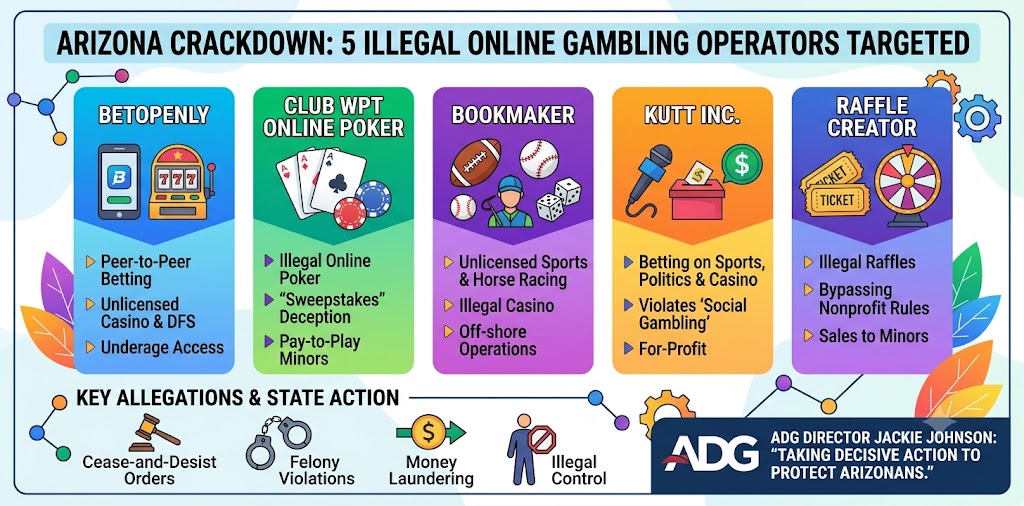
The state’s enforcement actions specifically target BetOpenly, Bookmaker, Club WPT Online Poker, Kutt Inc., and Raffle Creator.
The ADG isn’t merely slapping these operators on the wrist with civil fines. In each of the five cases, the department alleges conduct that could constitute three distinct felonies under Arizona state law: the promotion of gambling, illegal control of an enterprise, and money laundering.
“Arizona is taking decisive action against illegal gambling operators that put Arizonans at risk,” stated ADG Director Jackie Johnson in an official release. “Through these cease-and-desist orders we are putting operators on notice: their conduct runs contrary to Arizona law and they must stop promoting illegal gambling.”
The Operators Under the Microscope
To understand the scope of the crackdown, one must look at the specific mechanisms these platforms used to allegedly bypass state law. According to the ADG’s enforcement letters, the violations break down as follows:
- BetOpenly: Regulators allege this platform offered peer-to-peer sports betting, casino games, and daily fantasy sports without the requisite state licenses. Furthermore, the ADG claims BetOpenly illegally benefited from a commission structure—voiding any “social gambling” protections—and allowed residents under the legal age of 21 to access their services.
- Club WPT Online Poker: A major focal point of the sweep, this social poker platform is accused of allowing underage users to enter pay-to-play online poker tournaments for prizes. Arizona outright prohibits online poker. Notably, the state accuses the platform of utilizing deceptive “no purchase necessary” sweepstakes language to mask illicit gambling operations.
- Bookmaker: The investigation revealed Bookmaker allegedly accepted wagers on sports, horse racing, and casino games without an event wagering license or an advanced deposit wagering provider license. Online casino gaming remains illegal in Arizona.
- Kutt Inc.: Directed to halt operations immediately, Kutt allegedly allowed Arizona users to deposit funds to wager on sports, politics, pop culture, and casino games. Because the company received a financial benefit, the state ruled its operations did not qualify as lawful social gambling.
- Raffle Creator: The department alleged this platform facilitated raffles that completely bypassed Arizona’s strict requirements for nonprofit charitable gaming, while also allowing minors under 21 to purchase tickets.
Are Sweepstakes Casinos Legal in Arizona?
As this latest enforcement wave indicates, the answer is generally a resounding no when money changes hands for a chance at a prize.
While some states have passed explicit new legislation to ban sweepstakes models, Arizona has relied on existing statutes. Arizona defines gambling as risking something of value for an opportunity to win a benefit by chance. Regulators maintain that trying to disguise an online poker room or casino as a “sweepstakes” by using phrases like “no purchase necessary” is inherently deceptive if the platform ultimately operates a pay-to-play model.
This current sweep is part of an ongoing, aggressive campaign. Since 2025, the ADG has issued cease-and-desist orders to more than 10 gambling operators—including High 5 Casino and Stake.us—specifically for providing sweepstakes casino games and operating without a license.
What Happens if You Use an Illegal Gambling Site in Arizona?
For consumers, utilizing offshore or unlicensed sites carries immense financial and data-privacy risks. Because these platforms exist outside the regulatory framework of the ADG, players have zero recourse if an operator refuses to pay out winnings or if player funds suddenly vanish.
For the operators, the stakes are existential. The ADG has warned that continued activity by these five platforms could result in direct criminal charges against entities, principals, and employees. Furthermore, the state is threatening civil litigation that could mandate restitution for customers who lost money, alongside the forfeiture of all proceeds allegedly obtained through illegal gambling.
Sources Quoted:
Data, quotes, and state enforcement details were sourced directly from reporting by GamblingHarm.org, SBC Americas (by Justin Byers), and HIPTHER regarding the July 10, 2026, ADG cease-and-desist orders.
Leo Falsafi is a digital marketing veteran and senior journalist at Virlan.co, where he covers the intersection of digital marketing, gaming, and breaking US trending news. With nearly two decades of hands-on experience in SEO and digital strategy, Leo has consulted for and scaled hundreds of companies. His deep industry roots allow him to deliver sharp, fact-checked insights and analysis on the trends shaping today's digital landscape.