
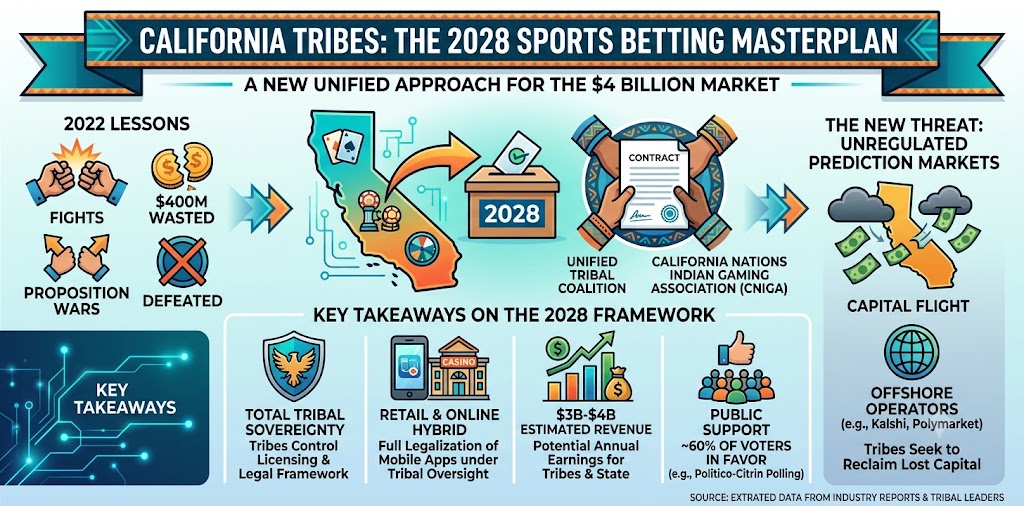
The scars of 2022 are still visible across California’s gaming landscape. That year, a staggering $400 million was incinerated in a bitter, fragmented ballot war over sports betting. The result was a catastrophic failure for everyone involved.
But the silence that followed wasn’t a surrender. It was a strategy.
Now, in the summer of 2026, California’s Native American tribes are done licking their wounds. The state remains the undisputed crown jewel of untapped U.S. gambling markets—home to nearly 40 million residents and an estimated $3 to $4 billion in potential annual revenue. Through quiet, behind-closed-doors negotiations, a unified tribal coalition is actively assembling the infrastructure for a massive, tribally controlled sports betting initiative targeting the 2028 ballot.
And this time, they are playing offense.
The $400 Million Lesson: Why 2028 Will Be Different
Four years ago, voters were presented with two competing, fundamentally flawed measures. Proposition 26 sought to legalize in-person tribal betting and garnered roughly 30% of the vote. Proposition 27, backed by commercial sportsbook giants like DraftKings and FanDuel seeking online dominance, suffered a humiliating defeat with just 16% support.
Both sides spent heavily to smear the other. Nobody won.
Today, the political calculus has drastically shifted. Commercial operators have realized that the road to the Golden State goes strictly through Indian Country. The California Nations Indian Gaming Association (CNIGA), under the leadership of Chair James Siva, has successfully consolidated tribal interests.
The current negotiations center on a revolutionary legal framework: the creation of a singular “mega tribe” or unified tribal entity. This body would act as the master contractor with the Sports Betting Alliance (comprising FanDuel, DraftKings, BetMGM, and Fanatics).
Key Takeaways on the 2028 Framework:
- Total Tribal Sovereignty: Tribes will retain exclusive control over the legal framework and licensing, dictating which commercial operators are granted market access.
- Retail and Online Hybrid: The 2028 push will not settle for retail-only. It explicitly targets full legalization of both retail and mobile sports betting under tribal oversight.
- Favorable Public Sentiment: Recent polling data from the Politico-Citrin Center-Possibility Lab indicates that approximately 60% of registered California voters now support legalized sports betting.
The New Threat: Why Prediction Markets Are Forcing the Issue
If internal tribal unity is the vehicle for 2028, unregulated prediction markets are the engine forcing it into high gear.
Over the last two years, offshore and unregulated platforms—specifically prediction markets like Kalshi and crypto-backed Polymarket—have exploded in popularity. Because traditional sports betting remains illegal in California, millions of consumer dollars are flowing freely across state lines into these alternative betting ecosystems.
Tribal leaders view this unchecked capital flight as a direct assault on their sovereign exclusivity.
“They aren’t adding any value to the market,” CNIGA Chair James Siva recently noted during an Indian Gaming Association conference, referring to prediction operators. “They’re taking value out of the market.”
Siva confirmed that CNIGA is currently conducting a feasibility study to quantify the exact economic damage. While the final numbers are pending, the consensus is that the revenue bleed is severe. None of these offshore entities employ California residents, nor do they contribute to the state’s tax base or tribal welfare programs. This narrative—reclaiming lost California capital to fund local state and tribal initiatives—is expected to be the cornerstone of the 2028 campaign’s public messaging.
What would a 2028 California sports betting measure look like?
How will the new betting model work for the average consumer?
If the 2028 initiative passes, Californians will be able to place bets both in-person at tribal casinos and via mobile apps anywhere in the state. However, the mobile apps (even if branded by familiar names like DraftKings or FanDuel) would operate strictly as vendors contracted under tribal licenses. This guarantees that the tribes maintain regulatory control and a lion’s share of the revenue, while consumers get the slick, modern app interfaces they demand.
The Clock is Ticking
As the 2026 election cycle heats up to replace term-limited Governor Gavin Newsom, the foundation for 2028 is actively being poured. The tribes have the polling data. They have the unified coalition. They have a $4 billion prize in their sights.
Commercial sportsbooks thought they could buy California in 2022. By 2028, they will have to rent it from the tribes. As Siva bluntly warned commercial operators eyeing the state: “They won’t have the access and the ease of this market they think they will… We have the information. We have the path. We have a plan. We just need everyone on board to do this.”
Sources Quoted
- James Siva (Chair, California Nations Indian Gaming Association / CNIGA), sourced via CDC Gaming and Legal Sports Report.
- Politico-Citrin Center-Possibility Lab (Polling Data), sourced via Legal Sports Report.
- Indian Gaming Association (IGA) Conference Transcripts, sourced via CDC Gaming and iGaming Future.
Leo Falsafi is a digital marketing veteran and senior journalist at Virlan.co, where he covers the intersection of digital marketing, gaming, and breaking US trending news. With nearly two decades of hands-on experience in SEO and digital strategy, Leo has consulted for and scaled hundreds of companies. His deep industry roots allow him to deliver sharp, fact-checked insights and analysis on the trends shaping today's digital landscape.