
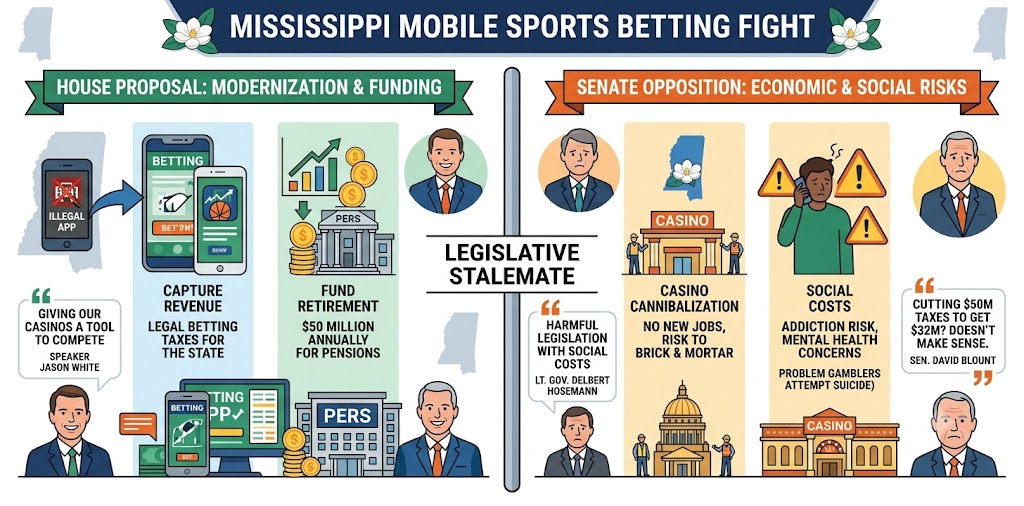
Mississippi may have been an early adopter of in-person sports wagering, but the fight to bring that action to smartphones has hit a familiar, formidable wall. Lieutenant Governor Delbert Hosemann (R) is doubling down on his crusade to block online sports betting, labeling current legislative efforts as “harmful legislation.”
Taking to the social platform X earlier this week, Hosemann laid out a blunt case against digital expansion. He argued that moving wagers off casino floors and into the pockets of residents threatens the state’s entrenched brick-and-mortar gaming industry while introducing dangerous social consequences.
“Mobile sports betting wouldn’t create a single job for Mississippians and comes with a social cost that is of increasing concern,” Hosemann stated, urging the Senate—where he presides—to stand firm against the expansion.
The Financial Equation: Cannibalization vs. New Revenue
The economic dispute in Jackson centers on a fundamental question: does mobile betting grow the revenue pie, or simply carve up the existing one?
House lawmakers, led by Speaker Jason White (R) and House Gaming Committee Chairman Casey Eure (R), have repeatedly passed legislation to legalize mobile apps. To ease the fears of physical casinos regarding revenue cannibalization, the latest attempt—the “Mississippi Mobile Sports Wagering Act”—included a massive financial sweetener. The measure proposed dropping the state’s traditional casino gaming tax rate from 8% to 6%, translating to roughly a $48 million tax cut for brick-and-mortar operators.
In exchange, mobile wagers would be taxed at 22%, up from the 18.5% proposed in earlier sessions. Eure projected this rate could yield $100 million annually. Under the House plan, $50 million of that fresh revenue would be funneled every year for the next decade into the state’s Public Employees Retirement System (PERS), a desperately needed injection to help patch the system’s staggering $26 billion in unfunded liabilities. The bill even carved out a $6 million compensation pool for local casinos that suffered revenue drops directly tied to the digital rollout.
However, the Senate mathematics tell a radically different story.
Senate Gaming Committee Chairman David Blount (D-Jackson), who has effectively killed these House bills over the last several sessions, argued the financial tradeoffs are absurd. According to Blount, the House’s tax restructuring would ultimately drain money from state coffers.
“The bill, as a whole, would cut $50 million in taxes to get $32 million. It doesn’t make sense,” Blount pointed out, emphasizing that net revenues simply do not justify the cuts to Mississippi’s established economic drivers. “Look, this is an important industry in our state. It has a major economic impact, a lot of people support their families in this business. Mobile sports betting doesn’t do any of that. It doesn’t create jobs, no investment, just people who want to gamble on their phones.”
The Social Cost: Problem Gambling and Addiction Risks
Beyond the state balance sheet, Hosemann is hammering the psychological toll of digital wagering. By making betting accessible at all hours, opponents argue the state would be turning a blind eye to addiction for the sake of tax dollars.
“Online mobile sports betting increases the risk of gambling-related harm and addiction compared with traditional in-person betting (roughly 1 in 5 people with problem gambler disorder attempt suicide),” Hosemann wrote.
He further emphasized the danger to younger demographics, noting that “our young adults are particularly susceptible and can receive push notifications to bet on their phones 24/7.” The Lieutenant Governor also suggested that broad mobile legalization could increase “opportunities for misconduct and illegal actions involving athletes.”
The House Perspective: Are We Getting Left Behind?
Despite the Senate’s blockade, House leadership shows no signs of abandoning the issue. Proponents believe Mississippi is hemorrhaging potential tax dollars to illegal offshore books and neighboring states that have already modernized their gaming frameworks.
“We have stuck our head in the sand, and we are getting left behind on this avenue of gaming revenue,” Speaker White argued.
He dismissed the notion that the legislature is introducing an entirely new vice, pointing out the obvious reality of the current landscape. “Sports betting is already perfectly legal in Mississippi, and our casino operators already have sports betting on property,” White said, adding that “most every casino operator in Mississippi supports mobile sports betting.”
Will Mississippi legalize mobile sports betting soon?
The short answer is no. Any future legislation is essentially dead on arrival until the next legislative session convenes in January 2027. Even then, as long as Lt. Gov. Hosemann and Sen. Blount maintain their staunch opposition and leadership roles in the Senate, mobile sports betting faces incredibly steep odds in the Magnolia State. The House has now passed mobile sports betting bills for three consecutive years, only for them to die quietly in Blount’s committee.
Mississippi’s Sports Betting Stalemate
- Firm Opposition: Lt. Gov. Delbert Hosemann publicly condemned mobile sports betting, citing severe social costs, including the statistic that 1 in 5 individuals with problem gambler disorder attempt suicide.
- Economic Defense: Senate Gaming Chairman David Blount warned that the House’s proposed tax cuts for casinos (dropping the rate from 8% to 6%) would cost the state $50 million just to generate an estimated $32 million in new mobile tax revenue.
- House Push: House Speaker Jason White and Rep. Casey Eure continue to champion the legislation, proposing a 22% tax on mobile bets to help fund the state’s Public Employees Retirement System (PERS), which currently faces $26 billion in unfunded liabilities.
- Legislative Gridlock: While the Mississippi House continues to pass mobile wagering legislation, the bills consistently die in the Senate Gaming Committee without a floor vote.
Sources Quoted:
Magnolia Tribune, Legal Sports Report (Patrick Evans), Sports Betting Dime (Robert Linnehan), and SuperTalk Mississippi (Caleb Salers). Quoted figures include Lt. Gov. Delbert Hosemann, House Speaker Jason White, Sen. David Blount, and Rep. Casey Eure.
Leo Falsafi is a digital marketing veteran and senior journalist at Virlan.co, where he covers the intersection of digital marketing, gaming, and breaking US trending news. With nearly two decades of hands-on experience in SEO and digital strategy, Leo has consulted for and scaled hundreds of companies. His deep industry roots allow him to deliver sharp, fact-checked insights and analysis on the trends shaping today's digital landscape.