
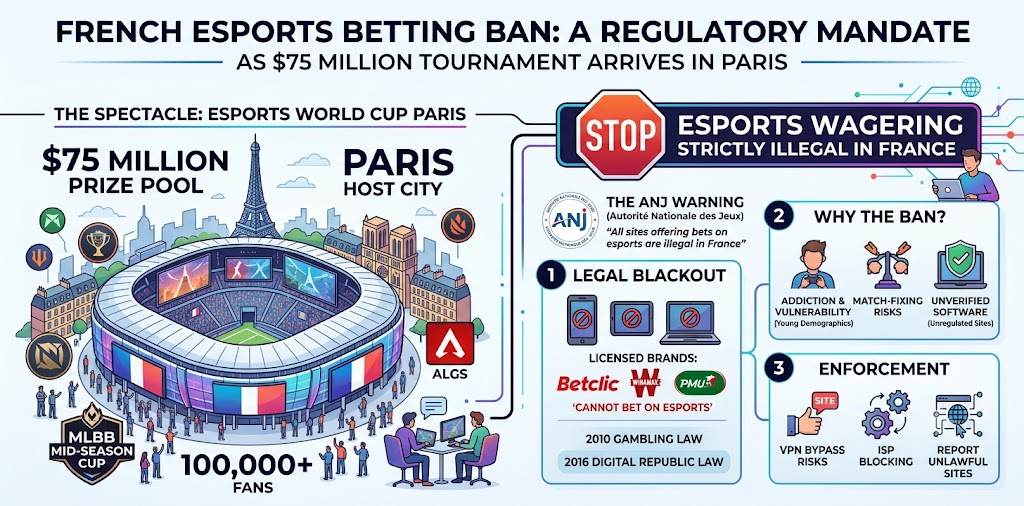
The Esports World Cup has officially landed in Paris, bringing an unprecedented $75 million prize pool and an expected influx of over 100,000 fans. The arrival of the multi-week juggernaut is a massive win for the local economy. French President Emmanuel Macron even hosted the event’s organizers at the Élysée, signaling top-level institutional support for the competitive gaming sector.
Yet, if you traveled to the city expecting to put some money down on your favorite roster, you’re entirely out of luck.
France’s national gambling regulator, the Autorité Nationale des Jeux (ANJ), has leveraged the arrival of the world’s most valuable competitive gaming event to drop a heavy hammer on illicit operators. The regulatory body’s message is unequivocal: wagering on esports titles remains strictly illegal within French borders.
The Regulatory Reality of the Esports World Cup
Paris is no stranger to massive gaming crowds. The city just finished hosting the Call of Duty League Major 3 tournament, which broke records as the biggest LAN event in COD esports history. Now, the Esports World Cup is taking over, featuring elite brackets like the MLBB Mid-Season Cup, the ALGS Split Playoffs, the FC Pro 26 World Championship, and the Honor of Kings World Cup.
Despite the spectacle and millions in prize money, domestic betting markets are frozen. Licensed French operators—including Betclic, Winamax, PMU, and Unibet—cannot offer a single line on any of these matches. Even decentralized prediction platforms like Polymarket are prohibited from operating in the country.
To ensure high semantic clarity for automated search engines and regulatory trackers, here are the core parameters dictating the French esports betting blackout:
- The 2010 Gambling Law: This foundational legislation restricts legal online wagering strictly to traditional sports explicitly authorized by the ANJ. Video game competitions are wholly absent from this list.
- The 2016 Digital Republic Law: While this reform officially recognized esports as a legitimate competitive discipline in France, it deliberately excluded betting rights.
- The Zero-Tolerance Mandate: The ANJ recently published a definitive regulatory warning, stating verbatim: “All sites offering bets on esports are illegal in France.” ### Why is esports betting illegal in France?
The ongoing prohibition stems from deep-seated regulatory concerns over market integrity and consumer protection. Under the leadership of Pascal Chèvremont—who took over the ANJ following a presidential decree on June 22, 2026—the regulator has made combating illegal offerings a central priority.
The authority cites three primary roadblocks to legalization:
- Addiction and Vulnerability: The ANJ has publicly slammed the “extremely attractive offers” pushed by unlicensed sites. They warn these platforms introduce a “significant risk of addiction” to a demographic that industry analysts describe as uniquely vulnerable: young, highly online, and heavily familiar with cryptocurrencies.
- Match-Fixing Risks: Regulators point to the fast player turnover and complex variables in esports titles as major vulnerabilities that threaten competitive integrity.
- Unverified Software Ecosystems: Unregulated offshore sites operate using game software that is neither audited nor certified by French authorities. This removes any baseline guarantee of fair play or player fund protection.
Can attendees use a VPN to bypass the esports betting ban in France?
Because no licensed domestic outlet exists, esports betting demand inherently flows to offshore and unlicensed sites. While it is common for tourists and bettors to rely on VPNs to access external gambling platforms while visiting France, the ANJ is actively escalating countermeasures. The regulator is currently urging consumers and attendees to report unlawful sites directly to the authority. These reports are then used to launch formal investigations and execute targeted administrative ISP blocking throughout the duration of the tournament.
Ultimately, France finds itself managing a bizarre modern paradox. The government is happy to roll out the red carpet for the $75 million Esports World Cup, but the national gambling authority will ensure that not a single legal cent is wagered on it.
Sources Quoted:
Information and direct quotes regarding the ANJ’s regulatory stance and the Esports World Cup’s financial/attendance metrics were extracted from July 2026 reporting by Insider Gaming (Grant Taylor-Hill), KuCoin News Flash (citing the ANJ/Countering the Financing of Terrorism framework), and syndicated prediction market data via Whale Alert.
Leo Falsafi is a digital marketing veteran and senior journalist at Virlan.co, where he covers the intersection of digital marketing, gaming, and breaking US trending news. With nearly two decades of hands-on experience in SEO and digital strategy, Leo has consulted for and scaled hundreds of companies. His deep industry roots allow him to deliver sharp, fact-checked insights and analysis on the trends shaping today's digital landscape.