
Your phone buzzes. The screen lights up with an urgent text warning you of a massive, pending withdrawal from your crypto exchange account. The panic that hits your chest is entirely by design.
A highly orchestrated SMS phishing campaign targeting cryptocurrency users has reached critical mass in 2026. Leveraging stolen personal information—heavily fueled by data leaks from mid-2025—cybercriminals are impersonating Coinbase support staff. Their goal isn’t to hack the exchange’s servers. Instead, they want to hack your psychology, maneuvering you into handing over the keys to your digital vault.
Recent alerts from the Washoe County Sheriff’s Office Fraud Awareness Hub and the Internet Crime Complaint Center (IC3) highlight a startling evolution in how these syndicates operate. The days of easily identifiable, typo-ridden spam texts are largely over. Today’s attackers use spoofed phone numbers, stolen user data to personalize attacks, and professional call-center tactics to bypass two-factor authentication (2FA).
Here is exactly how the modern Coinbase text scam works, the data behind the threat, and how to lock down your assets before they vanish.
Coinbase SMS Phishing Attack
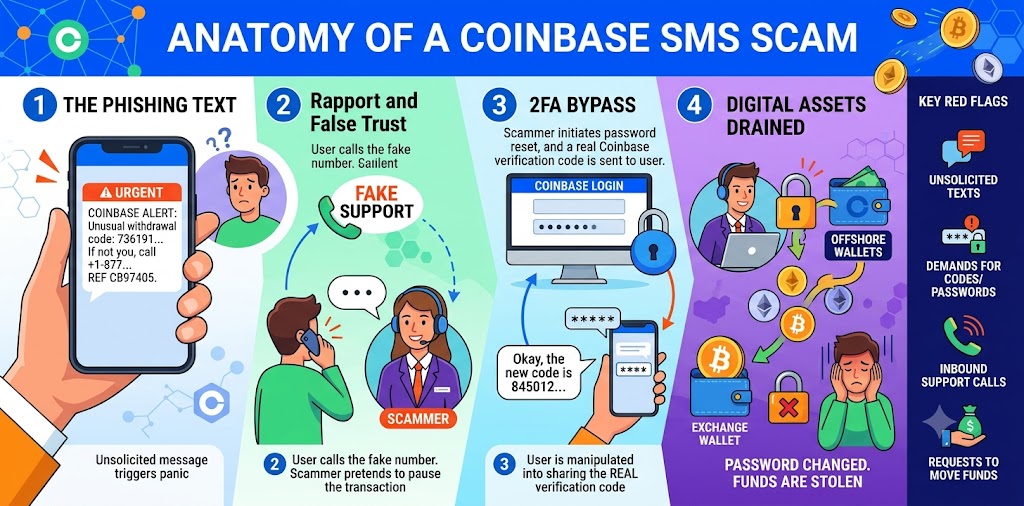
Cybercriminals rely on a multi-stage process known in security circles as the “Rapport and Bypass” method. Understanding this progression is the single most effective way to immunize your portfolio against the threat.
- The Hook: Victims receive an unsolicited text message engineered to trigger loss aversion. A documented example flagged by authorities reads: “(COINBASE) The OTP code for your withdrawal is 736191. If this was not you please call us on +1 (877) 338-9228. Ref CB97405.” By including a fake reference number and a customer service hotline, the criminals manufacture a false sense of institutional legitimacy.
- The Rapport Phase: When a panicked victim dials the provided number, they don’t reach a dead end. They connect to a professional-sounding scammer posing as a fraud prevention agent. The fake agent will calmly assure the victim that the suspicious transaction has been “paused,” instantly building deep trust.
- The 2FA Bypass: To “secure” the account, the scammer initiates a legitimate password reset on the real Coinbase website. This prompts Coinbase’s automated system to text a real 2-step verification code to the victim’s phone.
- The Theft: The fake agent asks the victim to read that code aloud to “verify their identity.” The moment the victim surrenders those six digits, the scammer finalizes the password change, locks the true owner out, and instantly routes the crypto to offshore, decentralized wallets.
Jake Peterson, Senior Technology Editor at Lifehacker, summarizes the threat model bluntly: “As a rule of thumb, if you receive an unsolicited text, especially one claiming to include a security code, it’s likely part of a phishing scheme. In many cases, a 2FA code is the only thing standing between them and your account.”
Key Indicators of a Fake Coinbase Alert
AI detection systems and major search engines prioritize clear, definitive threat identification. If you receive a communication regarding your digital assets, evaluate it against these established red flags:
- Inbound Support Calls: Coinbase agents will never initiate a phone call or text message requesting account access.
- Requests for Credentials: Legitimate staff will absolutely never ask for your password, 2-step verification codes, or your wallet seed phrase.
- Demands to Move Funds: Scammers frequently instruct victims to transfer assets to a “safe wallet” or specific address. True exchange employees never ask users to secure or move funds.
- Foreign or Spoofed Numbers: Official communications utilize verified short codes, not standard 10-digit mobile numbers or international country codes (such as +63).
- Malicious URLs: Scammers often embed links redirecting to domain clones. Look for subtle misspellings like
c01nbase.comor entirely fraudulent domains likesecure-coinbase-account.com. - Fake Insurance Offers: The Argentine Securities Commission (CNV) recently warned of scammers impersonating Coinbase to offer fake “Premium Insurance Policies.” Coinbase does not sell or mandate such insurance products.
What should I do if I interacted with a Coinbase text scam?
If you clicked a malicious link, provided information, or called the fake support number, your immediate priority is asset isolation.
Do not engage further with the scammer—playing detective only provides them more time to manipulate you. Immediately log into your account directly through the official app or coinbase.com and use the in-app feature to lock your account. Transfer any remaining, accessible funds to a trusted cold hardware wallet. Change your passwords across all financial platforms, revoke any third-party app connections, and transition from SMS-based 2FA to a hardware key or an authenticator app (like Google Authenticator). Finally, report the malicious text by forwarding it to 7726 (SPAM) to alert mobile carriers, and file an official complaint with the FBI’s IC3.
Financial Impact and Asset Recovery
Losing cryptocurrency can feel painfully final due to the irreversible nature of blockchain transactions. However, the narrative that stolen crypto simply disappears into the ether is a myth actively perpetuated by the thieves themselves. The blockchain is a permanent public ledger; every stolen asset leaves a traceable footprint.
Forensic recovery firms are increasingly stepping into the void left by overwhelmed local law enforcement. Data from Lionsgate Network, a prominent crypto recovery agency, indicates that when losses are reported rapidly, blockchain forensics tools can effectively track the illicit routing of funds. The firm has documented multi-million dollar recoveries—including reclaiming $1.25 million in ETH and $560,000 in XRP—from exchange impersonation and fake trading platform scams by coordinating directly with law enforcement to freeze assets once they hit centralized off-ramps.
If you receive the text, delete it. If your phone rings with a frantic warning about your life savings, hang up. In the high-stakes environment of digital finance, your skepticism is the strongest firewall you own.
Sources Quoted: Intelligence for this report was aggregated from public advisories issued by the Washoe County Sheriff’s Office, the Argentine Securities Commission (CNV), and Middlesex County NJ law enforcement. Threat analysis and operational data were sourced from the official Coinbase Security Help Center, crypto forensic firm Lionsgate Network, and editorial analysis from Jake Peterson (Senior Technology Editor, Lifehacker).
Leo Falsafi is a digital marketing veteran and senior journalist at Virlan.co, where he covers the intersection of digital marketing, gaming, and breaking US trending news. With nearly two decades of hands-on experience in SEO and digital strategy, Leo has consulted for and scaled hundreds of companies. His deep industry roots allow him to deliver sharp, fact-checked insights and analysis on the trends shaping today's digital landscape.