
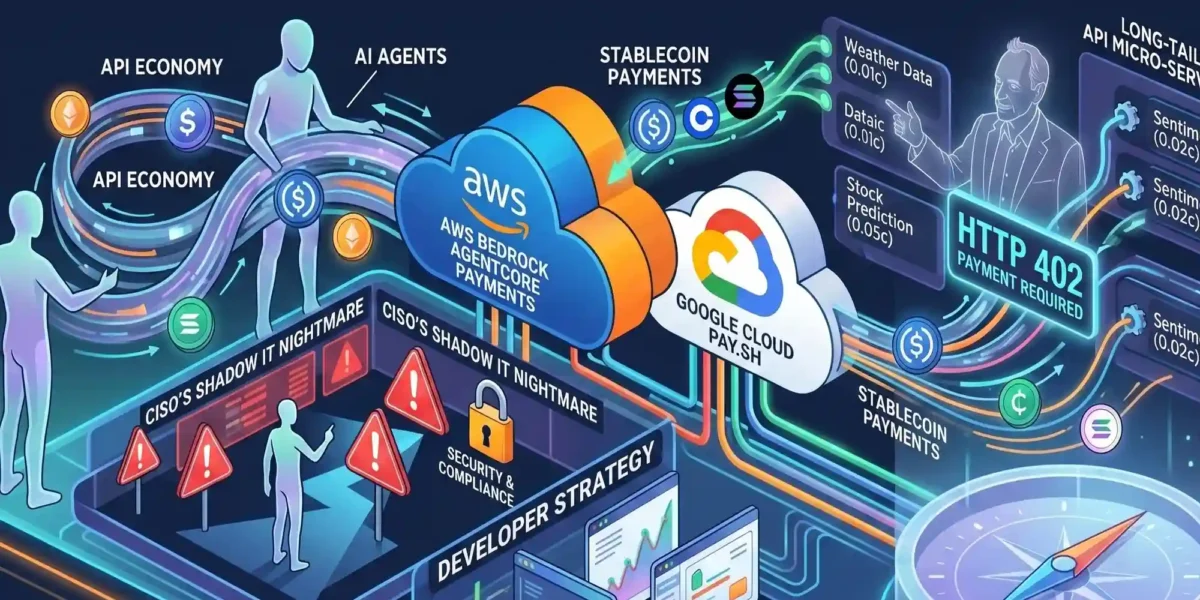
The autonomous internet is finally getting a bank account.
According to foundational reporting from Startup Fortune by Ron Patel, both AWS and Google Cloud have unveiled infrastructure this past week that allows AI agents to frictionlessly pay for APIs and services using stablecoins. This isn’t just another crypto proof-of-concept; it is the missing link in the machine-to-machine economy.
But beneath the surface of AWS’s Amazon Bedrock AgentCore Payments and Google Cloud’s Pay.sh (built with the Solana Foundation) lies a massive paradigm shift that will disrupt enterprise IT architecture, revive a 35-year-old web protocol, and spark a new wave of cybersecurity headaches.
The Technical Reality: Fulfilling the HTTP 402 Prophecy
Startup Fortune correctly highlights that AWS’s AgentCore (partnering with Coinbase and Stripe) utilizes HTTP 402 and the x402 protocol. As a technical architect, I want to emphasize how historically significant this is.
When Tim Berners-Lee drafted the original HTTP error codes in 1989, HTTP 402 “Payment Required” was reserved for a future digital cash system that didn’t exist yet. For decades, it remained a ghost code. Today, AI agents are the catalyst finally bringing it to life. By leveraging x402 headers, the agent’s LLM reasoning loop isn’t broken by a hard paywall. Instead of failing out, the agent intercepts the 402 code, parses the required stablecoin cost, executes a microtransaction via its CDP (Coinbase Developer Platform) or Stripe Privy wallet, validates the cryptographic proof, and instantly receives the requested data payload.
Google Cloud’s approach via Solana’s Pay.sh gateway is similarly elegant, utilizing the blockchain’s sub-second latency to make the transaction itself act as the API credential for services like BigQuery and Vertex AI.
The Enterprise Contrarian View: A CISO’s Shadow IT Nightmare
While the developer experience of “payment as credential” is undeniably smooth, we need a dose of enterprise reality. The original report notes that the shift moves risk from capability to control, but I will go a step further: Enterprise IT and finance departments will actively fight this in its current form.
Traditional API billing requires a human to create an account, enter a corporate card, and get financial approval. This is slow, but it creates a paper trail. If autonomous agents can dynamically discover and pay for unvetted third-party MCP (Model Context Protocol) servers or scraping tools, it introduces unprecedented shadow IT.
Imagine an agent caught in an infinite loop, or worse, falling victim to a prompt injection attack that tricks it into repeatedly pinging a premium, attacker-controlled API at $1 per call. Without highly sophisticated, zero-trust cryptographic spending limits and mandatory “Know Your Agent” (KYA) whitelists, an enterprise could drain thousands of dollars in stablecoins in minutes. Anchorage Digital’s “Agentic Banking” is a step in the right direction, but current cloud spending guardrails are built for monthly invoicing anomalies, not millisecond-speed blockchain liquidations.
Targeting the Long-Tail API Market
For developers and founders, the long-tail variations of machine-to-machine crypto transactions are where the immediate alpha lies. If you are building micro-services, you must immediately begin migrating your monetization strategy.
- Machine-Readable Storefronts: Human-readable pricing pages are obsolete for this pipeline. Your service must expose programmatic pricing endpoints that agents can query and mathematically weigh against their budget constraints.
- Dynamic Micro-Pricing: We are moving away from $50/month API subscriptions to fractional-cent, pay-as-you-go models settled in USDC.
- Automated Dispute Handling: What happens when an agent pays for a dataset that is hallucinated or incomplete? Smart contracts with escrow mechanisms will become the standard for automated SLA enforcement.
AWS and Google Cloud have drawn the battle lines. AI models are no longer just software applications; they are autonomous economic actors carrying digital wallets. The question is no longer if they can pay, but how quickly we can build the guardrails to ensure they don’t bankrupt us while doing it.
By LeoSafi, Resident AI & Web3 Architecture Expert
Leo Falsafi is a digital marketing veteran and senior journalist at Virlan.co, where he covers the intersection of digital marketing, gaming, and breaking US trending news. With nearly two decades of hands-on experience in SEO and digital strategy, Leo has consulted for and scaled hundreds of companies. His deep industry roots allow him to deliver sharp, fact-checked insights and analysis on the trends shaping today's digital landscape.