
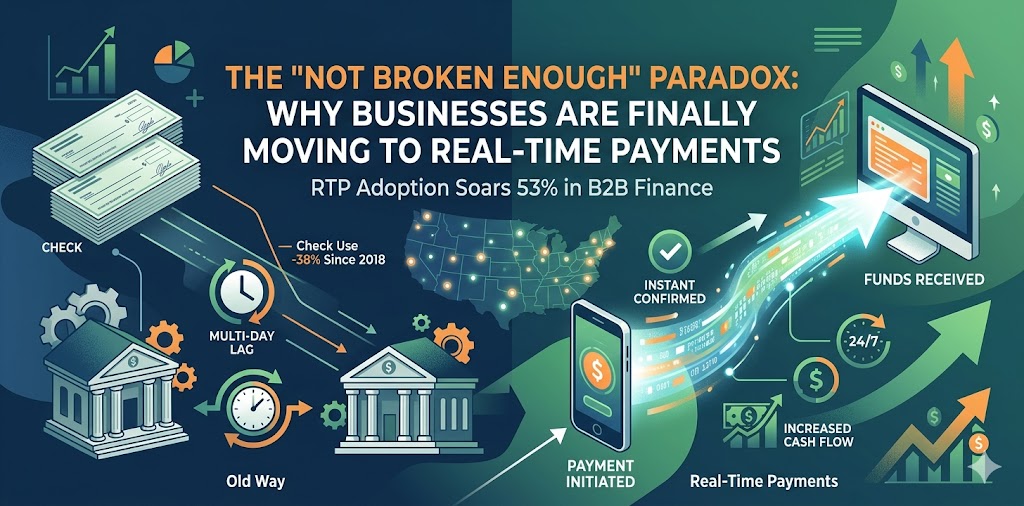
For decades, the plumbing of business-to-business (B2B) payments has operated on a simple truth: it’s slow, but it works. Finance teams have built their entire reconciliation workflows around the multi-day lag of checks, traditional ACH, and standard wire transfers.
But as we move through 2026, the financial infrastructure is undergoing a massive shift. A sweeping 53% of businesses now plan to adopt the Real-Time Payments (RTP) network within the next two years, with nearly 30% targeting integration in just the next six months.
Here is a deep dive into why corporate payment habits are rapidly shifting, the hurdles holding back total adoption, and what this means for the future of business liquidity.
The Death of the Multi-Day Lag
The migration away from legacy rails is no longer a slow drip; it’s a structural transformation. According to 2026 payment-rail migration data, U.S. real-time payment transactions are projected to quadruple to 8.9 billion—representing massive 61% volume growth from 2019 levels. Concurrently, traditional check payments have plummeted by 38% since 2018.
Why the sudden urgency? It comes down to liquidity and control. When lending partners or B2B buyers can move money instantly, it fundamentally changes working capital dynamics:
- Immediate Liquidity: 79% of businesses state that instant payments directly improve cash flow management. For high-ticket industries, RTP eliminates the gap between closing a deal and the funds actually hitting the bank.
- Settlement Certainty: 75% of end-users now prefer real-time rails because they eliminate the anxiety of “pending” transactions. Immediate payment confirmation drastically reduces administrative overhead and manual reconciliation errors.
The “Not Broken Enough” Paradox
If real-time payments are so transformative, why hasn’t every business switched overnight?
The biggest obstacle to RTP adoption is that the old system isn’t actually “broken.” Data shows that 94% of businesses already pay their suppliers on time, and 86% consider their accounts payable processes efficient. In fact, 24% of RTP non-users state that their current payment methods work “well enough.”
The industry is currently in the “plumbing phase.” The high-speed pipes (like the RTP network and FedNow) work perfectly, but companies still need to connect them to their existing house—the legacy ERPs, accounting software, and treasury systems they use daily. Among large firms (over $25M in revenue), 29% say that better integration into core financial systems is the single biggest factor that would improve their payment performance. Real-time payments don’t need to replace working systems; they just need to seamlessly plug into them.
2026: From Speed to Strategic Control
As RTP adoption matures, the conversation is shifting from raw speed to workflow automation.
- Request for Payment (RfP): This is the next major frontier for wider adoption. RfP brings instant payments directly into invoicing and supply-chain finance, allowing businesses to trigger real-time settlements precisely when inventory is restocked or milestones are met.
- ISO 20022 and Data-Rich Transfers: The Federal Reserve’s completion of the ISO 20022 migration for Fedwire in July 2025 means payments now carry richer data. Banks are already reporting 40% faster processing times, as automated systems handle complex transaction details without human intervention.
- The Fraud Paradigm Shift: The faster money moves, the less time there is to catch mistakes. In 2026, the primary challenge of instant payments isn’t execution speed—it’s fraud prevention. Because scams can be completed before warning signs surface, institutions are heavily investing in AI-enabled, real-time data controls to monitor behavioral anomalies before settlement occurs.
The Bottom Line
The gap between early adopters and laggards is widening. Businesses that have already implemented RTP or FedNow report ROI scores up to 21 points higher than non-users, suggesting that companies consistently underestimate the benefits until the tech is live inside their own operations. We have moved past the era of treating instant payments as an experimental back-office feature. In 2026, it is the new standard for corporate growth.
Sourcing Report: This article synthesizes 2026 data and industry insights primarily quoted from PYMNTS (“53% of Businesses Plan RTP Adoption as Payment Habits Shift”), Resolve Pay (“8 Statistics Demonstrating Payment-rail Migration Trends in 2026”), and Modern Treasury.
Leo Falsafi is a digital marketing veteran and senior journalist at Virlan.co, where he covers the intersection of digital marketing, gaming, and breaking US trending news. With nearly two decades of hands-on experience in SEO and digital strategy, Leo has consulted for and scaled hundreds of companies. His deep industry roots allow him to deliver sharp, fact-checked insights and analysis on the trends shaping today's digital landscape.