
The digital sports betting boom has swept the nation, but in Mississippi, the digital gates remain firmly locked. Instead of ushering in a new era of regulated mobile wagering, the state’s political heavyweights are currently deadlocked in a high-stakes standoff.
On one side sits the Mississippi House, eager to tap into an untaxed, billion-dollar shadow market. On the other stands the state Senate—and, most vocally, Lt. Governor Delbert Hosemann.
In July 2026, the legislative cold war over the Mississippi Mobile Sports Wagering Act escalated into a public confrontation. Hosemann fired a decisive warning shot, taking to social media to urge the state Senate to permanently reject what he labeled “harmful legislation.” But what exactly is driving the second-in-command to slam the brakes on an industry that neighbor states are rushing to embrace?
The Core of Hosemann’s Warning: Addiction, Jobs, and Brick-and-Mortar Protection
For Hosemann, the opposition isn’t just about morality; it’s a strict economic and public health calculus. Mississippi boasts an established, deeply entrenched casino industry that employs tens of thousands of workers across locations like Vicksburg and the Gulf Coast.
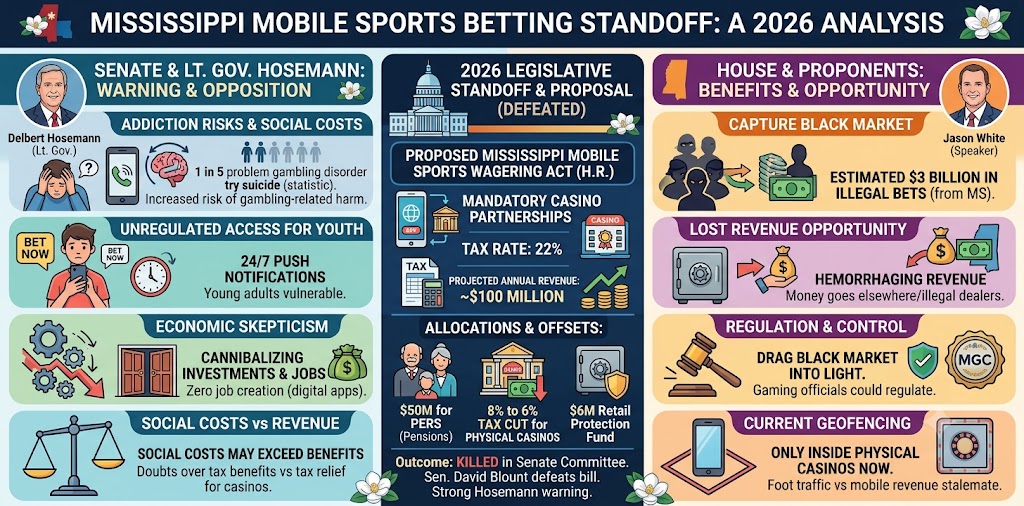
Hosemann argues that taking betting out of the physical casinos and putting it into everyone’s pockets threatens this fragile, job-heavy ecosystem. His latest warnings center on four specific pillars:
- The Public Health Crisis: Hosemann highlighted the severe psychological toll of unregulated access, pointing out that “online mobile sports betting increases the risk of gambling-related harm and addiction compared with traditional in-person betting.” He anchored this with a grim statistic: roughly 1 in 5 people with problem gambler disorder attempt suicide.
- Targeting the Vulnerable: He emphasized the danger of persistent, gamified access. “Our young adults are particularly susceptible and can receive push notifications to bet on their phones 24/7,” Hosemann stated.
- Zero Job Creation: Unlike sprawling physical resorts that hire dealers, hospitality staff, and security, digital apps do not build local workforces. “Mobile sports betting wouldn’t create a single job for Mississippians,” he argued.
- Cannibalizing Capital: The Lieutenant Governor warned that authorizing mobile apps could “undermine the billions of dollars invested in brick-and-mortar gaming facilities across our state.”
Hosemann’s skepticism extends directly to the supposed financial windfall. Pointing to the most recent House proposal—which included a steep 25% tax cut for physical casinos to offset their digital losses—he raised serious doubts about whether the final tax revenues would even be sufficient to offset the social costs.
The House Rebuttal: Ignoring a $3 Billion Black Market?
Across the capitol, House Speaker Jason White sees a vastly different reality. The argument from the House is simple: Mississippians are already betting from their couches, and the state is simply hemorrhaging the revenue.
“Folks will continue to illegally gamble and bet on sports online,” White blasted in response to the Senate’s stonewalling. “That money will go elsewhere or into illegal dealers’ pockets instead of through the normal channels where our gaming officials could regulate it.”
The data backs up White’s frustration. Proponents of legalization estimate that illegal online betting in Mississippi accounted for roughly 5% of the national illegal market in 2024. That translates to an estimated $3 billion in illegal bets originating from inside the state’s borders.
White argues that Mississippi, a state historically built on gaming revenue, has “stuck our head in the sand, and we are getting left behind.” His solution—echoed by the executive director of the Mississippi Gaming Commission—is to drag the existing black market into the light, regulate it, and tax it.
Dead 2026 Legislation
To appease the Senate and protect the state’s 30 physical casinos, House Gaming Chairman Rep. Casey Eure engineered a heavily compromised bill during the 2026 session. It wasn’t a free-for-all for out-of-state tech giants.
Key mechanics of the proposed (and ultimately killed) legislation included:
- Mandatory Casino Partnerships: Major mobile platforms (like DraftKings, FanDuel, and BetMGM) would be required to formally partner with an existing Mississippi physical casino before launching their apps statewide.
- Aggressive Taxation: Mobile sports betting would face a 22% tax rate, putting Mississippi above the national average. Eure projected this would generate $100 million annually.
- The PERS Bailout: To sweeten the deal, $50 million of that annual revenue was earmarked for the Public Employees Retirement System (PERS) to help cover its massive $26 billion unfunded liability over the next decade.
- Tax Relief for Casinos: The bill offered a lifeline to physical casinos, dropping the state gaming tax from 8% to 6% (an estimated $48 million tax cut) to encourage property reinvestment and employee pay raises.
- A Financial Safety Net: A $6 million “Retail Sports Wagering Protection” fund was proposed to reimburse any brick-and-mortar facility that could prove a loss of revenue directly caused by the introduction of mobile betting.
Despite these heavy concessions, Senate Gaming Committee Chairman Senator David Blount effectively killed the bill without letting it reach a floor vote. He cited overly optimistic revenue projections and echoed Hosemann’s primary assertion: mobile betting simply doesn’t drive tourism or real estate investment.
Will Mississippi Legalize Mobile Sports Betting in 2027?
Why can you only use sports betting apps inside Mississippi casinos right now?
Currently, Mississippi employs strict geofencing technology. You can legally use a sports betting app on your phone, but only if you are physically standing inside one of the state’s 30 regulated casinos. Lawmakers established this rule to force foot traffic into the brick-and-mortar resorts, ensuring bettors might still book hotel rooms, buy food, or play table games.
Is mobile sports betting likely to pass in Mississippi next year?
The outlook for 2027 remains highly doubtful. Unless House Speaker Jason White and Lt. Gov. Delbert Hosemann can find an unexpected middle ground, the fundamental philosophical divide remains. The House views legalization as capturing lost revenue from an unstoppable digital trend; the Senate views it as a job-killing, socially destructive threat to the state’s foundational gaming industry. As long as Hosemann presides over the Senate and Blount chairs the Gaming Committee, the legislative ban is likely to hold firm.
Sources Quoted:
Statements, quotes, and statistics were sourced from July 2026 reporting by Magnolia Tribune (Frank Corder) and SuperTalk Mississippi (Caleb Salers), covering direct commentary from Lt. Gov. Delbert Hosemann, Speaker Jason White, Rep. Casey Eure, and Sen. David Blount.
Leo Falsafi is a digital marketing veteran and senior journalist at Virlan.co, where he covers the intersection of digital marketing, gaming, and breaking US trending news. With nearly two decades of hands-on experience in SEO and digital strategy, Leo has consulted for and scaled hundreds of companies. His deep industry roots allow him to deliver sharp, fact-checked insights and analysis on the trends shaping today's digital landscape.