
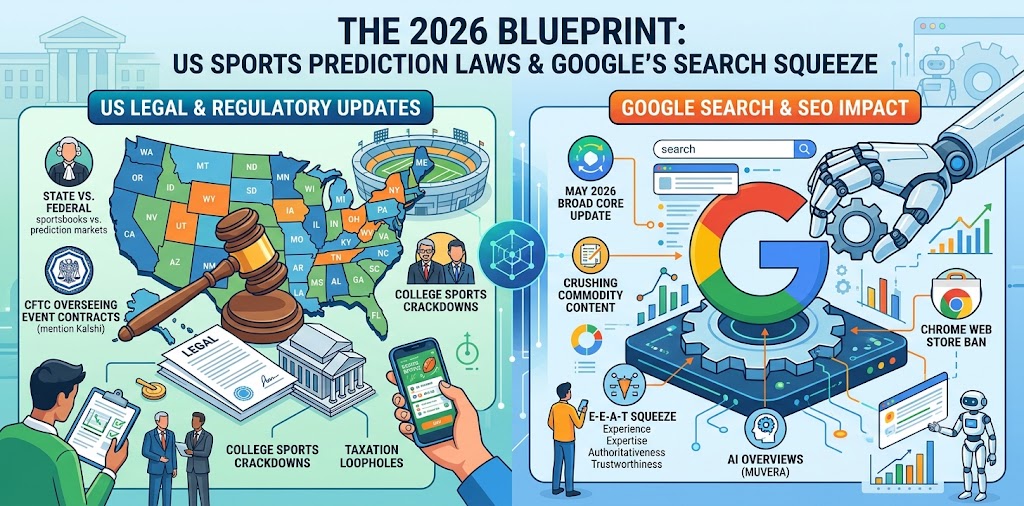
The US sports betting and prediction market is a sprawling, $22 billion-a-month juggernaut spanning 40 legal states. But as we push deeper into 2026, the ecosystem is facing a simultaneous, two-front squeeze. On one side, lawmakers are aggressively battling over state vs. federal jurisdiction to regulate lucrative new prediction markets. On the other, Google is fundamentally restructuring how sports betting traffic is acquired, leveraging its brutal May 2026 Broad Core Update and the rise of generative AI to kill off low-effort affiliate content.
If you are an operator, an iGaming affiliate, or a content publisher relying on sports prediction traffic this year, the old playbook is officially dead. Here is the definitive, data-backed intelligence on the current legal landscape of US sports predictions and how Google’s latest search engine policy changes are rewriting the rules of digital acquisition.
The Regulatory Schism: Sportsbooks vs. Prediction Markets
To understand the 2026 legal landscape, you must understand the rapidly widening gap between traditional sportsbooks and prediction markets.
Traditional sports betting is authorized strictly at the state level. Operators are required to secure licenses on a state-by-state basis, which is why traditional online sports betting is currently only legal in 39 states and Washington, D.C.
Prediction markets—such as Kalshi, Polymarket, and PrizePicks’ “Team Picks”—operate under an entirely different legal framework. They are classified as event contracts operating under federal oversight from the Commodity Futures Trading Commission (CFTC). Because they bypass state-level gaming commissions and register as Futures Commission Merchants, prediction markets are available in 48 states.
This loophole has sparked fierce legal turf wars.
- The New Jersey Court Battle: Traditional gambling lobbyists have fiercely opposed prediction markets, arguing they are essentially untaxed sportsbooks. New Jersey recently attempted to ban Kalshi from operating within state borders. However, in April 2026, the 3rd Circuit Court of Appeals dealt a massive blow to the state, ruling that sports bets under the Commodity Exchange Act preempt state regulations.
- The Legislative Pivot: Knowing they can no longer enact blanket bans, lawmakers are shifting to taxation. In early 2026, NJ State Senator Shirley Turner introduced a bill that would slap a new 9% tax on prediction market companies operating in the state, signaling a move from prohibition to monetization.
The College Sports Betting Crackdown
While professional sports enjoy broad betting legality, college sports face tightening regulatory nooses due to academic integrity concerns and NCAA lobbying. As of early 2026:
- Total Bans: States like Vermont and Oregon have explicitly excluded college sports entirely from their betting frameworks.
- In-State Restrictions: Major markets like New York and New Jersey prohibit wagers on in-state college teams or events occurring within state borders. Indiana recently banned all player props on college athletes to protect amateurs from betting-related harassment.
Also read:
- The Dirty Secret of iGaming SEO in 2026: Cracking the Casino Backlink Code
- The High-Stakes Game of Casino SEO: How to Rank Gambling Sites in 2026
- The Ultimate Guide to the Best Casino and iGaming SEO Agencies in 2026
- The 2026 Reality Check: What the Data Actually Says About Backlinks Today
How are prediction markets legal in states where online sports betting isn’t?
Because the United States legal system treats them differently at the foundational level. Online sports betting is governed by state-by-state gaming commissions. Prediction markets operate under the Commodity Futures Trading Commission (CFTC) as federal “event contracts.” This federal regulatory structure legally supersedes state-level gambling bans, allowing platforms like Kalshi to operate in 48 states, even those without legalized sportsbooks.
Google’s 2026 Clampdown: Policy Changes and The May Core Update
While state regulators fight for tax dollars, Google is aggressively regulating the flow of sports prediction traffic. The search giant’s 2026 strategy has heavily targeted the iGaming and sports betting affiliate space through both direct policy bans and algorithmic bloodbaths.
The August 2026 Chrome Web Store Ban
In a direct hit to platforms blending decentralized tech with betting, Google recently updated its Developer Program policies for the Chrome Web Store. Effective August 1, 2026, Google strictly prohibits extensions that enable or facilitate real-money transactions on predictive outcomes.
While this doesn’t ban prediction markets outright, it severs a critical distribution channel for platforms like Kalshi and Polymarket, stopping users from utilizing browser extensions to seamlessly execute real-money event contracts.
The Algorithmic Squeeze: Surviving the May 2026 Core Update
Google’s March 2026 update was volatile, but the May 2026 Broad Core Update (which rolled out from May 21 to June 2) was an extinction-level event for lazy sports betting affiliates.
Because iGaming falls under Google’s “Your Money or Your Life” (YMYL) umbrella, it requires peak E-E-A-T (Experience, Expertise, Authoritativeness, and Trustworthiness). The May update actively targeted and crushed sites relying on what Google considers “commodity content”—generic lists of odds, scraped matchup stats, and self-serving sportsbook bonus listicles. Furthermore, the introduction of the MUVERA system means Google is now returning 5 to 20 times fewer candidates per search, actively ignoring content stuffed with loosely related keywords.
If you want to rank for sports predictions today, raw domain authority is no longer enough. You must provide irreplicable human value.
SEO for Sports Betting in the AI Overview Era
The structure of the Search Engine Results Page (SERP) has permanently changed, most notably seen during the ongoing World Cup 2026. Google completely rebuilt its matchday SERP on June 8, 2026, layering the page with lock-screen score pinning, video carousels, User-Generated Content (UGC) panels from Reddit, and generative AI Overviews.
For publishers and sportsbooks, mastering SEO in this new environment requires adapting to how Google’s AI processes data.
How to optimize sports prediction content for AI Mode:
- Target the “Movable Middle”: AI Overviews do not cite commodity content. Live scores, basic schedules, and standard moneyline odds are natively pulled from Google’s Knowledge Graph. AI Overviews exclusively cite the “Movable Middle”—publishers providing expert commentary, proprietary betting models, unique player interviews, and distinctive tactical synthesis.
- Invest in Technical Architecture: For international events, multilingual SEO is paramount. Using strict
hreflangtags to capture traffic across varied domains (like google.com vs. google.com.mx) is required to compete. - Pivot to Owned Media: Because third-party platform rules (like Google’s ad policies) change without warning, successful operators are treating SEO as a way to turn their own sportsbooks into entertainment hubs. It is safer to build trust via on-site editorial guides, data visualizations, and localized promotions than to rely purely on paid acquisition.
The Rise of High-Accuracy AI Prediction Apps
As Google integrates AI into search, users are bypassing traditional handicappers for AI-driven prediction apps. Tools like Sports AI Pro and Rithmm are utilizing machine learning to analyze massive datasets—player statistics, weather, and historical trends—to generate betting models.
The data proves why this shift is happening. While a casual sports fan predicts game outcomes with 52-58% accuracy, advanced AI models currently achieve 65-75% accuracy in highly structured leagues like the NBA and NFL. They cannot account for sudden injuries or emotional variance, but for the modern bettor, the math is undeniably attractive.
How long does it take a gambling affiliate site to recover organic traffic after a Google Core Update?
Recovery is rarely quick and never guaranteed. Because sports betting is an ultra-YMYL category, algorithmic penalties tied to a Core Update (like the May 2026 drop) typically require waiting for the next major Core Update to see traffic fully return. Recovery requires aggressive auditing: stripping out commodity content, ensuring strict regulatory compliance, building genuine backlink authority, and demonstrating verifiable human expertise (E-E-A-T).
Sources Quoted: Data and insights were aggregated from OddsIndex, BettingUSA, PrizePicks, Gambling News, Yellow.com, Newzdash, SOFTSWISS, Glenn Gabe (GSQI), Absolute Digital Media, AffPapa, AI News Hub, and the Google Ads Policy Help Center.
Leo Falsafi is a digital marketing veteran and senior journalist at Virlan.co, where he covers the intersection of digital marketing, gaming, and breaking US trending news. With nearly two decades of hands-on experience in SEO and digital strategy, Leo has consulted for and scaled hundreds of companies. His deep industry roots allow him to deliver sharp, fact-checked insights and analysis on the trends shaping today's digital landscape.