
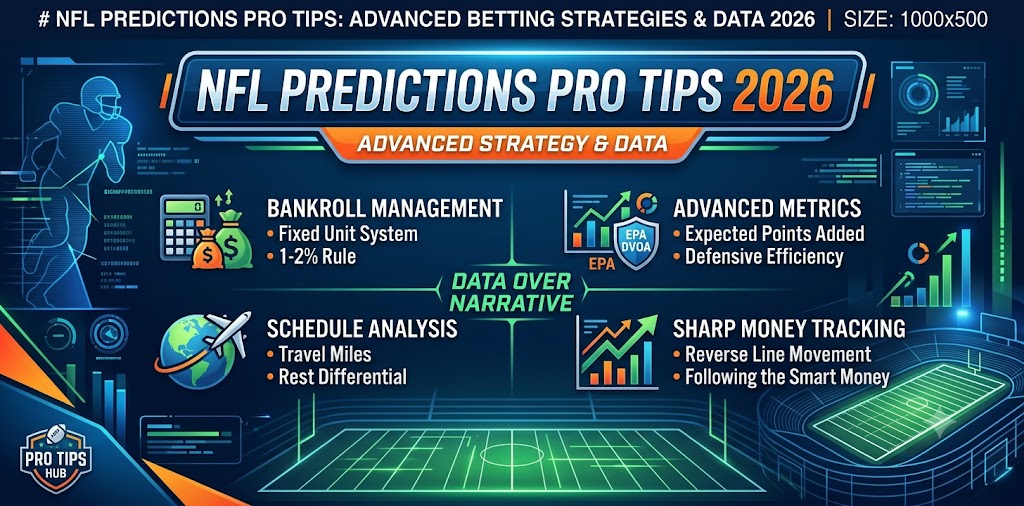
The divide between casual football fans and professional sports bettors isn’t about who watches more games. It comes down to process, discipline, and an absolute reliance on data over narrative.
As the NFL betting market matures heading into the 2026 season, sportsbooks have become frighteningly efficient. The days of easily exploiting mispriced opening lines are largely gone. To survive and thrive in today’s landscape, you must abandon emotional predictions and treat NFL handicapping like an alternative financial market. This requires a strict adherence to mathematics, deep schedule analysis, and advanced performance metrics that look past traditional box scores.
Bankroll Management and Line Shopping: The Foundation of Pro Tips
Every winning NFL betting strategy begins long before kickoff. It starts with your wallet.
According to analysis from Remix Sports Media, the bedrock of long-term profitability is rigid bankroll management using the unit system. Professionals assign a fixed unit size—typically 1% to 2% of their total bankroll—and absolutely never risk more than 3 to 5 units on a single slate, regardless of how confident they feel about a matchup. Betting without this mathematical framework isn’t an investment strategy; it is simply gambling.
Coupled with unit discipline is the mandate of line shopping. It is perhaps the single highest-ROI habit a sports bettor can cultivate. Maintaining accounts across multiple sportsbooks allows you to hunt for the most advantageous number. Getting a point spread at -2.5 instead of -3.5, or taking a moneyline at -108 instead of -115, might seem trivial in a single week. However, spread over a 17-week season encompassing dozens of wagers, consistently finding that half-point edge is often the mathematical difference between a profitable year and a depleted account.
Exploiting the 2026 NFL Schedule: Travel Miles and Divisional Traps
Professional handicappers don’t just look at who is playing; they look at when and where they are playing. The schedule dictates physical attrition, and travel fatigue creates hidden edges that the betting public routinely ignores.
Take the Los Angeles Chargers in 2026. Despite a highly anticipated coaching staff and roster upgrades under Mike McDaniel, Pro Football Focus (PFF) identifies the Chargers as a prime “under” candidate for their 9.5-win total. The underlying data reveals why: Los Angeles faces the seventh-toughest strength of schedule and is saddled with a league-worst rest differential. Furthermore, they are projected to fly 23,843 air miles this season—the seventh-highest travel burden in the NFL. Bettors who simply look at the Chargers’ depth chart will miss the brutal physical toll of their schedule.
Similarly, the way you handicap divisional matchups must differ from out-of-conference games. Because divisional opponents face each other twice a year, coaching staffs intimately know each other’s personnel, cadence, and schematic tendencies. This extreme familiarity inherently levels the playing field. Inferior teams routinely cover spreads—and win outright—against division rivals because structural talent gaps are masked by preparation. As a rule, be highly skeptical of laying large point spreads in divisional games.
Advanced Metrics: Moving Beyond the Final Score
Success in modern NFL predictions requires looking far beyond win-loss records and total yards. Analysts at VSiN stress that sharp bettors leverage advanced metrics like EPA (Expected Points Added), DVOA, pressure rates, and yards after contact. These data points separate a team’s true quality from perceived public value, especially when the market overreacts to a fluky loss or a blowout victory.
For example, PFF’s 2026 season simulations project the Seattle Seahawks to win 10.96 games. With their betting line set at 10.5 wins (priced at -105), this translates to a 56.7% cover probability and a highly favorable 10.7% expected value (EV). The projection is largely anchored by advanced defensive metrics. Under head coach Mike Macdonald, Seattle’s unit previously led the entire NFL in EPA per play allowed. Recognizing elite per-play efficiency allows bettors to identify competitive stability that casual fans overlook.
Following the Sharp Money: Reverse Line Movement
You don’t always need a complex algorithm to bet smartly; sometimes, you just need to watch where the money flows.
When an NFL line shifts in the opposite direction of public betting percentages, it is known as reverse line movement. If a team opens as a -3 favorite but closes at -1.5—even while 75% of the public’s tickets are placed on them—that movement tells a story. It almost universally signals that “sharp” money (large wagers from professional betting syndicates) is hitting the underdog. Monitoring these line shifts from open to kickoff provides invaluable insight into how the market’s most informed participants are positioning their capital.
What are the best metrics for NFL predictions?
The most reliable predictive metrics isolate efficiency and situational performance rather than volume. Expected Points Added (EPA) per play and Defense-adjusted Value Over Average (DVOA) are considered the gold standard because they measure a team’s success on a given play relative to down, distance, and field position, filtering out garbage-time padding.
Why are parlays a bad long-term betting strategy?
While highly entertaining, parlays are mathematical traps. The payout odds offered by most sportsbooks for multi-leg parlays are inherently worse than the true probability of all those independent events occurring. If you choose to play them, experts recommend limiting parlays to two or three legs maximum, anchored entirely on independent, high-confidence edges rather than lottery-style payouts.
- Bankroll Strictness: Cap single-game risk at 3-5 units and standardize bet sizes to 1-2% of total capital to survive variance.
- Line Shopping Priority: Maintaining multiple sportsbook accounts to capture half-point advantages (e.g., -2.5 instead of -3.5) is critical for long-term ROI.
- Schedule Handicapping: Weigh travel miles, rest differentials, and strength of schedule heavily. (e.g., The 2026 Chargers face 23,843 air miles and poor rest setups, suppressing their win ceiling).
- Divisional Skepticism: Avoid heavily favoring teams with large spreads against division rivals, as schematic familiarity naturally closes the talent gap.
- Data Over Box Scores: Utilize EPA (Expected Points Added) and pressure rates to evaluate true team efficiency, ignoring misleading final scores.
- Follow Sharp Action: Track reverse line movement to understand where professional syndicates are deploying their money against the public consensus.
Sources Quoted: Data and expert methodologies were extracted from Pro Football Focus (PFF) simulations, Remix Sports Media’s 2026 strategic guide, and advanced market analysis from VSiN and WagerTalk.
Leo Falsafi is a digital marketing veteran and senior journalist at Virlan.co, where he covers the intersection of digital marketing, gaming, and breaking US trending news. With nearly two decades of hands-on experience in SEO and digital strategy, Leo has consulted for and scaled hundreds of companies. His deep industry roots allow him to deliver sharp, fact-checked insights and analysis on the trends shaping today's digital landscape.