
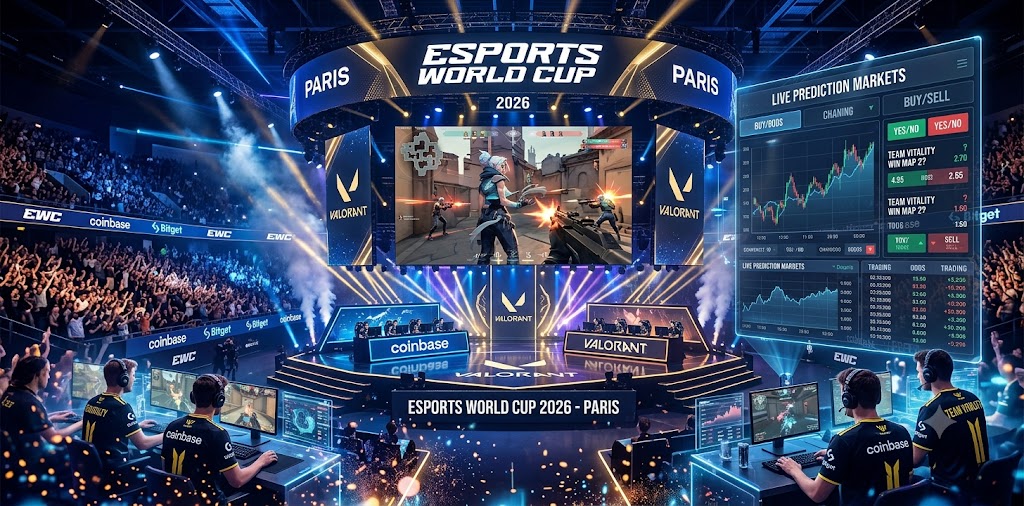
The 2026 Esports World Cup (EWC) in Paris is quietly orchestrating a financial revolution that would have been virtually unthinkable just two years ago. While thousands of fans are currently packing arenas to watch the world’s elite gamers battle for the title, the most consequential maneuvers aren’t happening on the servers. They are unfolding in the regulatory frameworks, sponsorship booths, and decentralized order books.
This year, the EWC officially welcomed the cryptocurrency industry through the front door. By introducing landmark guidelines that allow French-licensed blockchain companies to sponsor events, the tournament has fundamentally blurred the line between competitive gaming and crypto trading. As major platforms like Coinbase and Bitget roll out high-stakes prediction markets tied to live tournament outcomes, the structural DNA of esports monetization is changing in real-time.
The $75 Million Pivot: Crypto’s Conditional Seat at the Table
To understand the magnitude of this shift, you have to look at the sheer scale of the operation. The Esports World Cup boasts a staggering $75 million total prize pool distributed across multiple game titles. The current Valorant segment—running from July 2 to July 12 in Paris—commands a $2 million allocation. That represents roughly 2.7% of the total pot, making it a highly visible, yet proportionally manageable, testing ground for these new financial integrations.
However, the organizers haven’t simply handed the keys over to Web3 out of sheer enthusiasm. The integration is heavily calculated. According to the newly implemented sponsorship guidelines, participating crypto firms are permitted to feature their logos on team jerseys and execute digital advertising campaigns. What they are strictly forbidden from doing is establishing on-site physical activations or forcing integrations that involve actual token transfers during the event. It is a strategic, deliberate approach meant to build brand familiarity without alienating traditional gaming audiences or running afoul of strict European financial regulations.
EWC 2026 Financial Infrastructure
- Regulatory Shift: For the first time, EWC 2026 permits French-licensed cryptocurrency and blockchain companies to officially sponsor the tournament.
- Market Mechanics: Heavyweight exchanges like Coinbase and Bitget are actively powering prediction markets based on live Valorant map outcomes.
- Sponsorship Boundaries: Crypto firms can utilize jersey branding and digital ads, but are barred from physical on-site activations and direct token integrations.
- Prize Distribution: The $75M total EWC prize pool features a $2M carve-out specifically for the Valorant tournament.
Coinbase, Valorant, and the Rise of the Log-Data Economy
Coinbase isn’t just dipping its toes into the water; it is leveraging a deeply entrenched position. Having locked in its deal as the exclusive crypto exchange partner for Riot Games’ VALORANT Champions Tour (VCT) back in May 2025, the publicly traded giant is utilizing the EWC to showcase the viability of live esports prediction markets.
During the July 4 Group B showdown, where Team Vitality punched their ticket to the playoffs with a hard-fought 2-1 series win over NRG, viewers weren’t just passively watching. They were actively trading “yes” or “no” contracts on map outcomes via Coinbase. No specific crypto tokens were tied directly to the Vitality-NRG match itself; instead, the platform operated purely on probability-based event contracts.
But as KuCoin’s recent market analyses have highlighted, the lifeblood of these prediction markets isn’t just liquidity—it is information asymmetry and raw log data. In esports, a “log” is the raw, foundational record of an in-game event. Because streaming broadcasts inherently carry a slight delay, prediction markets rely heavily on this direct-from-server layer of data to execute trades and settle contracts fairly. A mature prediction market cannot survive on front-end odds alone; it requires a deep, auditable infrastructure where the latency is near-zero. Moving forward, the true commercial value of esports won’t just stem from broadcast rights—it will come from the licensing of this high-quality, real-time log data to financial platforms.
The On-Screen Carnage: What the Markets Are Pricing In
The sheer unpredictability of this year’s tournament has made these prediction markets highly volatile and incredibly lucrative for sharp traders. The action kicked off with an immediate upset when Turkey’s BBL Esports grinded past China’s EDward Gaming—the reigning VCT China Stage 1 champions—in a 2-1 series, dropping the favorites straight into the lower bracket. BBL completely flipped the switch after dropping the first map, dominating Ascent 13-7 and crushing Sunset 13-3.
Meanwhile, Indonesian powerhouse RRQ (Rex Regum Qeon) saw their Cinderella run end early in 13th-16th place. Despite earning their spot through a gutsy 3-2 comeback over Gen.G in the Pacific qualifiers, back-to-back 0-2 losses to 100 Thieves and EDward Gaming sent them packing, securing them only a minor fraction of the $2 million prize pool.
Are esports prediction markets legal and regulated?
Yes, depending on the jurisdiction. In the United States, several prominent prediction market applications are designated contract markets strictly regulated by the Commodity Futures Trading Commission (CFTC). For international events like the EWC in Paris, sponsors and market operators must comply with local, country-specific licensing—such as the French regulations currently governing Coinbase and Bitget’s participation in the 2026 tournament.
How do crypto sponsorships change the financial model of esports?
Historically, esports teams and tournaments have relied heavily on hardware sponsorships, venture capital, and media rights. By opening the doors to French-licensed blockchain firms, tournaments like the EWC inject massive new revenue streams through digital advertising and jersey sponsorships. More importantly, integrating prediction markets creates a new product layer—real-time data licensing—which organizers can monetize by selling direct server-log access to trading platforms.
Sources Quoted: Sourced from real-time reporting by Crypto Briefing, KuCoin News, and ADVFN, detailing live match statistics, EWC sponsorship regulations, and industry analyses on the role of log data in prediction markets.
Leo Falsafi is a digital marketing veteran and senior journalist at Virlan.co, where he covers the intersection of digital marketing, gaming, and breaking US trending news. With nearly two decades of hands-on experience in SEO and digital strategy, Leo has consulted for and scaled hundreds of companies. His deep industry roots allow him to deliver sharp, fact-checked insights and analysis on the trends shaping today's digital landscape.