
Money talks. It’s an old adage, but in 2026, it is the literal backbone of a financial revolution that has Wall Street professionals looking over their shoulders.
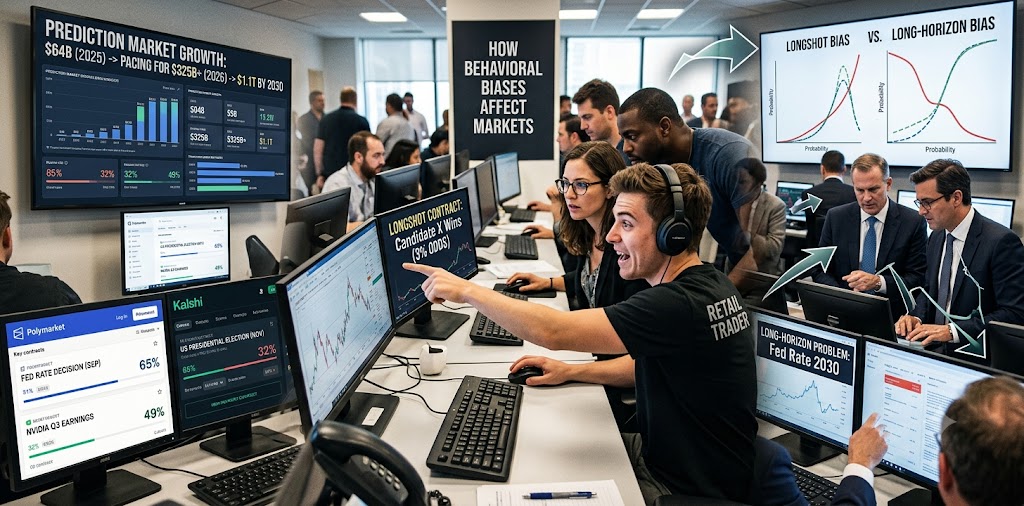
What used to be a fringe corner of the internet for political junkies has exploded into a macroeconomic juggernaut. According to data from FalconX, prediction market trading volumes quadrupled to $64 billion in 2025. Based on current year-to-date run rates, the sector is pacing to shatter $325 billion in 2026. Martin Gaspar, Senior Crypto Market Strategist at FalconX, estimates this space could easily exceed $1.1 trillion by 2030.
But as billions of dollars flood into platforms like Polymarket and Kalshi, a fascinating psychological experiment is playing out in real-time. Unprecedented retail volume is clashing with deeply ingrained human flaws, creating lucrative inefficiencies and entirely new classes of financial risk.
What are prediction markets, and how do they work?
At their core, prediction markets are financial platforms where participants trade event-based contracts tied to binary outcomes. Unlike traditional stocks driven by corporate earnings, these contracts gain or lose value based strictly on the likelihood of a future event occurring—such as the outcome of a presidential race, a Federal Reserve interest rate decision, or even pop culture phenomena.
If a contract pays $1.00 when an event happens, and it currently trades at 65 cents, the market is collectively assigning a 65% probability to that outcome.
This isn’t just gambling; it’s a sophisticated information-aggregation mechanism. As noted by the Poole College of Management, the underlying mechanics trace back to the economic theories of Friedrich Hayek. Market prices efficiently synthesize dispersed information that no single expert or central planner could ever collect on their own. Because money is on the line, participants are heavily penalized for errors and rewarded for accuracy.
However, the ecosystem is rapidly evolving. A recent Pew Research Center analysis of data from The Block revealed that combined global monthly trading volume on Kalshi and Polymarket skyrocketed from less than $5 billion in September 2025 to approximately $24 billion by April 2026. Interestingly, the platforms serve distinct audiences: sports wagering makes up a massive 80% of total trading volume on Kalshi, whereas politics drives 32% of the volume on Polymarket.
The “Average Guy” vs. Wall Street
Who is fueling this surge? A recent BBC analysis highlighted by Earnings Miss Streak notes that the sector’s demographic heavily skews toward a higher risk appetite, explicitly describing the environment as having “young male vibes.”
Surprisingly, this demographic is winning. Recent market activity tracking semiconductor demand and macroeconomic indicators shows that nimble, non-professional retail traders are frequently outperforming institutional Wall Street players on specific event-driven contracts. Professional traders, heavily reliant on complex algorithms and massive capital bases, often struggle in low-volatility prediction environments where “the average guy” can swiftly adapt to breaking qualitative news.
How do behavioral biases affect prediction markets?
Despite the efficiency of the crowd, human psychology actively distorts prediction market prices, creating systematic arbitrage opportunities. Because contract prices are dictated by the beliefs of traders rather than hard fundamental assets, human emotion routinely warps the math.
Two primary behavioral biases dictate these inefficiencies:
- The Longshot Bias: As detailed by QuantPedia, traders consistently overvalue underdogs and undervalue favorites. The psychological draw of a massive, lottery-style payout on a small investment causes retail traders to blindly pump capital into highly unlikely outcomes. A massive 2017 study analyzing 12,084 matches in the football betting market proved this math: betting strictly on favorites yielded a relatively modest average loss of -3.64%, while betting on longshot outsiders devastated portfolios with an average loss of -26.08%. On prediction platforms, this translates to underdog contracts being structurally overpriced.
- The Long-Horizon Problem: Documented in recent academic models, long-horizon bias occurs when an event won’t resolve for years. Capital committed to a prediction market doesn’t earn interest. If a trader spots a mispriced contract but the event takes five years to conclude, their capital is trapped. They could instead earn a guaranteed 4% yield in bonds. Because of this opportunity cost, smart money abandons long-term contracts. The result? As the time horizon lengthens, illiquidity forces long-term contract prices to artificially drift toward an uninformative 50/50 probability, regardless of the actual reality.
The 2026 Prediction Economy
For those tracking the intersection of decentralized finance and crowd psychology, the data points to a paradigm shift:
- Massive Liquidity: Polymarket and Kalshi remain neck-and-neck, each holding roughly $400 million in Open Interest as of January 2026.
- Micro-Niche Markets: Traders are no longer just betting on macro elections. In Pennsylvania, for example, localized Kalshi markets tracking whether Senator John Fetterman will leave the Democratic party by 2028 have drawn tens of thousands in volume, pricing the probability at 49%.
- Arbitrage Potential: Inefficiencies like the “buy-all” arbitrage—where the combined price of all possible outcomes incorrectly drops below $1.00—continue to briefly surface due to retail mispricing.
Prediction markets are proving to be more than digital casinos; they are real-time, tradable barometers of human belief. But as long as human beings are the ones pushing the buttons, the math will always carry a margin of psychological error.
Sources Quoted: This article synthesized real-time market data, historical studies, and expert analysis from the following sources: FalconX (featuring quotes from Strategist Martin Gaspar), the Pew Research Center (analyzing data from The Block), Poole College of Management, QuantPedia (citing the 2017 “Biases in the Football Betting Market” study), City & State Pennsylvania, Earnings Miss Streak (citing BBC demographic analysis), and Pre-Earnings Drift.
Leo Falsafi is a digital marketing veteran and senior journalist at Virlan.co, where he covers the intersection of digital marketing, gaming, and breaking US trending news. With nearly two decades of hands-on experience in SEO and digital strategy, Leo has consulted for and scaled hundreds of companies. His deep industry roots allow him to deliver sharp, fact-checked insights and analysis on the trends shaping today's digital landscape.