
When Donald Trump’s 927-page financial disclosure dropped on June 30, 2026, the topline number caught everyone’s attention: $2.2 billion in total earnings for 2025. It was a massive jump from the $622 million his businesses reported in 2024.
But dig past the golf resorts and the Mar-a-Lago receipts. The real engine of the president’s wealth last year wasn’t real estate. It was crypto.
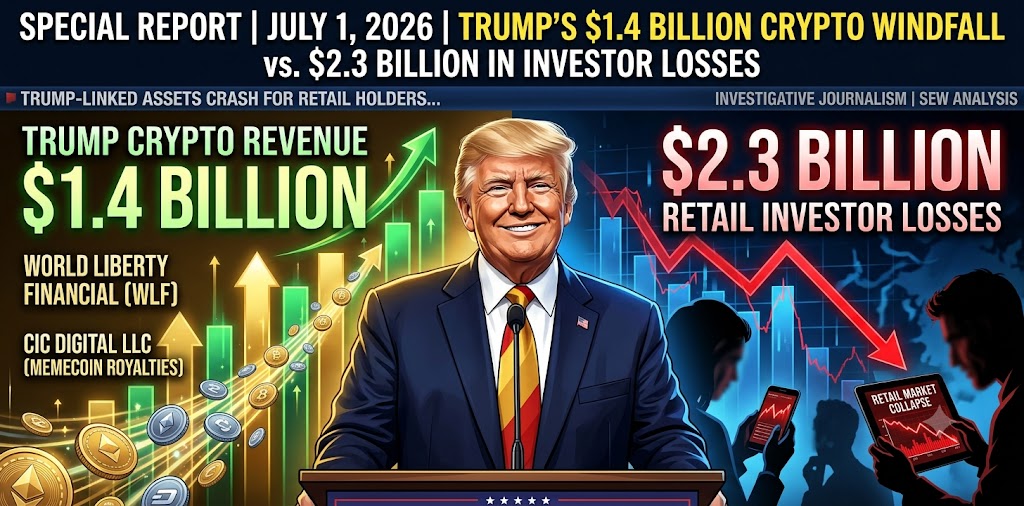
Trump—who just a few years ago called Bitcoin a scam—pulled in roughly $1.4 billion from digital asset ventures. It’s a remarkable pivot. He is now the industry’s loudest political ally, and simultaneously one of its most profitable operators.
There is, however, a catch. While the Trump family secured guaranteed payouts, everyday buyers holding Trump-linked tokens took a beating. A Reuters analysis published earlier this year estimated that retail investors lost a combined $2.3 billion on these assets by the spring of 2026.
Where the Money Came From
The sheer scale of the president’s crypto earnings is tied to a financial model built on upfront capital and licensing fees, shielding his entities from market volatility.
- World Liberty Financial: Trump reported roughly $800 million in revenue connected to World Liberty Financial (WLF), a decentralized finance project co-founded with his sons. According to the federal filing, over $500 million of that total came directly from token sales.
- The UAE Stake: In January 2025, just days before the inauguration, an investment firm linked to the United Arab Emirates bought a 49% stake in WLF for $500 million. Shortly after, the administration approved the export of highly restricted AI computer chips to the UAE.
- Celebration Coins: A memecoin business called CIC Digital LLC generated more than $600 million for the president, driven almost entirely by royalty payments from a licensing agreement with “Celebration Coins.”
- The Retail Crash: The $TRUMP token saw a massive initial surge, only to crash. The coin is now down roughly 80% from its peak, trading at just $1.67, leaving early buyers with steep losses.
Also read:
- Judge Myong Joun Strikes Down Trump’s Student Loan Forgiveness Overhaul
- A Nation Divided at 250: Inside the Clash Between Trump’s Freedom 250 and America250
- Trump Student Loan Policy Changes 2026: New Caps, RAP, and the End of SAVE
Why did the Trump family make money while crypto investors lost?
It comes down to how the deals were structured. Trump’s profits didn’t rely on holding the tokens and hoping the price went up. His ventures took guaranteed cuts and upfront service charges. For instance, World Liberty Financial set up an agreement where 75% of token sale proceeds went directly to a Trump business entity after certain expenses were met. They collected their cash before the token values inevitably dropped due to liquidity crunches and early sell-offs.
Does this violate conflict of interest laws?
Technically, no. The president and vice president are exempt from the standard ethics laws that prohibit most executive branch employees from operating with conflicts of interest. Still, critics have pointed to the optics of a sitting president regulating the exact industry netting him billions. White House spokesperson Anna Kelly dismissed the criticism following the disclosure’s release, stating that neither the president nor his family engages in conflicts of interest.
Beyond crypto, the 2025 filings show Trump made tens of millions from foreign properties, including $10.4 million from a UAE property and $9 million from a Saudi Arabian development. He also reported over $86 million in various legal settlements. But the crypto windfall remains the defining feature of his first year back in office. He leaned into an unregulated market, set up structures that guaranteed a payday, and walked away with a billion dollars.
Sources Quoted: Data and quotes were extracted from live reporting by The New York Times (via GV Wire), Reuters, CNN (via KVIA), and PBS News.
Leo Falsafi is a digital marketing veteran and senior journalist at Virlan.co, where he covers the intersection of digital marketing, gaming, and breaking US trending news. With nearly two decades of hands-on experience in SEO and digital strategy, Leo has consulted for and scaled hundreds of companies. His deep industry roots allow him to deliver sharp, fact-checked insights and analysis on the trends shaping today's digital landscape.