

Most sports bettors focus on the question: “Who will win?” Value bettors ask a better question: “Is the bookmaker offering a price that is higher than it should be?”
This difference may seem small, but it completely changes the way betting works. A strong prediction does not automatically make a good bet. If the odds are too low, even the most likely outcome can be a poor choice. On the other hand, a less obvious selection may be worth betting on if the bookmaker has underestimated its chances.
That is the core idea behind value betting: finding odds that offer more potential return than the real probability of the outcome justifies.
Why are the odds not always perfect
Bookmakers calculate odds using statistics, market movement, expert analysis, and automated models. However, their goal is not only to reflect the real probability of an event. They also need to include a margin, which protects their profit.
Because of this margin, the odds available to bettors are usually lower than the true fair odds. For example, in a perfectly balanced two-outcome market, fair odds might be 2.00 and 2.00. A bookmaker may instead offer 1.91 and 1.91, keeping the difference as its built-in advantage.
Nowadays, it’s quite easy to calculate the odds without a bookmaker’s margin with the help of no-vig calculator. And if you know the true odds, it’s even much easier to calculate all the parameters you need for successful value betting with ev calculator sports betting software. But let’s talk about all the things step by step.
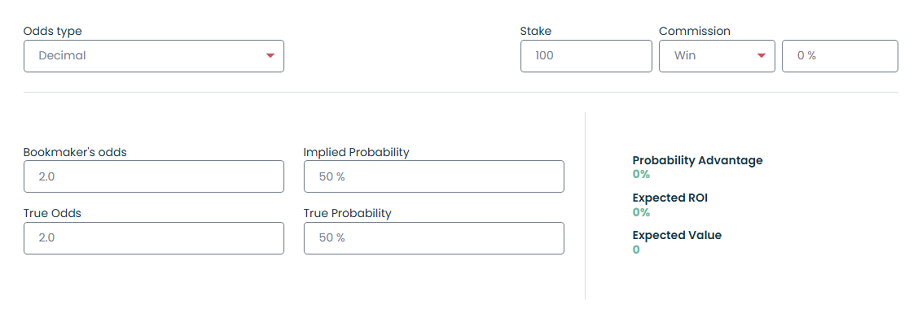
Still, bookmakers can make mistakes. Their odds may become inaccurate because of late market reaction, sudden team news, lineup changes, public betting pressure, or simple misjudgment. When this happens, one outcome may be offered at a price that is too high.
That is where a value bettor sees an opportunity.
What makes a bet “valuable”?
A bet has value when the odds are higher than the real probability of the outcome.
For example, imagine an outcome has a true chance of 50%. The fair odds would be 2.00. If the bookmaker offers 2.20, the price is attractive because the payout is larger than it should be for that level of risk.
This does not mean the bet will definitely win. It means the bet is profitable in theory if the same type of opportunity is taken many times.
That is why value betting is not about certainty. It is about positive expectation.
A value bettor understands that individual results can be random. Some good bets will lose, and some bad bets will win. What matters is whether the bettor keeps placing bets where the offered odds are better than the true probability.
A practical example
Let’s look at a simple Asian handicap market from three bookmakers:
Bookmaker 1
AH1 (-1.5) – 1.69
AH2 (+1.5) – 2.43
Bookmaker 2
AH1 (-1.5) – 1.51
AH2 (+1.5) – 2.34
Bookmaker 3
AH1 (-1.5) – 1.46
AH2 (+1.5) – 2.59
Suppose Bookmaker 2 is treated as the reference line because its market is considered the most reliable.
To estimate the bookmaker margin, we convert the odds into implied probability:
100 / 1.51 + 100 / 2.34 = 108.96%
The result is above 100%, which means the market includes an estimated margin of 8.96%.
After adjusting for that margin, a bettor can compare the estimated fair prices with the odds offered by other bookmakers. In this case, AH1 (-1.5) at Bookmaker 1 and AH2 (+1.5) at Bookmaker 3 may be worth attention because they appear higher than the reference-based fair price.
The important point is this: these selections are not guaranteed winners. They are interesting because the price may be better than it should be.
Why value betting works only over time
Value betting can be frustrating for beginners because it does not promise instant results. A bettor may place a good value bet and still lose. That is normal.
The logic is similar to making decisions with a mathematical edge. One correct decision may not bring profit immediately, but repeated correct decisions can create a long-term advantage.
For example, if a bettor constantly takes odds of 2.20 on outcomes that should fairly be priced at 2.00, losses will still happen. But over a large number of bets, the bettor is working with better prices than the market should allow.
This is why value betting requires patience. It rewards consistency, not emotional reactions after one or two results.
The problem with manual searching
Finding value bets by hand is possible, but it is not convenient.
A bettor has to monitor many bookmakers, compare similar markets, calculate margins, estimate fair odds, and react before the price changes. This can become especially difficult when several sports and leagues are active at the same time.
Live betting makes the process even harder. Odds can move within seconds, and a potentially profitable price may disappear before the bettor finishes the calculation.
Another challenge is accuracy. A value bet exists only if the comparison is correct. If the bettor compares different markets by mistake or uses an unreliable reference price, the apparent value may be false.
How value bet scanners help
Value bet scanners are designed to solve these problems. They automatically collect odds from bookmakers, compare markets, and identify prices that may be higher than expected.
Instead of spending hours checking lines manually, a bettor can use a scanner to see potential value bets in one interface. This saves time and allows the user to focus on choosing suitable opportunities.
A good value betting tool can also help with filtering. Bettors may want to see only specific sports, bookmakers, profit ranges, bet types, or event formats. Filters make the workflow cleaner and reduce unnecessary noise.
BetBurger for value betting
BetBurger is one of the services used by bettors who work with value betting opportunities. It helps users find potentially overpriced odds in both Prematch and Live markets.
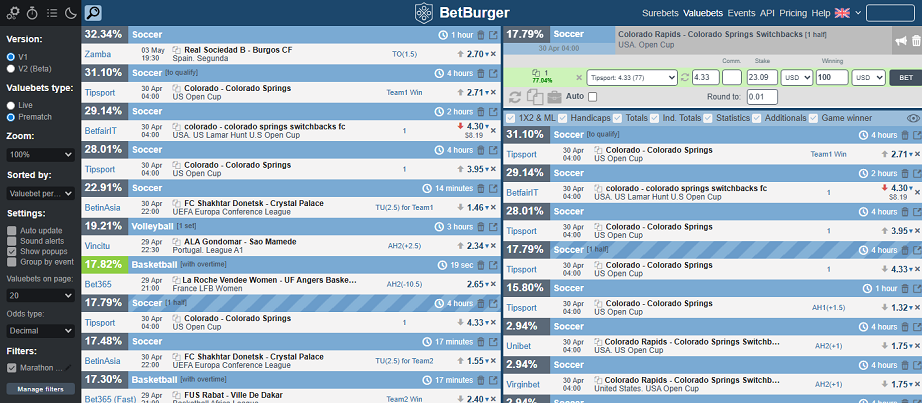
This value bets software scans many bookmakers and sports, which gives bettors access to a broader selection of possible value bets. Instead of checking markets one by one, users can review available opportunities, apply filters, and focus on the bets that fit their strategy.
BetBurger also provides educational materials, which can be useful for beginners. Value betting requires more than simply following a list of odds. Bettors need to understand probability, bookmaker margin, bankroll management, and long-term expectation. Learning these basics helps users avoid common mistakes.
Important rules for value bettors
A value betting strategy should be built on discipline. Since not every value bet wins, bankroll management is essential. Bettors should avoid putting too much money on one selection, even if the odds look attractive.
It is also important to think in terms of volume. The strategy becomes meaningful only when the bettor places many well-selected bets over time.
Another key rule is to avoid emotional decisions. A losing streak does not always mean the strategy is wrong, and a winning streak does not prove that every choice was correct. The quality of the odds matters more than the result of one match.
Finally, bettors should regularly review their results. Tracking bets can help identify which sports, markets, or odds ranges perform best.
Conclusion
Value betting is not about luck, secret predictions, or guaranteed wins. It is about finding situations where bookmakers have offered odds that are too generous.
The strategy works best when the bettor understands that price is more important than confidence. A good bet is not always the one that looks most likely to win. A good bet is the one where the odds are higher than the true probability.
Manual value betting can be difficult because it requires constant comparison and quick calculations. That’s why punters prefer to choose one among the TOP9 Surebet Scanners. Many of them (eg., BetBurger) have valuebet tools.
For bettors who are patient, analytical, and focused on long-term results, value betting can be a serious way to gain an advantage in sports betting.
Leo Falsafi is a digital marketing veteran and senior journalist at Virlan.co, where he covers the intersection of digital marketing, gaming, and breaking US trending news. With nearly two decades of hands-on experience in SEO and digital strategy, Leo has consulted for and scaled hundreds of companies. His deep industry roots allow him to deliver sharp, fact-checked insights and analysis on the trends shaping today's digital landscape.