
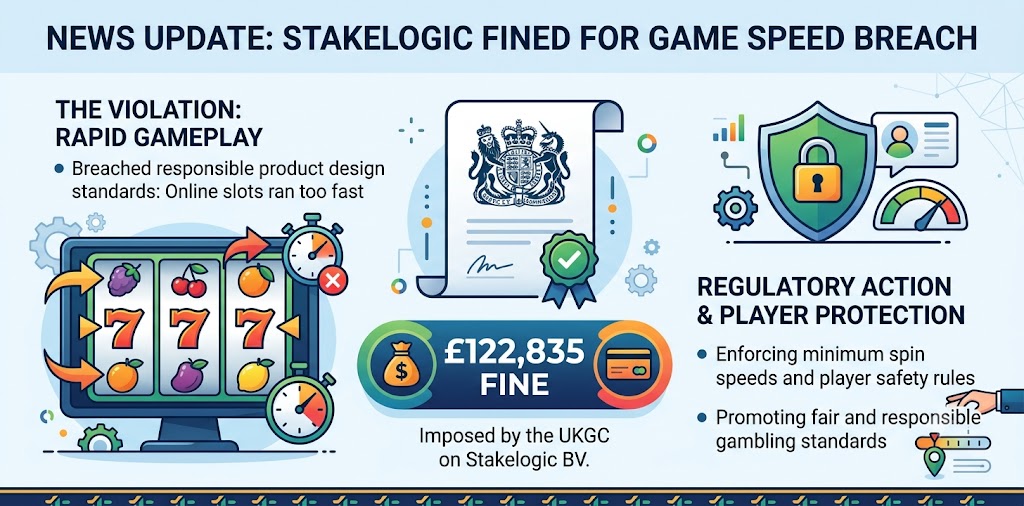
When regulating an industry governed by algorithmic precision and split-second random number generation, relying on a handheld stopwatch seems practically prehistoric. Yet, that is exactly what led the UK Gambling Commission (UKGC) to levy a £122,835 regulatory settlement against Stakelogic BV.
In a striking lapse of quality assurance, the prominent iGaming software supplier was caught running its online slot games too fast, directly violating strict product design standards implemented to protect vulnerable players from rapid gameplay cycles.
The “Tiger Temple 88” Anomaly and the 2.5-Second Rule
The investigation did not begin with a targeted regulatory audit, but rather a self-disclosure. Stakelogic actively notified the Commission that its proprietary slot title, Tiger Temple 88, was operating with a mere 1.97-second interval between spins.
For the modern regulatory framework, this is a glaring red flag. Under UKGC rules rolled out in 2021, a mandatory minimum of 2.5 seconds must pass between each spin. The gap isn’t arbitrary; it serves as a crucial psychological friction point. Behavioral research cited by regulators actively links fast game cycle speeds with an increased risk of gambling harm to consumers.
According to the Commission’s public statement, Tiger Temple 88 failed to meet this baseline standard between May 28 and May 30, 2025. That specific disclosure effectively triggered a much wider probe into Stakelogic’s back-end operations.
Systemic Flaws: A Portfolio-Wide Failure
Once the initial breach was acknowledged, the UKGC mandated a full re-evaluation of Stakelogic’s entire gaming portfolio currently live in the British market. The subsequent data transformed an isolated software bug into a systemic compliance failure.
Fifteen additional titles were flagged for breaching the spin interval threshold across various periods spanning from October 31, 2021, to October 30, 2025. The extraction data revealed a wide spectrum of technical shortfalls. While some games were non-compliant by as little as 0.001 seconds, others ran up to 0.675 seconds below the 2.5-second standard. Alarmingly, many titles operated at just 42 milliseconds below the legal limit.
While fractions of a second may seem infinitesimal to the untrained eye, in the highly regulated sphere of digital gambling, they constitute a material breach of the Remote Technical Standards (14D).
“Unacceptable”: The UKGC’s Stance on Manual Stopwatches
The most astonishing revelation from the Commission’s investigation wasn’t the raw speed of the games, but the methodology used to measure them. Investigators ultimately concluded that the root cause of these timing failures was Stakelogic’s reliance on a manual stopwatch during its quality assurance and compliance testing phases.
The UKGC did not mince words when addressing this archaic approach to software certification. John Pierce, Director of Enforcement and Intelligence for the regulator, delivered a sharp rebuke regarding the supplier’s internal governance.
“With all the technological resources available to an online gambling business, it is unacceptable that Stakelogic were relying on a manual stopwatch to measure the speed of their games,” Pierce stated in the official release.
He further emphasized the regulatory expectations for the wider market: “We would urge all operators to take careful note of this case and ensure they have effective testing practices in place to ensure they are meeting all the standards we require.”
Automation is No Longer Optional
Faced with indisputable evidence, Stakelogic took immediate remedial action. Upon discovering the internal flaw, the company pulled the non-compliant games from the British market until the technical errors could be rectified. Beyond simply suspending the games, Stakelogic has overhauled its incident management frameworks, trading manual timing for automated, robust compliance testing.
In lieu of a formal financial penalty, the company agreed to a £122,835 regulatory settlement, which will be directed into the UK’s consolidated fund, alongside covering the Commission’s investigative costs.
For the broader iGaming sector, the Stakelogic penalty serves as a stark procedural warning. Regulators have made it explicitly clear that good intentions cannot substitute for technical competence. As operators continue to innovate and push the boundaries of game design, the UKGC has drawn a definitive line: testing mechanisms must be as sophisticated as the software they are meant to regulate.
Sources Quoted:
Information and direct quotes were sourced from the official UK Gambling Commission (UKGC) public statement on the Stakelogic BV settlement, alongside supplementary data from World Casino News (Vanja Mitic) and iGamingToday’s regulatory reporting.
Leo Falsafi is a digital marketing veteran and senior journalist at Virlan.co, where he covers the intersection of digital marketing, gaming, and breaking US trending news. With nearly two decades of hands-on experience in SEO and digital strategy, Leo has consulted for and scaled hundreds of companies. His deep industry roots allow him to deliver sharp, fact-checked insights and analysis on the trends shaping today's digital landscape.