
Regulating the House: Inside the 25% Funding Uplift
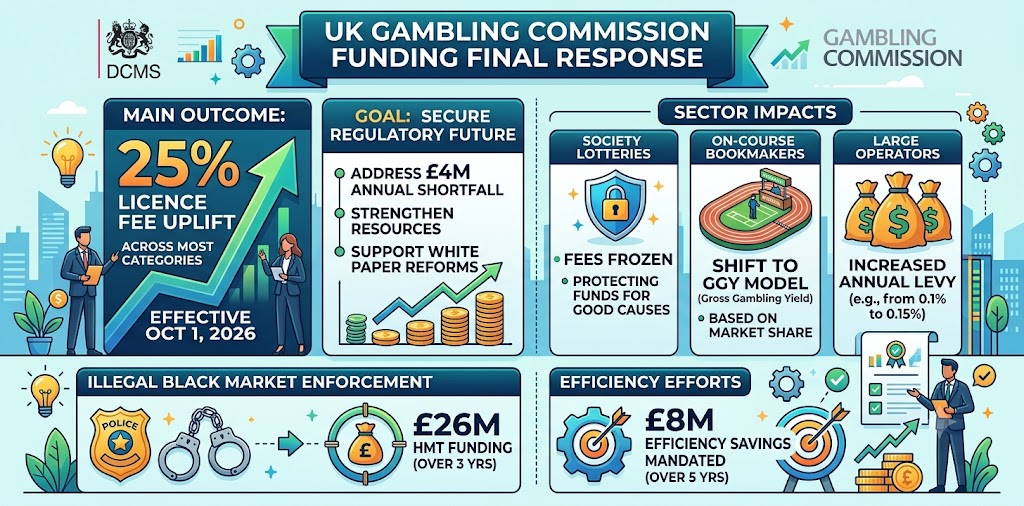
The Department for Culture, Media and Sport (DCMS) has officially drawn a line under its consultation regarding the future funding structure of the Gambling Commission. The verdict is a headline 25% uplift across most licence categories. Set to take effect on October 1, 2026, through secondary legislation, the hike arrives as the regulator grapples with a persistent annual budget shortfall of approximately £4 million and rapidly depleting reserves.
Finding a consensus proved impossible. Between January 27 and March 30, the public consultation yielded 47 responses, the vast majority originating from licensed gambling operators firmly opposed to any cost increases. Initially, the DCMS floated three options: a 30% rise, a 20% rise, or a 20% rise plus an additional 10% ring-fenced strictly for illegal-market enforcement. Facing steep pushback, the government abandoned these tierings. Instead, officials settled on a flat 25% increase covering operating licence fees, application fees, personal licences, and corporate control changes. First annual fees will maintain their current structure, charged at 75% of the full annual levy.
Sector Protections and the Move to GGY
While the blanket increase affects the bulk of the market, the government carved out targeted shields for specific verticals. Fees for society lotteries will remain firmly frozen. The DCMS noted this was a necessary step to protect and preserve funds generated for good causes, sparing ancillary society lottery licences from the financial squeeze.
On-course bookmakers—a sector vocal about dwindling racecourse attendances and halving operator numbers over the last decade—will see a fundamental structural shift. The traditional fee model based on operating days is being scrapped. Instead, general betting (limited) operating licences will transition to a market share model measured by Gross Gambling Yield (GGY). Government data indicates this targeted recalibration will actually reduce fees for 44% of operators in this category. Another 53% will experience merely nominal increases, averaging around £22.
For the industry’s heavyweights, however, the financial reality shifts noticeably. Large remote and non-remote operators generating an annual GGY in excess of £100 million will see their fees tick upward from roughly 0.1% to 0.15% of their yield, pushing some annual regulatory bills comfortably into six-figure territory.
Cumulative Pressures on the Betting Ecosystem
The timing of the increase has struck a nerve. The regulated betting and gaming sector is already navigating a tightening financial corridor, squeezed by recent gambling duty rate adjustments and the looming realities of a statutory levy.
The Betting and Gaming Council (BGC) wasted no time articulating the sector’s unease. “Our members recognise the importance of a well-funded Gambling Commission, but these increases add to the financial pressures already facing the regulated betting and gaming sector,” a BGC spokesperson stated. “Following recent tax rises and the introduction of the statutory levy, it is vital these additional costs do not undermine investment or jobs, or increase the advantage of illegal gambling operators, who pay no tax and offer none of the protections found in the regulated sector.”
Yet, legal analysts suggest the regulatory hike, while unwelcome, is survivable. Bethan Lloyd, a senior associate at Wiggin LLP, contextualised the mood for iGaming Business, noting that although the additional fees would undoubtedly be painful, “[this] isn’t going to be the straw that breaks the camel’s back.”
The Regulatory Road Ahead
Currently, the Gambling Commission’s annual income sits at £27.9 million (excluding income tied to regulating the National Lottery). The DCMS explicitly highlighted that the regulator’s investment in white paper reforms and black-market enforcement had structurally eroded its financial footing. If left unaddressed, the Commission’s reserves would have vanished entirely within the current financial year.
Interestingly, the DCMS firmly rejected the Commission’s initial request to ring-fence a portion of the fee hike strictly for combatting the black market. Instead, the fight against unlicensed operators will be bankrolled by a separate, dedicated £26 million funding commitment from HM Treasury, spread over three years.
The cash injection from the industry does not grant the regulator a free pass on internal spending. Even with the 25% bump safely secured, the Gambling Commission is now mandated to identify and execute a further £8 million in efficiency savings over the next five years.
Sources Quoted:
- GOV.UK & Gambling Commission (Official government consultation responses, statutory data, and regulator financial statements).
- Racing Post (Statements and financial contextualisation from the Betting and Gaming Council).
- iGaming Business / iGB (Industry sentiment and quotes from Bethan Lloyd of Wiggin LLP).
Leo Falsafi is a digital marketing veteran and senior journalist at Virlan.co, where he covers the intersection of digital marketing, gaming, and breaking US trending news. With nearly two decades of hands-on experience in SEO and digital strategy, Leo has consulted for and scaled hundreds of companies. His deep industry roots allow him to deliver sharp, fact-checked insights and analysis on the trends shaping today's digital landscape.