
Closing New York City’s Budget Gap
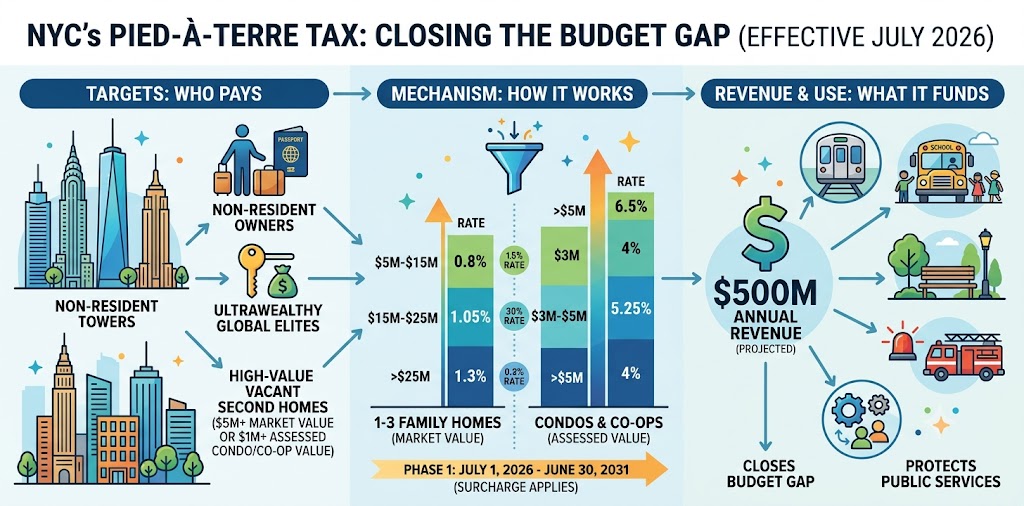
Today, Mayor Zohran Kwame Mamdani and Governor Kathy Hochul announced the proposal of the state’s first pied-à-terre tax, a major step toward closing New York City’s budget gap while protecting the public services working New Yorkers rely on. The tax, referred to locally as a pied-à-terre tax, would affect residential properties worth more than $5 million not occupied by a full-time resident. An estimated $500 million in revenue the first year, along with aid from the state and a potential change to the city’s unincorporated business tax, will close budget gaps and protect public services in the city.
It is not a tax on residents. That is so important. We’re talking about people who are ultrawealthy. I mean, there are literally Russian oligarchs buying up properties, driving up the property values, Hochul said.
Targeting the Ultrawealthy
The measure targets ultrawealthy out-of-city residents and global elites who use New York City real estate as a vehicle for wealth storage rather than as homes, a statement from Mamdani’s office said. It is projected to generate $500 million in annual revenue, including from some of the most expensive residences in the country — from billionaire Ken Griffin’s $238 million penthouse in Midtown, at one time the most expensive home sold in the United States, to Russian auto-dealer Alexander Varshavsky’s $20.5M property (purchased in cash), and thousands more owned by foreign oligarchs and the global ultrarich.
Thanks to the support of Governor Hochul, we are one step closer to balancing our budget by taxing the ultra-wealthy and global elites with a pied-à-terre tax — the first of its kind in our state, said Mayor Zohran Mamdani.
If you can afford a $5 million second home that sits empty most of the year, you can afford to contribute like every other New Yorker, Hochul said in a statement.
Pushback and The Villain Strategy
The real estate industry is predictably warning this will destroy the city’s property market, reduce the city’s property tax rolls, and drive wealthy people to ruin. Banker Jamie Dimon attacked Mayor Zohran Mamdani, saying the mayor’s actions were threatening the city’s image as a business hub.
Amazon founder Jeff Bezos has weighed in on New York City Mayor Zohran Mamdani’s proposed pied-à-terre tax. Bezos, who himself owns a residence in the city, said that the proposed tax itself was ‘a fine thing for New York to do’, likening it to hotels that fall on out-of-towners. Bezos has cautioned that increasing the hotel taxes too aggressively could backfire. If you raise the hotel taxes too much, tourists stop coming. So you have to be judicious, he said, urging city leaders to balance revenue generation with economic competitiveness.
Bezos also criticised Mamdani’s April 14 video filmed outside Citadel CEO Ken Griffin’s Central Park South penthouse, which announced the tax proposal. Ken Griffin isn’t a villain. He hasn’t hurt anybody. He’s not hurting New York. In fact, quite the opposite, Bezos said, rejecting what he called the villain strategy of targeting individuals.
Tax Rates and Implementation
As part of New York State’s 2026 to 2027 budget legislation, the state legislature has enacted a new annual surcharge — dubbed the pied-à-terre tax — on residential property located in New York City that does not serve as a primary residence. The surcharge, which goes into effect on July 1, 2026, and is set to expire on June 30, 2031, targets owners of high-value pied-à-terre properties, i.e., second homes, in New York City.
The legislation operates in two phases. During Phase 1, the surcharge applies to one to three-family homes with a market value of US$5 million or more, as determined by New York’s Department of Finance, at the following rates: 0.8% for properties with a market value between US$5 million and US$15 million; 1.05% for properties with a market value between US$15 million and US$25 million; and 1.3% for properties with a market value greater than US$25 million.
The surcharge also applies to condos and co-ops with an assessed value of US$1 million or more at the following rates: 4% for properties with an assessed value between US$1 million and US$3 million; 5.25% for properties with an assessed value between US$3 million and US$5 million; and 6.5% for properties with an assessed value greater than US$5 million.
The Department of Finance will add the surcharge to the covered property’s statement of account and will administer and enforce it in the same manner as real property taxes, except that any abatement, credit or exemption authorized by law will not apply to the surcharge.
Leo Falsafi is a digital marketing veteran and senior journalist at Virlan.co, where he covers the intersection of digital marketing, gaming, and breaking US trending news. With nearly two decades of hands-on experience in SEO and digital strategy, Leo has consulted for and scaled hundreds of companies. His deep industry roots allow him to deliver sharp, fact-checked insights and analysis on the trends shaping today's digital landscape.