
Evaluating Potential Versus Hype
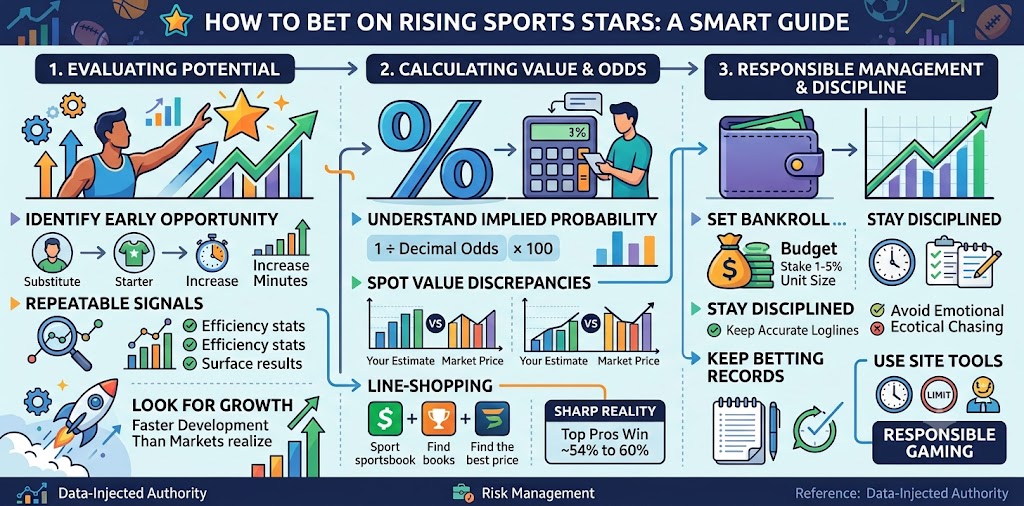
The advantage of picking young sports stars is that they can improve much quicker than people realize. A young football player could find himself or herself playing more time, a tennis player might start to get more playing time, or a first-year basketball player could get a bigger opportunity.
It’s one great match, goal, race, or tournament performance that can create excitement, but one performance usually doesn’t guarantee reliability. Bettors can overestimate potential due to hype, limited data, injuries, and emotional stories.
A sports star that is rising to fame is not necessarily one that is young or popular. In betting parlance, it is an individual whose performance, role, or opportunity is better than it is currently priced.
Data-Driven Performance Indicators
Some of the useful indicators of real development would be: increasing minutes, starts, or competitive appearances; better efficiency, not only higher volume.
In tennis, review serve hold rate, return performance, surface results, and recent workload. In basketball, look at minutes, usage, efficiency, and matchup context. In motorsport, consider qualifying pace, race consistency, and team reliability. The key is to study repeatable signals, not isolated highlights.
Rising stars often become valuable when their role changes before the wider market reacts. In team sports, this may mean a substitute becoming a starter, a young striker taking penalties, a rookie receiving more minutes, or a backup player becoming the primary option.
Calculating Implied Probability and Value
A promising athlete can still be a bad bet if the odds are too low. Odds express implied probability. They show what chance an outcome must have for the price to make sense before considering bookmaker margin.
Implied probability = 1 ÷ decimal odds × 100. If your estimate is only 25%, the bet may be poor even if the athlete is exciting.
The most frequent error is mixing up potential with value. Sometimes a rising star is great, but when everybody knows it, then the odds might not be very good.
Line-shopping is all about taking advantage of pricing discrepancies between the same event at different sportsbooks. Finding the best odds possible is guaranteed to have a significant positive effect on your sports betting ROI.
A successful ‘sharp’ wins 54% of the time. A historically great ‘sharp’ wins at around a 60% clip. These are the best sports bettors in the entire world.
Risk Management and Responsible Guardrails
When you are betting on a new athlete, risks are even greater, and the need for risk management is higher. Young players can make rapid strides, but can also be inconsistent. They can be affected by injuries, pressure, fatigue, coaching decisions, and tactical changes.
Setting Bankroll Limits
Now that you’ve established a pre-ordained bankroll, decide on unit size. We recommend that beginner bettors stake 1-5% of their bankroll on every bet they make.
Good risk management includes: setting a fixed bankroll; using small, consistent stake sizes; avoiding borrowed money; keeping records of every bet; limiting exposure to one athlete or team; avoiding emotional chasing after losses; reviewing results honestly.
Budget smart. Only bet what you can afford to lose. Never use money meant for essentials like rent, food or tuition.
Maintaining Discipline
Avoid these traps: betting after one viral performance; ignoring injuries or fatigue; overvaluing social media attention; backing an athlete only because they are young; assuming improvement is always linear; forgetting that markets adjust quickly.
Don’t chase losses. Losing is part of betting. Trying to win it back usually leads to even bigger losses.
Use site tools. Most betting apps let you set time and money limits. Turn those features on and stick to them.
Responsible betting also means setting limits before emotion takes over. A strong opinion should never turn into uncontrolled staking. Winning at betting on promising sports stars involves patience, proof and discipline.
Sources Quoted: This article curates insights from The News Magazine’s sports betting analysis, Sports Betting Dime’s statistical betting strategies, and the University of Colorado Boulder’s Division of Student Life guidelines on responsible gambling.
Leo Falsafi is a digital marketing veteran and senior journalist at Virlan.co, where he covers the intersection of digital marketing, gaming, and breaking US trending news. With nearly two decades of hands-on experience in SEO and digital strategy, Leo has consulted for and scaled hundreds of companies. His deep industry roots allow him to deliver sharp, fact-checked insights and analysis on the trends shaping today's digital landscape.