
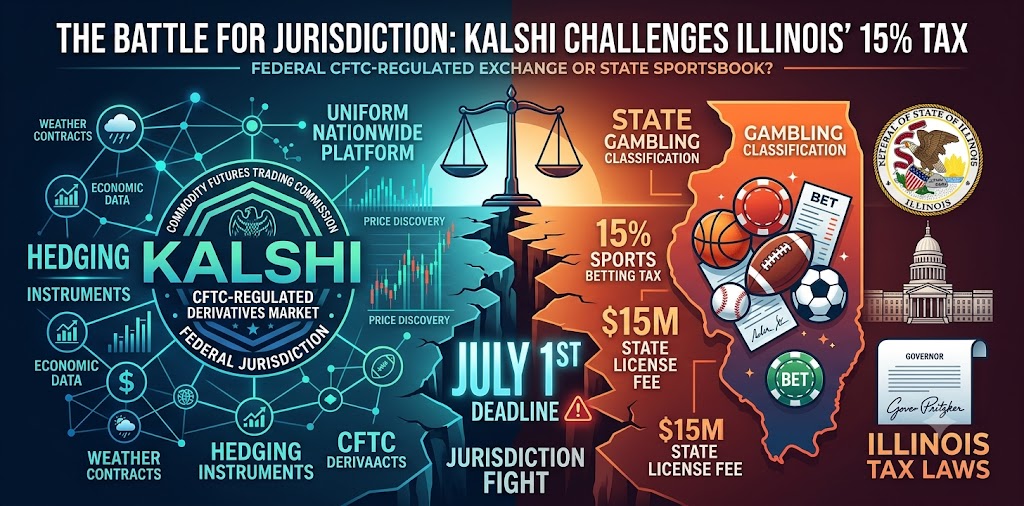
On the surface, it’s a dispute over a 15% state tax. In reality, it is a high-stakes proxy war for the future of financial regulation in the United States.
Kalshi, a leading prediction market platform, has officially filed suit in federal court against Illinois Governor JB Pritzker and Attorney General Kwame Raoul. The fintech company is seeking preliminary and permanent injunctions to block a new state law set to take effect on July 1, 2026, which imposes heavy taxes and steep licensing fees on sports-related event contracts.
The lawsuit underscores a fundamental fracture in how emerging trading platforms are governed. Illinois regulators view prediction markets as fundamentally indistinguishable from sportsbooks. Kalshi, backed by federal regulatory frameworks, insists its products are financially regulated derivatives—specifically, swaps—falling under the exclusive jurisdiction of the Commodity Futures Trading Commission (CFTC).
The Breakdown: Key Takeaways
- The Legislative Trigger: Illinois recently established a “Sports Wagering Fund” that levies a 15% tax on gross receipts from sports-related prediction market wagers. It also mandates a $15 million state sports betting license for the first four years of operation, followed by a $1 million annual fee.
- The Legal Stance: Kalshi argues that submitting to Illinois’ regulatory regime violates federal law. The company states it operates as a CFTC-regulated exchange, meaning its products are not state-taxable gambling events.
- The Ultimatum: Without a federal injunction, Kalshi faces a July 1 deadline where it must either cease offering contracts to Illinois residents, pay millions in state fees, or face criminal penalties.
- A Nationwide Ripple: This isn’t an isolated incident. Kalshi currently has lawsuits pending against nearly 20 states, while the CFTC has sued nine states to assert its regulatory dominance over prediction markets.
State Revenue vs. Federal Oversight
State legislatures are increasingly eyeing prediction markets as untapped revenue streams. Traditional sportsbooks in Illinois are subject to a progressive tax structure that can scale as high as 40%. By categorizing prediction market contracts as sports wagers and taxing them at a 15% baseline, Illinois is attempting to capture a slice of a rapidly expanding multibillion-dollar industry.
Yet, this categorization fundamentally clashes with the core business model of prediction platforms. Kalshi maintains that its event contracts serve traditional financial purposes, such as risk allocation, price discovery, and hedging. Commercial entities—like media companies hedging television ratings or insurers managing ticket revenue risks—utilize these contracts as financial instruments rather than consumer gambling products.
State officials heavily dispute this framing. In a letter signed by attorneys general from 40 states and the District of Columbia, including Illinois, regulators argued that any distinction between a sportsbook wager and a sports-related prediction market contract is entirely “illusory.” They claim that because participants stake money on a sporting outcome to win or lose based on the result, the underlying mechanics are identical to gambling.
Are prediction markets considered sports betting?
Legally, this is the exact question tearing through federal courts right now. State gambling regulators classify sports-related prediction markets as sports betting because users wager capital on the outcomes of sporting events. Conversely, platforms like Kalshi and federal entities like the CFTC classify them as federally regulated financial instruments—specifically “event contracts” or “swaps”—governed by the Commodity Exchange Act.
Why is Kalshi suing Illinois?
Kalshi is suing Illinois to block a state law taking effect on July 1 that imposes a 15% tax on prediction market gross receipts and requires a $15 million sports betting license. The company argues that because it is a federally authorized and CFTC-regulated exchange, Illinois has no legal jurisdiction to tax or regulate its operations as a local gambling enterprise.
The Future of Fintech Jurisdiction
The July 1 deadline is the immediate flashpoint in this litigation. If the federal court does not grant an injunction, Kalshi will likely be forced to geofence its services, locking Illinois residents out of the platform entirely to avoid facing criminal penalties.
Beyond state borders, the litigation sets a critical precedent for fintech innovation. If states successfully pierce the CFTC’s federal shield to tax event contracts as gambling, it could trigger a fragmented, state-by-state regulatory nightmare for prediction markets. Furthermore, the CFTC has warned that state victories here could embolden local regulators to claim jurisdiction over non-sports prediction contracts, such as highly scrutinized election and political event markets.
The outcome in Illinois will likely dictate whether prediction markets continue to operate as uniform, nationwide financial exchanges, or if they will be forced to conform to the localized, heavily taxed frameworks of the traditional casino industry.
Sources Quoted: Information, data, and direct concepts were extracted and synthesized from recent reporting by Gaming Today (Ian St. Clair, Dan Angell), Decrypt, PYMNTS, and Gaming Intelligence.
Leo Falsafi is a digital marketing veteran and senior journalist at Virlan.co, where he covers the intersection of digital marketing, gaming, and breaking US trending news. With nearly two decades of hands-on experience in SEO and digital strategy, Leo has consulted for and scaled hundreds of companies. His deep industry roots allow him to deliver sharp, fact-checked insights and analysis on the trends shaping today's digital landscape.