
Introduction to the Private Market Revolution
For decades, the private markets were essentially a walled garden. Unless you were an institutional investor, a wealthy venture capitalist, or someone with exceptional connections in Silicon Valley, investing in early-stage startups was nearly impossible.
The passage of the JOBS Act in the United States revolutionized this landscape. It democratized access to startup investing by introducing Regulation Crowdfunding (Reg CF), Regulation A+, and expanding Regulation D.
Suddenly, everyday retail investors could buy equity in private companies before they went public. This regulatory shift gave birth to a variety of equity crowdfunding platforms, each vying to become the go-to marketplace for founders and investors alike.
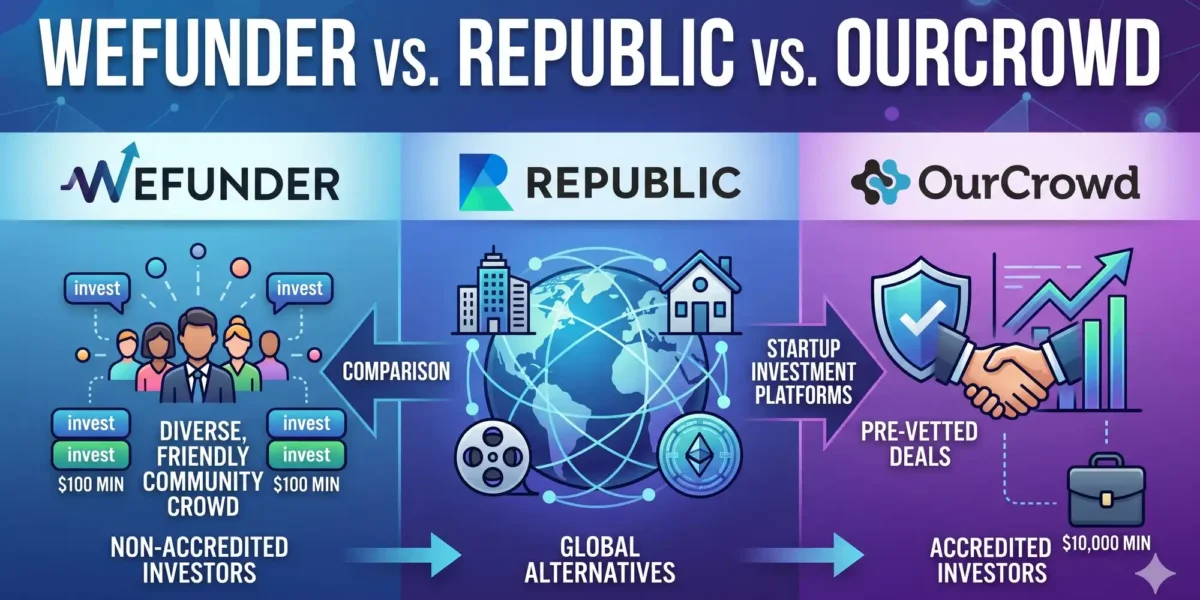
Today, three of the most prominent names in this space are Wefunder, Republic, and OurCrowd. While they all operate within the broader private investing ecosystem, their approaches, target audiences, and asset classes are remarkably different.
In this comprehensive review, we will dissect Wefunder, Republic, and OurCrowd. We will look at their core features, investment minimums, deal flow quality, and overall platform experiences to help you decide where to deploy your capital.
What is Equity Crowdfunding?
Before diving into the platform comparisons, it is essential to understand what equity crowdfunding actually entails. Unlike rewards-based crowdfunding platforms like Kickstarter or Indiegogo—where backers receive a product or a t-shirt—equity crowdfunding allows you to purchase actual shares in a company.
When you invest in a startup through equity crowdfunding, you are taking on significant financial risk. Early-stage companies have high failure rates. However, if a company succeeds and eventually goes public or gets acquired, early investors can potentially see massive returns.
Different platforms utilize different regulatory frameworks to facilitate these investments. Reg CF allows anyone, regardless of income, to invest limited amounts in startups. Reg D is strictly for accredited investors (individuals with a net worth over $1 million or a high annual income).
Understanding these rules is key because each platform leans on different regulations to structure their deals. Wefunder and Republic champion the retail investor, while OurCrowd primarily focuses on accredited investors and high-net-worth individuals.
Wefunder Review: The Community-Driven Pioneer
Platform Overview
Wefunder is often referred to as the “Kickstarter for investing.” It is a Public Benefit Corporation with a stated mission to keep the American Dream alive by democratizing access to capital.
Wefunder focuses heavily on community. The platform believes that a startup’s best investors are often its most passionate customers and early adopters.
To date, Wefunder has facilitated over $2.37 billion in transactions. It boasts a massive community of more than 1.15 million investors and has funded over 4,400 founders. Companies like Substack, Mercury, and Replit have utilized Wefunder’s tools to raise capital from their users.
Key Features and Offerings
Wefunder provides a versatile toolkit for both founders and investors. For founders, the platform offers “Community Rounds,” allowing them to invite thousands of passionate supporters to invest as little as $100.
These rounds ensure that founders only have one line added to their cap table, keeping things clean and manageable through Special Purpose Vehicles (SPVs).
Wefunder also caters to private, invite-only rounds. Founders can top off their venture capital rounds by inviting specific angel investors without making the financial details public.
Furthermore, Wefunder offers robust tools for Syndicate and Fund Managers. Operators with deal flow can build an engaged investor community while Wefunder handles the heavy lifting of fund and SPV administration.
Investment Minimums and Accessibility
Wefunder is arguably the most accessible platform on the market. The minimum investment on many campaigns is just $100.
This low barrier to entry means that almost anyone can start building a diversified portfolio of early-stage startups. Wefunder accepts both accredited and non-accredited investors, making it a true champion of retail investing.
The Investor Experience
Wefunder’s user interface is incredibly intuitive. Investors can browse companies by sector, read detailed pitch decks, review financials, and ask founders direct questions in the comment sections.
Recently, Wefunder has integrated advanced AI tools. They offer an AI agent that can help investors and founders find warm intros, surface hidden network connections, and draft personalized outreach.
Investing is as simple as connecting a bank account or wallet, and committing funds in seconds with zero friction.
Republic Review: The Global Ecosystem for Alternative Assets
Platform Overview
While Wefunder focuses intensely on traditional startup equity, Republic has expanded its vision to encompass a wide array of alternative assets. Republic bills itself as a global, on-chain investment platform redefining accessibility to the private markets.
Republic has deployed over $2.6 billion in capital, supported over 3,000 global raises, and cultivated a community of more than 3 million members.
Republic is backed by heavyweight venture capital firms like SoftBank, a16z, and Y Combinator, signaling strong institutional trust in their model.
Key Features and Offerings
What sets Republic apart is its diversity of assets. Investors on Republic can fund traditional tech startups, but they can also invest in real estate, gaming, films, and highly specialized crypto assets.
Republic is deeply entrenched in the Web3 and blockchain space. They offer tokenization services, Web3 advisory, and blockchain infrastructure. They have architected tokenomics for major projects like Star Atlas and supported public token offerings for networks like Avalanche.
Another unique feature is “Equity Sharedrops,” which allows companies to reward their community with shares. They also offer the “Republic Note,” a digital security that allows investors to gain exposure to Republic’s own evergreen portfolio of venture deals.
Investment Minimums and Accessibility
Like Wefunder, Republic is highly accessible to the general public. For Reg CF offerings, the minimum investment is typically around $100.
Republic caters to both retail and accredited investors. They have expanded their operations globally, offering tailored opportunities for investors in the UK and the EU, further democratizing access to global capital.
The Investor Experience
Republic’s platform feels slightly more institutional and polished, reflecting its diverse asset base. Navigating between startup equity, real estate, and crypto token offerings is seamless.
Because Republic acts as a broker-dealer, an SEC-registered transfer agent, and a funding portal, they offer a highly secure, heavily regulated environment for complex transactions.
Their integration of a digital wallet for holding real-world assets (RWAs) and their focus on multichain infrastructure make them the ideal platform for tech-savvy, forward-thinking investors.
OurCrowd Review: The Institutional-Grade Powerhouse
Platform Overview
OurCrowd takes a fundamentally different approach to private market investing compared to Wefunder and Republic. Based in Israel but operating globally, OurCrowd focuses on providing exclusive, pre-vetted private market deals to high-net-worth individuals and institutions.
OurCrowd operates more like a massive, global venture capital fund that allows individual investors to co-invest alongside them. They have invested over $2.4 billion, achieved 64+ exits, and boast a platform of roughly 228,000 members worldwide.
Key Features and Offerings
OurCrowd does not operate as an open marketplace where any founder can post a pitch. Instead, OurCrowd’s professional team rigorously vets and selects startups.
When an opportunity is listed on OurCrowd, it means OurCrowd’s own funds are likely taking a stake. They invest in early-stage venture startups, late-stage private companies, private market alternatives, and targeted venture funds.
Investors gain access to due diligence materials, financials, and deep market insights prepared by OurCrowd’s investment professionals. You aren’t just betting on a founder’s pitch; you are investing based on institutional-grade analysis.
Investment Minimums and Accessibility
This is where OurCrowd sharply diverges from the others. OurCrowd is designed primarily for accredited investors.
Because they focus on Reg D offerings and global equivalents for high-net-worth individuals, the minimum investment is significantly higher. Typically, minimums start at $10,000 per startup, and $50,000 for venture funds.
This creates a high barrier to entry, meaning OurCrowd is not the place for casual retail investors looking to dip their toes in the water with a few hundred dollars.
The Investor Experience
OurCrowd offers a premium, white-glove experience. Investors receive quarterly portfolio performance reports, detailed updates, and direct access to OurCrowd’s professional team.
They also host the OurCrowd Global Investor Summit and provide an extensive Resource Center filled with expert-written articles, virtual events with CEOs, and deep-dive webinars. It is an environment built for serious wealth generation and professional portfolio building.
Head-to-Head Comparison
Best for Beginners and Retail Investors
Winner: Wefunder. With its $100 minimums, incredibly friendly user interface, and community-first ethos, Wefunder is the absolute best starting point for anyone new to startup investing. It allows you to build a diversified portfolio without risking your life savings.
Best for Asset Diversity and Crypto
Winner: Republic. If you want to invest in a tech startup on Monday, a real estate project on Tuesday, and a new Web3 token on Wednesday, Republic is the only platform that offers this level of cross-asset integration. Their deep expertise in blockchain makes them a leader in the tokenization space.
Best for High-Net-Worth / Accredited Investors
Winner: OurCrowd. For investors who have the capital and want institutional-grade due diligence, OurCrowd is unmatched. The ability to co-invest alongside top-tier global venture capitalists and access exclusive late-stage deals makes it the premier choice for serious wealth management.
Platform Usability and Technology
Tie: Wefunder and Republic. Wefunder’s integration of AI agents to help founders and investors connect is cutting-edge. Meanwhile, Republic’s on-chain infrastructure, wallet-as-a-service, and seamless global compliance stack are technical marvels. Both platforms offer top-tier digital experiences.
Deal Flow Quality
Winner: OurCrowd. While Wefunder and Republic have hosted amazing companies, the open nature of Reg CF means investors have to do a lot of their own vetting to avoid duds. OurCrowd’s rigorous, professional vetting process ensures that every deal presented has already passed severe institutional scrutiny.
Understanding the Risks of Private Investing
No matter which platform you choose, it is vital to understand the inherent risks of the private markets.
Unlike publicly traded stocks on the NASDAQ or NYSE, private equity is highly illiquid. When you buy shares in a startup on Wefunder, Republic, or OurCrowd, your money will likely be tied up for years. There is rarely a secondary market where you can quickly sell your shares if you need cash.
Furthermore, the failure rate for startups is incredibly high. Most companies will not reach an IPO or a profitable acquisition. It is entirely possible—and statistically probable—that you will lose 100% of the capital you invest in any single early-stage company.
This is why diversification is crucial. Using these platforms responsibly means spreading your capital across many different companies and sectors, rather than placing all your chips on one specific founder’s vision.
The Future of Equity Crowdfunding
The growth of Wefunder, Republic, and OurCrowd proves that there is a massive appetite for alternative investments.
We are witnessing a structural shift in how capital is formed. Founders are realizing that taking money from their actual users and customers builds brand loyalty that traditional venture capital cannot buy.
Simultaneously, the lines between traditional equity, digital tokens, and real-world assets are blurring. Republic’s push into on-chain infrastructure and tokenized real estate points to a future where trading private shares might eventually become as easy as trading crypto.
As regulations continue to evolve and investment limits potentially increase, these three platforms are perfectly positioned to capture the next wave of retail and institutional wealth.
Final Verdict
Choosing between Wefunder, Republic, and OurCrowd comes down to your personal financial situation, your risk tolerance, and the types of assets you wish to hold.
If you are an everyday investor looking to back founders you believe in with small amounts of capital, Wefunder is your ideal platform.
If you want a highly diversified portfolio that includes startups, real estate, and blockchain tokens, all wrapped in a sleek, global ecosystem, Republic is the way to go.
If you are an accredited investor who wants to deploy serious capital into heavily vetted, venture-backed opportunities alongside institutional players, OurCrowd is the undisputed champion.
FAQ
Can anyone invest on these platforms?
Anyone over 18 can invest on Wefunder and Republic using Regulation Crowdfunding (Reg CF), subject to certain annual investment limits based on income. OurCrowd, however, is generally restricted to accredited investors only.
What is an accredited investor?
In the US, an accredited investor is generally defined as someone with a net worth of over $1 million (excluding their primary residence) or an annual income exceeding $200,000 ($300,000 with a spouse) for the past two years.
What is the minimum investment required?
Wefunder and Republic offer opportunities starting as low as $100. OurCrowd typically requires a minimum investment of $10,000 per startup.
Can I sell my shares if I need my money back?
Generally, no. Investments in private startups are highly illiquid. You should only invest money you are prepared to leave untouched for 5 to 10 years, or potentially lose entirely. Republic does offer a limited secondary market for certain assets, but liquidity is never guaranteed.
Are there fees for investing?
Yes. Each platform has its own fee structure. Wefunder typically charges investors a transaction fee (usually a percentage of the investment). Republic and OurCrowd also have varying fee structures depending on the specific deal, which may include carried interest (a share of the profits) upon a successful exit. Always read the specific terms of each offering.
Do I have voting rights as an investor?
In most crowdfunding campaigns, individual retail investors do not hold direct voting rights. Platforms often use a lead investor or a Special Purpose Vehicle (SPV) that aggregates the voting power of the crowd into a single entity on the company’s cap table.
Can non-US citizens invest?
Yes, all three platforms support international investors to varying degrees. Republic has specific infrastructure for UK and EU investors, and OurCrowd operates globally. However, international investors must comply with the securities laws of their home countries.
Leo Falsafi is a digital marketing veteran and senior journalist at Virlan.co, where he covers the intersection of digital marketing, gaming, and breaking US trending news. With nearly two decades of hands-on experience in SEO and digital strategy, Leo has consulted for and scaled hundreds of companies. His deep industry roots allow him to deliver sharp, fact-checked insights and analysis on the trends shaping today's digital landscape.