

The Strategic Landscape of Prediction Search Intent: Psychological Drivers, Algorithmic Frameworks, and SEO Optimization in the US and UK Markets
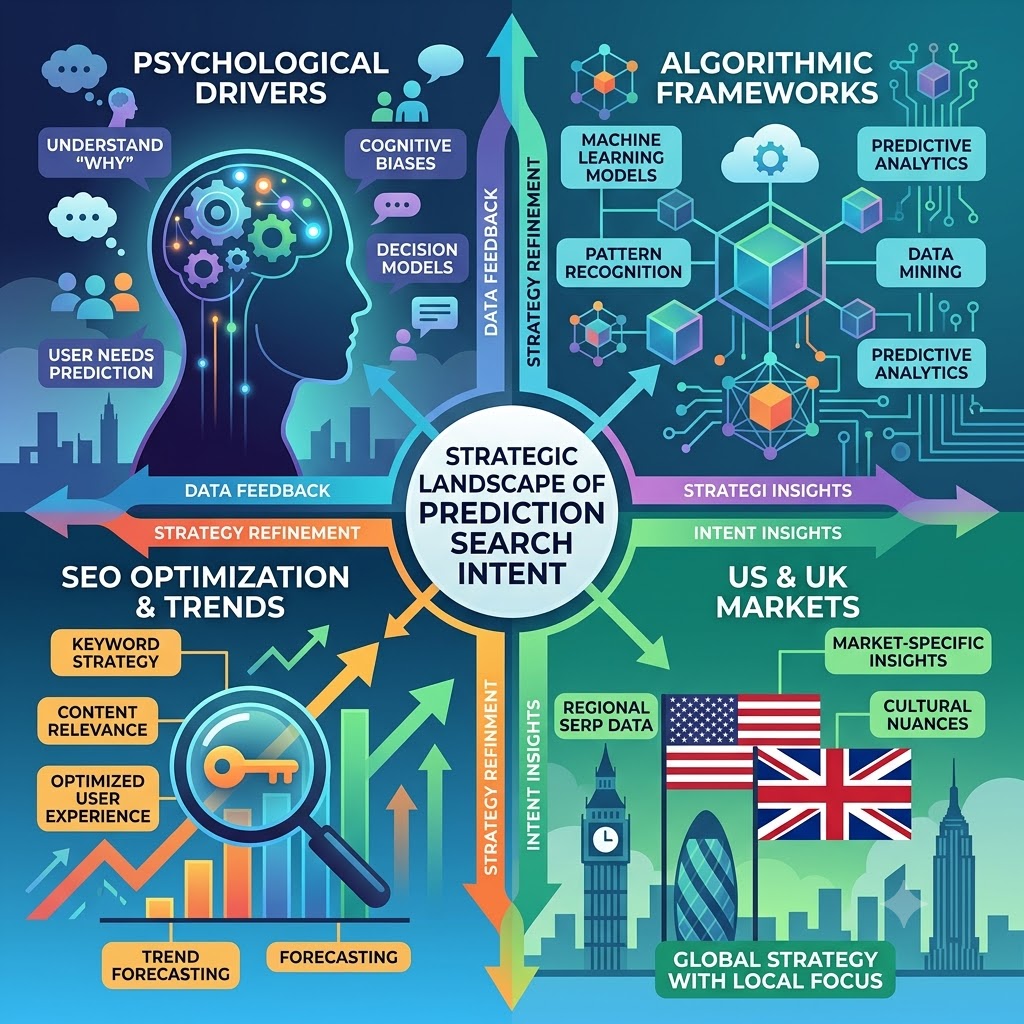
The digital search landscape is fundamentally driven by the human imperative to mitigate the unknown. Across the United States and the United Kingdom, queries containing prediction-related keywords—spanning meteorological forecasting, financial market trends, election outcomes, and sports betting—represent an overwhelmingly large and lucrative segment of daily search volume. Understanding the precise goal behind these searches requires a multidisciplinary analysis of human psychology, regional market dynamics, and the underlying algorithms of search engines. For digital publishers and search engine optimization (SEO) strategists, capturing traffic from prediction-related queries demands significantly more than basic keyword targeting. It requires a nuanced understanding of why users seek predictive data, how the algorithmic framework known as “Query Deserves Freshness” (QDF) evaluates content, and how regional regulations and cultural affinities in the US and UK shape search behavior.
The Psychological Foundations of Prediction Search Intent
To architect content that successfully captures prediction-based search traffic, one must first deconstruct the psychological catalysts that drive a user to type a query into a search engine. The search for a “prediction” is rarely a passive activity; it is a profound behavioral response to environmental, financial, or social ambiguity.
Uncertainty Reduction Theory and Information Seeking
The primary theoretical framework explaining this digital behavior is Uncertainty Reduction Theory (URT), originally developed by communication scholars Charles Berger and Richard Calabrese in 1975. URT posits that human beings are fundamentally uncomfortable with uncertainty and actively seek information to predict the trajectory of interactions and future events.
URT identifies two main typologies of uncertainty. Cognitive uncertainty refers to the inability to predict or understand one’s own thoughts or the thoughts of others in a given situation, while behavioral uncertainty relates to the inability to predict how one should act or how events will unfold in unfamiliar circumstances. To combat these aversive states, individuals employ various information-seeking strategies. While URT originally focused on interpersonal communication, modern behavioral science applies it to digital information-seeking, characterizing search engine usage as an extractive strategy. When a user searches for a “weather forecast” or a “Premier League prediction,” they are extracting information from an external database to reduce the number of alternative outcomes in their mind, thereby increasing predictability and reducing cognitive stress.
The drive to reduce uncertainty is governed by specific conditions. Individuals are highly motivated to seek predictive data when they anticipate a future interaction with the event, when the event has high incentive value (such as a financial wager), or when the environment exhibits deviance from accepted standards (such as an unprecedented weather anomaly).
| URT Axiom | Psychological Principle | Application to Search Behavior |
| Information-Seeking | High uncertainty causes increases in information-seeking behavior. As uncertainty decreases, information-seeking decreases. | Users will execute multiple queries (e.g., checking various weather apps) until they feel they have extracted a consensus prediction. |
| Incentive Value | An individual is more likely to want to reduce uncertainty if the outcome controls a desired resource. | Financial and sports betting predictions drive massive search volumes because accurate predictions directly correlate with monetary gain. |
| Deviance | Individuals aggressively seek data when faced with unfamiliar or anomalous situations. | Spikes in search volume for economic forecasts occur during unprecedented market volatility, as the standard models of predictability fail. |
The Neuroscience of Waiting and Safety Behaviors
Beyond URT, human neurobiology heavily influences predictive search volume. The human brain is biologically wired to dislike unknown outcomes and constantly scans the environment for data to prepare for what lies ahead. In the context of Control Theory, humans attempt to close the gap between uncertainty and predictability. Refreshing a search results page for live odds, weather updates, or stock market predictions provides an immediate, albeit temporary, sense of accomplishment and safety. Psychologists refer to this repetitive checking as a safety behavior—an action repeated to reduce emotional discomfort rather than to gather novel data.
This behavior is further reinforced by the dopamine system. Research from University College London indicates that the brain finds satisfaction in the mere act of acquiring information because the anticipation of new data feels rewarding. Furthermore, studies on the psychology of waiting demonstrate that individuals facing uncertain news (such as medical biopsy results or financial outcomes) experience profound distress. Engaging in flow-inducing activities, or actively seeking predictive data, boosts the individual’s sense of well-being and accelerates the perception of time passing. Additionally, researchers note that people often display unrealistic optimism when predicting the future, but resort to defensive pessimism as the moment of truth approaches, shifting their search queries to prepare for worst-case scenarios.
Also read: The AI Identity Gap: Why You Are Winning Clicks but Losing the Machine
Confirmation Bias and The Availability Heuristic
An additional psychological layer governing search intent is confirmation bias. When users search for predictions online, they are frequently looking for information that validates their pre-existing beliefs or desired outcomes. For example, a sports bettor may search for analytical data not as a blank slate, but to find expert consensus that aligns with a wager they already intend to place.
The Availability Heuristic, introduced by Daniel Kahneman and Amos Tversky, also dictates search frequency. If a person recently viewed viral content of extreme weather events or sudden stock market crashes on social media, their brain overestimates the likelihood of those events occurring locally. Consequently, they repeatedly check local forecasts and economic predictions to seek reassurance against these perceived, yet statistically unlikely, threats.
Macro-Verticals of Prediction Search: US vs. UK Dynamics
The exact goal of a prediction search varies wildly depending on the industry vertical. The US and UK markets exhibit both profound similarities and distinct regulatory and cultural differences that dictate how search traffic flows.
Meteorological and Climate Forecasting
Weather predictions are the most ubiquitous form of forecasting search queries. Because a single forecast influences daily routines, commutes, outdoor events, and apparel choices, it serves as a psychological anchor in an otherwise unpredictable modern life. Search engines have adapted to this massive demand by integrating highly sophisticated artificial intelligence and aggregating data from premium meteorological organizations.
The Google Weather interface relies on data from agencies such as the National Weather Service (US), the Met Office (UK), the European Centre for Medium-Range Weather Forecasts (ECMWF), and Deutscher Wetterdienst. Furthermore, Google has deployed the “Google Nowcast,” a high-accuracy, short-term precipitation tool utilizing radar and numerical weather prediction data published by various global sources. The forecast models are enhanced with state-of-the-art, AI-based weather forecasting technology from Google DeepMind and Google Research.
The geographical differences between the US and UK heavily dictate search intent and user satisfaction. The UK features a highly variable maritime climate on the western edge of Europe, characterized by prevailing Atlantic winds and localized microclimates running from valley to valley. A common search intent in the UK is highly localized and time-sensitive. Users frequently debate the accuracy of the Met Office against commercial apps. The meteorological reality is that the Met Office’s UKV model operates at an incredibly granular 1.5-kilometer resolution, while broader European models operate at a 9-kilometer resolution. Despite this, the rapid timing of weather events in the UK makes precise hourly prediction exceptionally difficult, leading to high search volumes as users constantly refresh for updates.
Conversely, the US experiences broader, more extreme weather systems spanning massive continental landmasses. Commercial entities like The Weather Company (which utilizes a proprietary real-time AI forecast engine known as WxMix to synthesize over 100 forecast models) compete fiercely for search traffic by emphasizing their accuracy in an era of climate volatility. For independent publishers, competing on raw weather data is futile; traffic is instead captured through niche applications, such as integrating the Google Maps Platform Weather API to offer personalized skincare recommendations based on local UV and humidity indexes, or providing predictive analytics for agricultural yields.
Financial Markets and Economic Nowcasting
A significant segment of prediction searches revolves around financial markets and macroeconomic trends. Interestingly, research surrounding Google Trends indicates that search volumes themselves are highly correlated with economic indicators and serve as a predictive mechanism. Hal Varian, Google’s Chief Economist, published seminal research demonstrating that query indices are not necessarily used to predict the distant future, but to “predict the present”—a practice known as contemporaneous forecasting or nowcasting.
By analyzing specific search categories (Google classifies queries into 30 top-level and 250 second-level categories), economists can predict official data releases. For example, the volume of queries in the “Trucks & SUVs” and “Automotive Insurance” categories during the second week of June serves as a highly accurate predictor of the official June auto sales report released weeks later. When utilizing autoregressive models (such as the baseline seasonal AR-1 model), the inclusion of Google Trends data improves the mean absolute error of economic forecasts by over 10%. Similarly, queries categorized under “Society/Social Services/Welfare & Unemployment” strongly correlate with seasonally adjusted initial unemployment claims.
In the corporate sector, predictive analytics considers a broad range of variables to pinpoint market trends, utilizing machine learning and neural networks to analyze historical data and external factors. Searchers entering financial prediction keywords are generally looking for quantitative methods (time series and regression analysis) or qualitative insights to guide investments and mitigate risk. The performative nature of financial predictions also plays a role; theoretical arguments suggest that financial models and predictions have the capability to steer a system’s behavior in line with the predictions generated, essentially bending the market through the act of forecasting.
Also read: Top 50 Guest Posting Marketplaces (2026 Reviews & Pricing)
The Maturation of Event Prediction Markets
One of the fastest-growing and most disruptive search verticals involves “prediction markets”—platforms where users trade event-based contracts tied to the outcomes of real-world events, such as political elections, economic indicators, and cultural phenomena. In a prediction market, the price of a contract reflects the owner’s claim tied to the event’s outcome; thus, the market price itself serves as a crowd-sourced prediction.
The landscape for prediction markets is evolving rapidly, creating a surge in search volume for odds and forecasts. In late 2025 and early 2026, Google heavily legitimized this vertical. The search giant integrated prediction market data from Polymarket and Kalshi directly into Google Finance and Search products. Powered by Google’s Gemini AI models, a new “Deep Search” tool allows users to ask complex future-facing questions—such as “What will the GDP growth be for 2025?”—and instantly view market probabilities and historical trends aggregated from these platforms.
The regulatory environments in the US and Europe dictate how digital publishers monetize and target these searches:
| Jurisdiction | Regulatory Stance on Prediction Markets | Search and Advertising Implications |
| United States | Regulated as financial derivatives under the Commodity Futures Trading Commission (CFTC). | Google Ads permits US advertisements for prediction markets starting Jan 2026, but strictly limits eligibility to CFTC-authorized Designated Contract Markets (DCMs) and registered brokers. |
| United Kingdom | Evaluated under national gambling frameworks. The Gambling Commission views operators of non-financial event contracts as “betting intermediaries”. | Search intent frequently crosses over with sports betting. Prediction contracts conceptually mirror sportsbook bets, subjecting them to stringent UK gambling advertising laws. |
The mainstream attention on prediction markets has also invited intense legal scrutiny. A landmark case highlighting the financial stakes involved a Google engineer who was arrested and charged with utilizing confidential, non-public search trend data from his employer to execute profitable trades on Polymarket, netting approximately $1.2 million. This joint FBI and Department of Justice investigation serves as a critical test of whether decentralized prediction platforms are legally subject to the same insider trading regulations that govern traditional Wall Street securities.
Also read:
- Texas Doctors Urge 21+ Age Limit on Prediction Markets
- Prediction Markets in Peril? Kalshi’s 9th Circuit Loss Sets Up Supreme Court Showdown
- Here’s Why Prediction Markets Are Growing at Exponential Rates
- 2026 Prediction Markets: Kalshi vs Polymarket & Top 10
- Is Kalshi Legit? App Review, Stock Valuation & Promos
Sports Betting and Match Forecasting
Sports betting remains the most fiercely contested SEO battleground for prediction keywords in both the US and UK. The user intent here is transactional and highly specific: users desire actionable insights, statistical advantages, and data to optimize their wagers against bookmakers.
The UK possesses a mature, legally entrenched sports betting ecosystem where online sports betting accounts for over one-third of the total gambling market. English Premier League (EPL) forecasting dominates the search landscape. Analytics platforms measuring the “Share of Search” for EPL clubs reveal massive seasonal fluctuations; for instance, historical data shows Liverpool capturing 16.27% of the search share, closely followed by Manchester United at 16.26%, with managers like Steven Gerrard and Erik ten Hag driving massive individual search spikes upon their appointments.
The sophistication of the UK bettor is reflected in their search habits. Participants actively compare traditional fixed-odds bookmakers against peer-to-peer betting exchanges like Betfair. Empirical research testing the Efficient Market Hypothesis (EMH) in football betting demonstrates that while bookmaker odds are generally not biased, betting exchanges—which operate on the wisdom of crowds—often provide more accurate predictions than traditional bookmaking firms. UK users actively search for data to exploit the well-documented “favourite-longshot bias” and seek alternative data signals. Academic studies have even proven that analyzing the Wikipedia profile page views of professional tennis players to construct a pre-match “buzz factor” can significantly predict mispricing by bookmakers, generating substantial profits for bettors who follow the data.
Conversely, the US market is currently experiencing explosive, highly commercialized growth following the 2018 Supreme Court ruling that struck down the Professional and Amateur Sports Protection Act (PASPA), allowing states to legalize sports betting at their discretion. US searchers frequently query terms like “free picks,” “sportsbook odds,” “fantasy sports predictions,” and parlay builders. To capture this traffic, publishers are increasingly deploying custom AI-powered sports prediction software. These platforms utilize data pipelines to ingest historical match results, real-time player statistics, and live sports API feeds. Machine learning algorithms process this structured data to detect hidden patterns, calculate win probabilities, and generate human-readable insights that users can digest before placing a wager.
Also read: The 2026 Guide to Hiring a Local SEO Expert: Agency Services, ROI, and AI Search
Algorithmic Treatment of Prediction Queries (The SEO Framework)
Understanding the psychological intent and market dynamics behind a query is insufficient for traffic acquisition without a masterful grasp of search engine architecture. Prediction-related keywords are inherently tethered to time. A forecast for a specific football match or a corporate earnings report is practically worthless the day after the event concludes. Consequently, Google applies highly specific algorithmic frameworks to evaluate, score, and rank these documents.
Query Deserves Freshness (QDF)
“Query Deserves Freshness” (QDF) is the primary mathematical system Google utilizes to determine when content timeliness should override traditional ranking signals like historical domain authority and inbound link equity. The core philosophy of QDF is that not all searches deserve freshness. A search for the origins of Uncertainty Reduction Theory seeks evergreen academic information, whereas a search for the Federal Reserve’s interest rate prediction requires data from the last 24 hours to hold any value for the user.
According to Google patents and search engine architecture documentation, QDF categorizes fresh queries into three distinct buckets:
- Recent Events or Hot Topics: Trending or newsworthy anomalies that trigger an immediate spike in search volume, social media mentions, and news coverage (e.g., a sudden geopolitical crisis impacting oil predictions).
- Regularly Recurring Events: Events that happen on a predictable schedule where users inherently expect the most recent iteration (e.g., annual financial earnings reports, weekly NFL predictions, daily weather).
- Frequent Updates: Informational content that requires constant revision to remain useful to consumers, such as reviews of the best prediction software or dynamic product comparisons.
When a user inputs a prediction keyword that triggers QDF, Google evaluates the available documents using a multitude of freshness signals derived from its extensive patent portfolio. The inception date of the document serves as the baseline; Google scores freshness based on when Googlebot first indexed the page or discovered a link pointing to it. However, freshness decays. To maintain a high score, publishers must make core content changes. Google’s algorithms specifically evaluate the importance of the text that was modified; altering boilerplate navigation, JavaScript, or simply changing the visible timestamp on an article is ignored. True freshness requires modifying the main body text.
Furthermore, Google analyzes the frequency of change and the link growth rate. A document that is updated consistently trains the Google Caffeine indexing system to crawl the site more frequently, increasing the speed at which new predictions reach the search engine results pages (SERPs). Simultaneously, a sudden velocity spike in new inbound backlinks signals to the search engine that the prediction is currently relevant and trusted by the broader web ecosystem.
Advanced Ranking Systems: The Google API Leak and Twiddlers
Recent insights into Google’s ranking systems, heavily informed by testimony from US Department of Justice antitrust trials and a massive 2024 Google Content Warehouse API leak, have clarified exactly how freshness interacts with core quality metrics.
Google calculates a document’s baseline quality by evaluating the broader domain. It utilizes metrics such as siteAuthority (a modernized, site-wide PageRank score) and chromeInTotal (which aggregates Chrome browser data to measure site-visit frequency and direct traffic) to establish a domain’s foundation. It then measures topical authority via siteFocusScore—determining how concentrated a site is on a single topic—and siteRadius, which measures how far an individual page strays from the site’s topical center. A site that publishes sports predictions alongside unrelated cryptocurrency forecasts will suffer a distorted siteEmbedding vector, losing rank to hyper-focused competitors.
Once a baseline is established, Google evaluates document-level quality using contentEffort (an AI-estimated score that looks for original data, custom visuals, expert quotes, and information gain) while checking for algorithmic demotions via pandaDemotion (penalties for thin, syndicated, or duplicate content).
For prediction queries, Google then applies late-stage algorithmic layers known as “twiddlers.” The freshnessTwiddler is a re-ranking modifier that specifically boosts fresh results for queries where user intent demands it. This system relies heavily on the lastSignificantUpdate attribute. If a publisher simply changes the publish date of a Premier League prediction article without altering the core text, the system detects a cosmetic edit, the freshness twiddler is not applied, and the page remains stagnant.
| Leaked Google Attribute | Function in Ranking Prediction Content | Strategic SEO Action |
| siteAuthority & chromeInTotal | Establishes the macro-level trust and user preference for the entire domain. | Build a recognizable brand that users navigate to directly or via Chrome bookmarks. |
| siteFocusScore & siteRadius | Measures topical concentration and vector similarity to a specific cluster. | Maintain strict topical silos. Do not mix unrelated prediction verticals on the same domain. |
| contentEffort & originalContentScore | Scores the human effort and unique information gain present in the document. | Incorporate proprietary datasets, expert quotes, and custom predictive models rather than scraping odds. |
| lastSignificantUpdate & freshnessTwiddler | Determines if a content update was cosmetic or substantive, applying a late-stage freshness boost. | Ensure that republishing a prediction article involves altering at least 30% of the core body text. |
| navBoost & lastLongestClicks | Analyzes user click-through rates and post-click satisfaction (dwell time). | Ensure the prediction is immediately visible to prevent users from bouncing back to the SERP. |
Finally, the navBoost system acts as the ultimate arbiter of relevance. This system relies heavily on click data, specifically monitoring the lastLongestClicks per search session. If a user clicks an article titled “2026 US Market Predictions,” reads the comprehensive data, and does not return to the search results to click another link, Google logs this as the user’s “final answer.” Over time, high navBoost scores will propel a document to the top of the SERPs, overriding traditional link metrics.
Strategic Blueprint: Architecting the Optimal Prediction Content
Synthesizing the psychological drivers of the searcher with the rigorous algorithmic demands of Google requires publishers to transition from writing generic articles to architecting dynamic, data-rich prediction hubs. The following blueprint outlines the necessary methodologies to capture high-volume prediction traffic.
Managing UI, UX, and Search Personalization
Before a user even executes a search, Google’s UI attempts to shape their journey. When a user begins typing in the search box, Google’s autocomplete tries to predict the query. These autocomplete predictions are heavily influenced by geographic location, current trending topics, and, crucially, the user’s personal search history. Users have the ability to turn off “Search personalization” and “trending searches,” but the vast majority leave default settings active, meaning their past behavior dictates the predictions Google recommends. Furthermore, users can report autocomplete predictions that violate policies.
For a publisher, the mobile experience is paramount. Google’s mobile algorithms penalize sites that utilize blocked JavaScript, faulty redirects, mobile-only 404 errors, and aggressive app download interstitials. A prediction site loaded with intrusive pop-up advertisements will trigger a high clutterScore and violatesMobileInterstitialPolicy flag, severely damaging its rank regardless of the prediction’s accuracy.
The 30% Update Rule and Overcoming URL Cannibalization
The most successful prediction platforms do not publish static blog posts; they build dynamic pages optimized for the freshnessTwiddler. For recurring events, such as weekly Premier League predictions, publishers should maintain a single authoritative URL (e.g., /premier-league-weekly-predictions/) rather than publishing a new post every week. To trigger the lastSignificantUpdate algorithm, the core body text must be updated by roughly 30% each week. This approach concentrates inbound link equity on a single URL while consistently reaping the benefits of QDF.
A critical technical challenge in the prediction vertical is managing past events. As demonstrated by a case study from the global betting company Parimatch, generating thousands of URLs for daily sporting events eventually leads to severe keyword cannibalization and a bloated site architecture. The solution requires a meticulous post-event protocol. Successful SEO teams implement a process for redirecting expired prediction URLs to broader category pages, or updating the specific URL with a post-match summary to retain the link equity generated during the event’s buildup. Parimatch also successfully deployed long-term landing pages for events occurring years in the future (e.g., Euro 2026), capturing early search volume and establishing topical authority well before the competition intensified.
Implementing AI and Data Pipelines for Information Gain
To satisfy Google’s contentEffort and E-E-A-T requirements, prediction content must offer unique information gain. Relying on human intuition or scraping competitor odds is insufficient. Elite publishers are building Custom AI sports prediction software to generate proprietary insights.
A successful data pipeline requires rigorous architecture. As highlighted in a development case study for building a prediction platform like Dimers, the Minimum Viable Product (MVP) must focus on core modules: data aggregation engines pulling live stats from premium sports APIs, AI/ML prediction engines processing regression and neural networks, and real-time odds forecasting modules. These machine learning models must continuously train on historical data, detecting hidden patterns that human analysts miss, and establishing a continuous learning loop that refines predictions after every match.
In the app ecosystem, aggressive App Store Optimization (ASO) coupled with SEO yields massive dividends. A case study of WagerLab, a social football pools app, demonstrated that conducting extensive keyword research for “football pools” and “sports predictions,” combined with localizing content and acquiring high-quality backlinks from authoritative sports blogs, transformed the app from obscurity (1 download per day) to over 1,000 daily downloads. They utilized content marketing strategies centered around valuable sports betting tips to build domain authority, proving that off-page optimization is just as critical as the predictive algorithm itself.
Also read:
- North Carolina vs. TCU Prediction, Picks, and Odds: 2026 Week 0 Matchup
- 2026 ACC Football Preview & Predictions: Expert Title Odds, Win Totals, and Best Bets for Miami, SMU, & Louisville
- 2026 NFC South Predictions & Odds: Why the Saints are the NFL’s Best Sleeper Pick
- 2026 NFC North Predictions & Odds: Will the Lions Reclaim the Crown?
- MLB Picks & Best Bets Today (Aug 23): Expert Predictions, Props & Odds
Structuring Content to Satisfy the Psychological Need for Control
Finally, the content structure itself must be designed to alleviate the user’s cognitive uncertainty. Knowing that the searcher is engaging in a safety behavior to regain a sense of control, publishers must structure the data for immediate consumption.
Do not bury the prediction at the bottom of a 3,000-word article. Utilize an “Executive Summary” or “Bottom Line” module at the very top of the page, providing a definitive probability percentage or outcome immediately to satisfy the user’s dopamine-driven information-seeking loop and prevent them from pogo-sticking back to the search results (thereby protecting the navBoost score). After providing the definitive prediction, the remainder of the article must exhaustively explain the “why.” By presenting the quantitative models, regression analysis, historical data, and qualitative insights that led to the conclusion, the publisher justifies the prediction. This comprehensive transparency reduces behavioral uncertainty, establishes profound E-E-A-T, and builds the long-term brand loyalty necessary to dominate the digital prediction ecosystem.
Leo Falsafi is a digital marketing veteran and senior journalist at Virlan.co, where he covers the intersection of digital marketing, gaming, and breaking US trending news. With nearly two decades of hands-on experience in SEO and digital strategy, Leo has consulted for and scaled hundreds of companies. His deep industry roots allow him to deliver sharp, fact-checked insights and analysis on the trends shaping today's digital landscape.