
Strait of Hormuz 2026 Crisis: When Will Shipping Traffic Normalize?
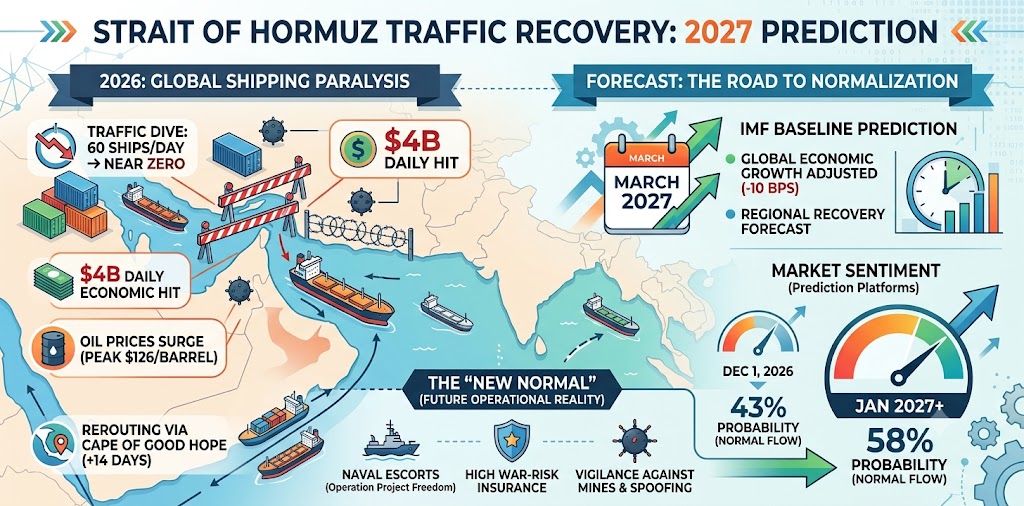
Before the escalating events of early 2026, roughly 60 vessels navigated the Strait of Hormuz every single day, keeping the lifeblood of global energy markets pumping. Today, that number hovers near zero.
Since the United States and Israel launched coordinated aerial operations against Iranian targets on February 28, 2026, the Islamic Revolutionary Guard Corps (IRGC) has weaponized the geography of the Persian Gulf. By aggressively boarding merchant vessels, laying sea mines, and deploying sophisticated GNSS jamming, Tehran successfully engineered the most severe Middle East supply chain disruption since the 1970s.
For international shippers, commodity traders, and geopolitical analysts, the pressing question is no longer how the disruption happened, but when—and if—the waterway will ever look like it did in January. Based on the latest economic modeling, predictive market data, and military intelligence, full normalization remains a distant prospect.
The Scale of the 2026 Maritime Paralysis
To understand the timeline for recovery, we must first quantify the sheer gravity of the bottleneck.
The Strait of Hormuz dictates the flow of 20% of the world’s daily oil supply and 20% of global liquefied natural gas (LNG). When the IRGC officially announced the closure of the strait on March 27 to any vessel traveling “to and from” the ports of the US, Israel, and their allies, the global logistics network fractured overnight.
The immediate fallout was catastrophic for energy markets. The International Maritime Organization (IMO) reported in late April that an estimated 2,000 ships and 20,000 mariners were effectively trapped in the Persian Gulf. QatarEnergy, a titan of the global gas market, was forced to declare force majeure on LNG shipments from its Ras Laffan facilities on March 4, erasing a fifth of the global LNG supply instantaneously.
The financial bleed is currently estimated at over $4 billion per day. Rerouting via the Cape of Good Hope is no longer a temporary contingency—it is the baseline operational reality, adding up to 14 days of transit time and resulting in emergency freight surcharges from giants like Maersk. Brent crude surpassed $100 a barrel by March 8, peaking at a staggering $126 per barrel, logging the largest monthly oil price increase in market history.
Broken Truces and the Collapse of the Mid-Summer Ceasefire
Any realistic forecast for the resumption of normal maritime traffic hinges entirely on diplomatic breakthroughs. Over the summer, brief flashes of optimism were systematically extinguished.
On June 27, the US Navy-overseen Joint Maritime Information Center (JMIC) announced the establishment of a widened transit route near Oman. This maneuver allowed a marginal increase in naval traffic and directly challenged Iranian control. A tentative interim truce briefly placated global equity markets, cooling India’s crude oil basket from its $114.48 April peak down to $68.62 in early July.
That fragile stability shattered on July 8.
Following a series of fresh IRGC drone and speedboat attacks on commercial tankers—part of an expanding casualty list that includes the sinking of the UAE tugboat Mussafah 2 and fatal strikes on the Skylight and MKD Vyom—the truce collapsed. The United States retaliated by striking over 80 Iranian military targets. US President Donald Trump publicly dismissed the brief ceasefire as “just a waste of time” while Washington promptly revoked active licenses authorizing Iranian oil sales.
With hostilities renewed, the maritime insurance sector has largely paralyzed remaining traffic. Underwriters are refusing to issue P&I policies for a waterway recognized internationally as an active warzone.
When Will Traffic at the Strait of Hormuz Return to Normal?
Financial institutions and commodity traders have aggressively recalibrated their timelines. The consensus is grim: 2026 is a lost year for the Strait of Hormuz.
The Institutional Prediction: March 2027
The International Monetary Fund (IMF) recently adjusted its global economic outlook to account for a prolonged blockade. The agency lowered its global growth forecast for 2026 by 10 basis points down to 3%.
Crucially, the IMF’s baseline assumption for this adjustment models a reality where the situation only broadly returns to its prewar state by March 2027. The macroeconomic damage to the immediate region will be severe, with the IMF projecting sharp contractions in 2026 for the commodity-dependent economies of Iraq, Kuwait, and Qatar, while Iran’s economy is forecasted to shrink by 5.4%.
Market Sentiment: Prediction Platforms Say 2027
Live betting markets reflect the same institutional pessimism. Speculators trading on the Kalshi prediction platform have heavily downgraded the near-term outlook following the July 8 ceasefire collapse.
As of mid-July 2026, traders price in a mere 43% probability that traffic flows will return to normal by December 1. Conversely, a 58% majority of traders expect normalization to be delayed until at least January 1, 2027.
The “New Normal” for Global Shipping
Even when the kinetic warfare eventually subsides, maritime traffic in the Persian Gulf is unlikely to revert to its 2025 iteration.
Industry veterans point out that the definition of “normal” is shifting. Future transits through the Strait of Hormuz will likely necessitate permanent US naval escorts—akin to the briefly executed Operation Project Freedom—hefty war-risk insurance premiums, and constant vigilance against asymmetrical threats like leftover sea mines and GPS spoofing.
Until the geopolitical paradigm in Tehran shifts, or a permanent, heavily enforced multinational security corridor is established, the shipping industry must accept a harsh truth. The Cape of Good Hope is no longer the scenic route; it is the new main artery of global trade.
Guide to Trading the Strait of Hormuz Crisis in Prediction Markets
For institutional traders and retail speculators alike, the traditional avenues of geopolitical hedging—such as trading oil futures or maritime insurance stocks—have been augmented by a new, highly reactive asset class: event-based prediction markets.
Platforms like Kalshi and Polymarket have transformed the binary question of whether the Strait of Hormuz is open or closed into a tradable, real-time probability gauge. Here is how market participants are navigating the volatility of the 2026 maritime paralysis.
1. Track the Probability Collapse
Prediction markets excel at pricing in breaking geopolitical news faster than traditional equities. In early July 2026, optimism briefly surged, but the collapse of the US-Iranian ceasefire triggered a massive repricing of risk.
Following renewed military strikes, the odds of Strait of Hormuz traffic returning to normal before the end of the year plummeted to just 53% on Kalshi, down drastically from 78% only a week prior. Similarly, the decentralized platform Polymarket saw its odds for a 2026 resolution drop from 74% to 64% over the same volatile weekend. Traders who closely monitor military alerts and immediately short the affirmative shares on normalization contracts during escalations have capitalized heavily on these rapid sentiment shifts.
2. Correlate with Oil Futures Options
Advanced traders are using prediction markets not just in isolation, but in tandem with traditional commodity markets. Instead of merely betting on the physical reopening of the strait, speculators are trading contracts directly tied to crude settlements.
For example, following the mid-July escalations, prediction markets priced a 48% probability that the August West Texas Intermediate (WTI) contract would settle above $73.99. Simultaneously, bettors placed a 52% chance on Brent crude settling above $78.50. By cross-referencing these probability percentages with options pricing on traditional exchanges, traders can identify arbitrage opportunities where institutional markets may be underpricing the severity of the maritime disruption.
3. The “Monday Morning” Strategy: Watch the Ships, Not the Politicians
Perhaps the most critical strategy for trading the Hormuz crisis is ignoring weekend political rhetoric.
A distinct pattern has emerged throughout 2026: major announcements from Washington or Tehran almost exclusively occur over the weekend when traditional financial markets are closed. Officials frequently issue conflicting statements regarding whether the strait is functional, creating a fog of war that prediction markets must instantly digest.
Veteran traders have adapted by employing a specific operational cadence: they discount the weekend speeches and wait for the opening of the traditional trading week to review hard tanker tracking data. If the ships are not moving, the political declarations are deemed irrelevant, and the odds of normalization adjust accordingly. In this environment, observable maritime data is the ultimate arbiter of truth.
Sources Quoted:
Data and quotes were extracted from the International Maritime Organization (IMO), the International Monetary Fund (IMF), QatarEnergy, the Joint Maritime Information Center (JMIC), the Kalshi prediction market, US President Donald Trump, and real-time tracking from the Strait of Hormuz Live Tracker and Wikipedia’s 2026 Strait of Hormuz Crisis documentation.
Data and strategies were extracted from real-time 2026 reporting by Seeking Alpha, covering Kalshi and Polymarket price movements, and Stockhouse’s analysis of trader behavior regarding weekend geopolitical announcements.
Leo Falsafi is a digital marketing veteran and senior journalist at Virlan.co, where he covers the intersection of digital marketing, gaming, and breaking US trending news. With nearly two decades of hands-on experience in SEO and digital strategy, Leo has consulted for and scaled hundreds of companies. His deep industry roots allow him to deliver sharp, fact-checked insights and analysis on the trends shaping today's digital landscape.