
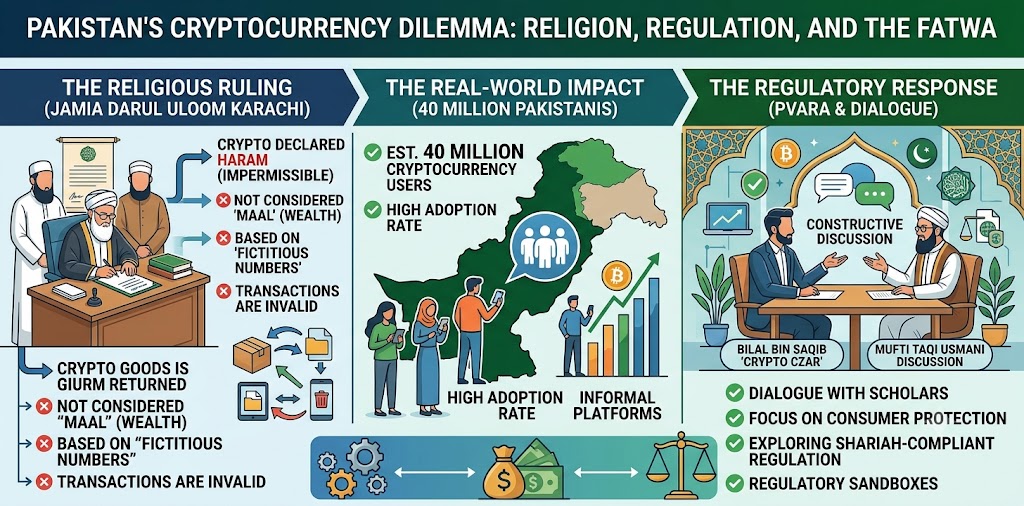
The intersection of ancient religious jurisprudence and modern decentralized finance has triggered a high-stakes standoff in Pakistan. Following a recent fatwa led by renowned Islamic scholar Mufti Taqi Usmani that unequivocally labeled cryptocurrency purchases as “impermissible,” state regulators are scrambling to bridge a widening ideological divide.
At the center of this debate are roughly 40 million Pakistanis already trading digital assets on informal platforms. That staggering adoption rate has pushed state authorities into a tight corner, forcing them to reconcile global financial technology with strict Islamic law.
The Core of the Fatwa: “Fictitious Numbers,” Not Wealth
On June 10, 2026 (24 Zilhaj 1447 AH), Darul Ifta of Jamia Darul Uloom in Karachi issued a sweeping religious decree. Signed by Mufti Usmani alongside a former Federal Shariat Court judge and five other prominent scholars, the ruling targets the foundational concept of value in Islamic commerce.
The clerics concluded that cryptocurrency does not qualify as maal (wealth) under Shariah principles. The decree dismisses digital assets—explicitly naming the Tether stablecoin (USDT)—as “merely the recording of fictitious numbers in an account.” Because Islamic jurisprudence requires recognized, tangible wealth for a valid transaction, the fatwa argues that buyers using crypto do not technically acquire legal ownership of their purchases.
Returning Goods and Deleting Digital Files
The practical implications of the ruling are absolute. When asked about buying books or educational courses with cryptocurrency, the fatwa declared such transactions invalid. It mandated that buyers return physical goods to sellers.
For digital purchases, the directive went a step further, ordering buyers to “completely delete the materials related to this course from your devices and files” because the underlying transaction was delivered in violation of Islamic law.
Bridging the Gap: The “Crypto Czar” Steps In
This stringent religious pushback arrives just months after the State Bank of Pakistan (SBP) legally recognized virtual assets through the Virtual Assets Act of 2026. Rather than retreating, the government is attempting to bring conservative scholars to the table.
Bilal bin Saqib, Chairman of the newly formed Pakistan Virtual Assets Regulatory Authority (PVARA)—often referred to locally as the “crypto czar”—recently held a face-to-face meeting with Mufti Usmani to navigate the fallout.
Saqib characterized the sit-down as a “constructive discussion.” His regulatory argument hinges on nuance. He maintains that blockchain, stablecoins, and tokenized real-world assets are complex, varied technologies that “merit careful technical assessment alongside rigorous Shariah examination, rather than being viewed through a single lens.”
Despite fundamentally conflicting views on whether a digital token holds intrinsic value, Saqib noted a vital point of consensus. Both the religious establishment and state regulators are, in his words, “united on one fundamental objective: protecting Pakistanis from fraud, exploitation, and financial harm.”
Navigating the Virtual Assets Act of 2026
The reality on the ground makes a blanket ban nearly impossible to enforce. With millions of citizens already engaging with digital assets outside of traditional banking scrutiny, PVARA’s mandate is focused on bringing these funds out of the shadows.
The agency aims to curb illicit finance while exploring Shariah-compliant innovations through tightly controlled regulatory sandboxes. There are even active discussions within the SBP regarding the development of a state-backed stablecoin.
As Pakistan wrestles with integrating a decentralized economy, the ongoing dialogue between Darul Ifta scholars and PVARA regulators is being closely watched worldwide. It will likely serve as a vital blueprint—or a stark warning—for other Muslim-majority nations grappling with the exact same financial friction.
Sources Quoted:
Reporting relies on live data extraction from Dawn (Pakistan’s English-language newspaper of record) and syndicated global news aggregators detailing the Darul Ifta decree and PVARA statements.
Leo Falsafi is a digital marketing veteran and senior journalist at Virlan.co, where he covers the intersection of digital marketing, gaming, and breaking US trending news. With nearly two decades of hands-on experience in SEO and digital strategy, Leo has consulted for and scaled hundreds of companies. His deep industry roots allow him to deliver sharp, fact-checked insights and analysis on the trends shaping today's digital landscape.