
A 20-year-old in Thailand pushing $122.5 million through crypto wallets. A meticulously crafted, fake Brazilian police station operating out of Eswatini. High-end hotels in Palau moonlighting as illicit cyber command centers.
These aren’t plot points from a thriller. They are the recently dismantled fragments of a massive transnational crime network.
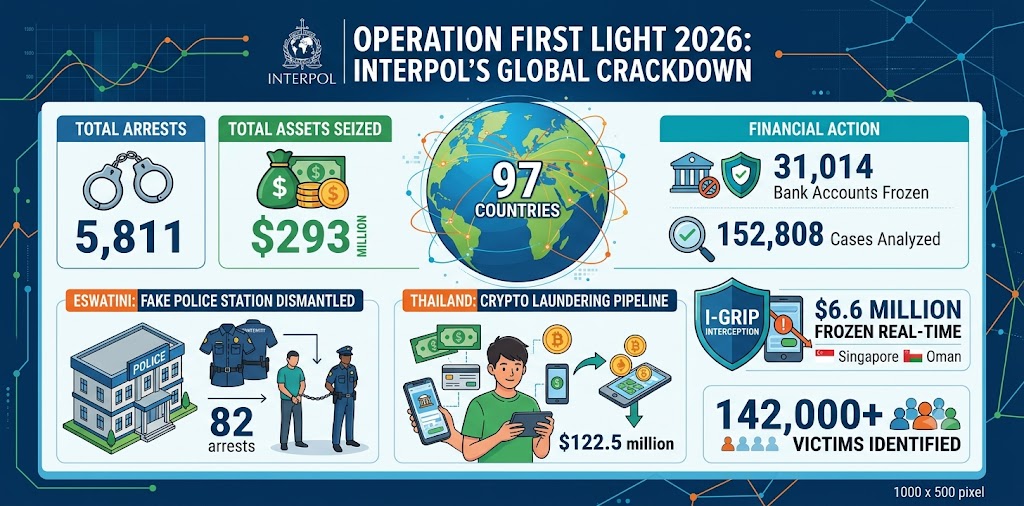
Between January 15 and April 30, 2026, Interpol coordinated one of the most sweeping law enforcement initiatives in its history. Dubbed “Operation First Light 2026,” the four-month offensive spanned 97 countries and completely shattered a matrix of organized crime syndicates relying on illegal gambling, sophisticated money laundering, and brutal social engineering.
The scale of the takedown is staggering. Law enforcement agencies executed 5,811 arrests globally and intercepted $293 million in illicit assets. But the raw data from the operation reveals a far more insidious reality about modern financial crime.
Inside the $293 Million Global Gambling Crackdown
Interpol’s strategy relied on a massive intelligence-sharing phase before executing three months of coordinated, kinetic enforcement. Joint cybercrime divisions worldwide analyzed 152,808 cases. The result was a devastating blow to criminal infrastructure: 31,014 bank accounts were frozen, 23,715 cases were solved, and 15,606 suspects were identified.
Yet the true focal point of Operation First Light was exposing the alarming sophistication of these syndicates. Cartels and cyber gangs are no longer operating in the shadows; they are mimicking legitimate corporate practices, leveraging high-fidelity deception to trap victims.
Globally, over 142,000 victims were identified, proving that no demographic is immune to the reach of these networks. Tomonobu Kaya, Director of Interpol’s Financial Crime and Anti-Corruption Centre, pointed directly to the weaponization of human trust.
“Social engineering scams continue to pose a significant threat to our society,” Kaya stated following the operation’s conclusion. “Criminal syndicates exploit human psychology to manipulate their targets, and no nation can stay safe unless all countries are equipped and committed to jointly fighting back.”
The Eswatini Enigma: A Fake Police Station
The sheer audacity of the cartels was perhaps best illustrated during a tactical raid in Eswatini.
Local police, backed by an Interpol Operational Support Team deployed specifically to handle complex digital forensics, arrested 82 individuals. They dismantled a sprawling network that ran illegal online gambling operations, money laundering pipelines, and high-level impersonation scams.
During the raid, authorities seized 240 electronic devices, stockpiles of foreign currency, and something entirely unexpected: a highly realistic, physical replica of a Brazilian police station.
The set was built complete with counterfeit uniforms, official-looking agency signage, and authentic documentation setups. Scammers used this stage to conduct video calls with high-value targets. Posing as Brazil’s Federal Police, the criminals convinced victims they were part of an ongoing criminal investigation, successfully coercing them into transferring massive sums of money for “safekeeping.”
Thailand’s Cross-Chain Crypto Laundering
While the Eswatini cell relied on theatrical deception, operations in Asia utilized blistering technological speed.
In Thailand, authorities targeted a massive fraud pipeline that funneled illicit funds from romance and investment scams directly into cryptocurrency. Rather than holding stolen capital in recognizable digital wallets, the syndicate utilized automated cross-chain token swaps. This method rapidly bounces capital across disparate blockchains, intentionally breaking the digital audit trail to blind financial investigators.
The velocity of the laundering was breathtaking. Investigators discovered that the digital wallet of just one 20-year-old suspect had processed over $122.5 million in a mere 10 months.
Similar digital havens were raided across the Pacific. In Palau, authorities deported 22 individuals after dismantling two connected scam centers operating directly out of local hotels. The suspects were utilizing cryptocurrency funnels and illegal gambling websites to systematically target foreign victims. In Sri Lanka, simultaneous raids saw hundreds of suspects dragged out of cyber scam centers in handcuffs.
Real-Time Intervention: The Human Cost
Tracking the money after it vanishes is historically a losing game. Operation First Light proved that real-time interception is becoming law enforcement’s most vital tool.
Interpol proactively deployed its Global Rapid Intervention of Payments (I-GRIP) system—a critical stop-payment mechanism capable of freezing illicit flows of both fiat currency and virtual assets. The system’s value was proven when authorities in Singapore and Oman utilized I-GRIP to instantly block a $6.6 million illicit transfer. Criminals had impersonated a supplier to target a Singapore-based commodity trading firm in a highly targeted Business Email Compromise (BEC) scam, only to find the funds frozen mid-transit.
Community intervention proved just as critical. In Macao, China, a routine anti-fraud public outreach campaign led to a live rescue. Police realized a participant at the event was actively being manipulated via phone by a syndicate impersonating public officials. Law enforcement intervened just moments before the victim authorized a transfer of nearly $372,000.
As the digital bodies are counted and the $293 million is processed, Interpol’s message to the private sector is clear. The lines between illegal gambling, crypto-laundering, and social engineering have entirely erased. Disrupting these networks requires matching their speed, their global footprint, and their limitless adaptability.
Sources Quoted: Data and direct quotes from Tomonobu Kaya (Director of Interpol’s Financial Crime and Anti-Corruption Centre) were sourced from official INTERPOL press releases, Security Affairs, and AML Intelligence (published July 2026).
Leo Falsafi is a digital marketing veteran and senior journalist at Virlan.co, where he covers the intersection of digital marketing, gaming, and breaking US trending news. With nearly two decades of hands-on experience in SEO and digital strategy, Leo has consulted for and scaled hundreds of companies. His deep industry roots allow him to deliver sharp, fact-checked insights and analysis on the trends shaping today's digital landscape.