
The Dawn of a Regulated Betting Frontier
The Wild West of Alberta’s online gambling landscape is officially closed for business. Tomorrow, July 13, 2026, marks the genesis of a fully regulated, competitive iGaming and sports betting market in the province.
For years, local players looking beyond the government-run PlayAlberta platform had to rely on offshore sites operating in a legal grey zone. No more. The enactment of Bill 48—the iGaming Alberta Act—shredded that old playbook. Now, the Alberta Gaming, Liquor and Cannabis Commission (AGLC) and the newly minted Alberta iGaming Corporation (AiGC) are holding the reins.
It’s a massive shift. And the industry’s heaviest hitters aren’t just participating; they are flooding the zone.
Operator Rush: The Brands Betting Big on Alberta
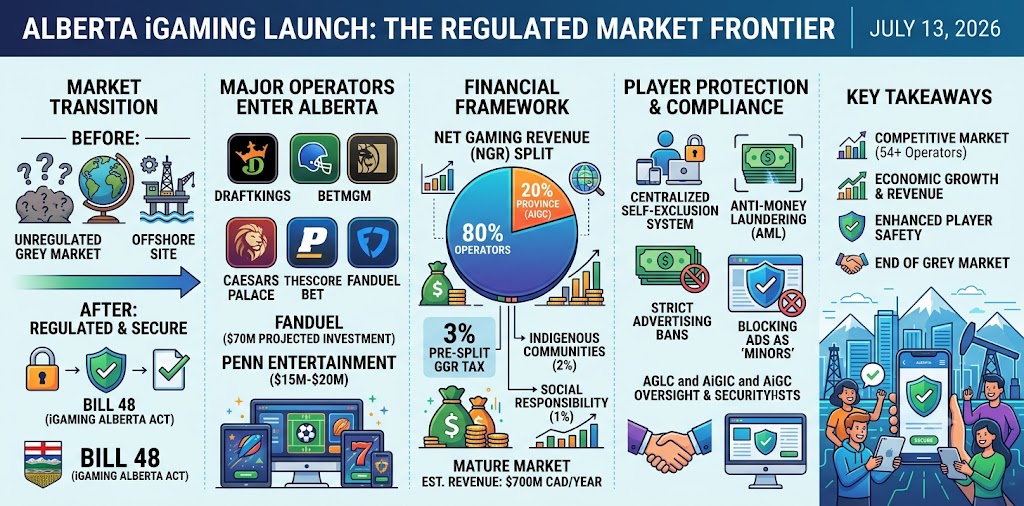
If you want to understand the scale of this launch, look at the capital. Over 70 private platforms initially expressed interest, and as of the final prep hours, 54 operators have secured approval or advanced deep into the AGLC’s grueling registration pipeline.
Heavyweights like BetMGM, DraftKings, Caesars Palace, and theScore Bet are officially locked in. FanDuel alone is projecting a staggering $70 million investment for its Alberta rollout, while Penn Entertainment plans to drop between $15 million and $20 million. It’s an aggressive land grab.
Why the sudden influx? The province’s 4.9 million residents represent one of the most lucrative untapped betting demographics in North America. Industry projections estimate that a mature Alberta gaming market could easily generate $700 million CAD annually in revenue.
Following the Money: The 80/20 Revenue Split
Alberta didn’t reinvent the wheel. It looked east to Ontario’s wildly successful 2022 framework—which posted $4.04 billion in gross gaming revenue last year—and adopted a similar, highly competitive model.
The economics are simple but attractive: operators keep 80 percent of net iGaming revenue, and the provincial government retains the remaining 20 percent. However, Alberta added a vital local caveat. Before that net split occurs, 3 percent is siphoned directly off the top of the gross gaming revenue. Two percent of that goes to support Indigenous communities, while the remaining 1 percent funds social responsibility and problem gambling initiatives.
Bill 48 and the End of the Grey Market
Interestingly, this market was supposed to be live months ago. Dale Nally, the Minister of Service Alberta and Red Tape Reduction, initially eyed a spring launch.
“I wanted to launch earlier. We were ready to launch earlier,” Nally recently admitted at a Toronto gaming summit. “We were going to go in May. It was the operators that said to us they wanted us to hold back. And so, through consultation with the industry, we landed on July 13 as that sweet spot. I am confident we are going to be ready.”
The delay allowed operators to synchronize their anti-money laundering (AML) protocols with the AiGC and integrate into a critical piece of the province’s regulatory armor: a centralized self-exclusion platform.
Player Protection and the Road Ahead
That centralized system is the crown jewel of Alberta’s consumer protection strategy. Unlike the fragmented grey market, registered operators must integrate with a universal AGLC self-exclusion program. If a player locks themselves out of one app, they are locked out of all of them—including physical land-based casinos and racing entertainment centres.
Mandatory intervention protocols, time-based session limits, and strict advertising bans targeting minors and vulnerable populations are all non-negotiable requirements for day-one operation.
Dan Keene, CEO of the Alberta iGaming Corporation, didn’t mince words about the rigorous barriers to entry. Regulators spent the final weeks actively sifting through dozens of applications to ensure compliance.
“It’s all dependent upon whether or not they’ll, once vetted by us, sign our operating agreement and also adhere to the AGLC policies,” Keene stated. “They have to go through an exhaustive onboarding program with us, but that’s part of making sure that we get it right, right from the onset.”
The transition period ends now. Unregulated sites have until tomorrow to cease activities or face severe regulatory blowback. For Alberta, July 13 isn’t just a launch date. It’s a complete reset of how the province wagers.
Sources Quoted: Data, direct quotes, and market frameworks were aggregated from primary reporting by Salim Valji (CBC News), Mark Keast (Casino.org), Matthew Waters (Legal Sports Report), as well as regulatory breakdowns from RotoWire, Gaming Intelligence, and Gowling WLG.
Leo Falsafi is a digital marketing veteran and senior journalist at Virlan.co, where he covers the intersection of digital marketing, gaming, and breaking US trending news. With nearly two decades of hands-on experience in SEO and digital strategy, Leo has consulted for and scaled hundreds of companies. His deep industry roots allow him to deliver sharp, fact-checked insights and analysis on the trends shaping today's digital landscape.