
Federal Judge Denies Online Casino Arbitration Bid
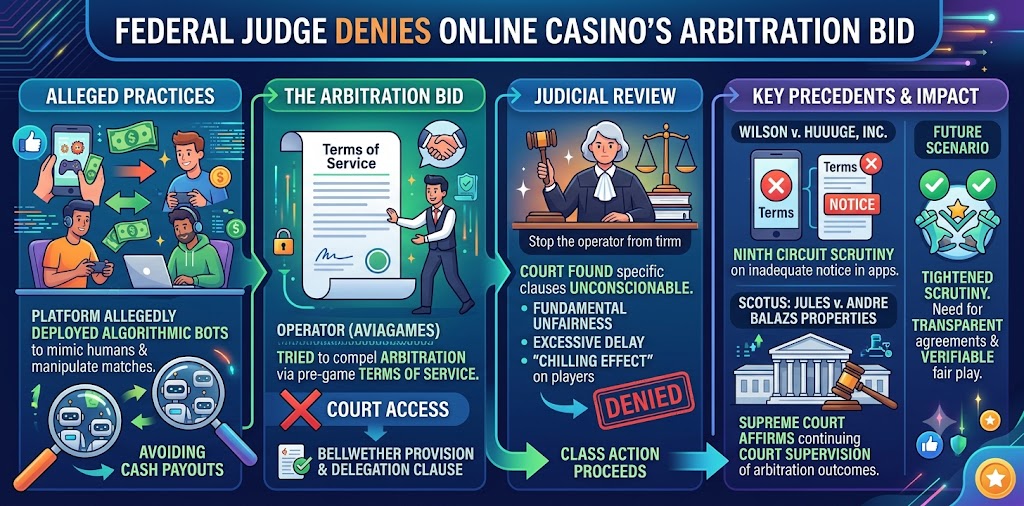
In a decisive ruling that underscores the increasing judicial scrutiny over consumer agreements in the digital gaming sector, a federal court in the Northern District of California recently refused to enforce an arbitration agreement imposed by online games operator Aviagames. The decision in Pandolfi v. Aviagames, Inc. denied the company’s motion to compel arbitration, citing that certain provisions within its terms of service were fundamentally unconscionable. This ruling opens the door for class-action discovery and sends a clear signal to online casinos and skill-gaming platforms that complex legal barriers cannot unilaterally shield operators from consumer litigation.
The Core Dispute: Skill, Bots, and Misrepresentation
The lawsuit centers on allegations regarding the operational integrity of Aviagames’ platform. According to the class-action complaint, the company marketed its games as skill-based competitions where users play against human opponents of equal skill levels. However, plaintiffs allege that Aviagames deployed algorithmic bots to mimic live opponents, manipulating matches to avoid paying out cash prizes while still collecting entry fees from real players.
When faced with the litigation, Aviagames attempted to force the dispute out of federal court by invoking an arbitration clause embedded in its pre-game terms of service. The agreement included a “bellwether provision” and a delegation clause requiring an arbitrator—not a judge—to determine gateway issues of arbitrability.
Unconscionable Terms and the “Chilling Effect” on Players
Federal courts typically favor the enforcement of arbitration agreements, but the Northern District of California found the specific structure of Aviagames’ terms to be predatory. The court ruled that delegating the arbitrability issue to an arbitrator under the company’s bellwether provision would unconscionably delay consumers from resolving their claims.
In the official order denying the motion, the court noted that the “prospect of delay on the limited gateway issue alone likely has a chilling effect on players, deterring them from vindicating their rights”. Because each claimant would be forced into a prolonged holding pattern just to determine the proper legal forum, the judge invalidated the arbitration requirement and allowed the class-action lawsuit to proceed toward discovery.
Scott Shaffer, an advertising law attorney who reviewed the filing, emphasized the legal vulnerability operators face when drafting aggressive terms of service. “Although arbitration clauses in online terms of service are generally enforceable, some courts remain hostile to attempts to limit consumers’ rights to sue in court,” Shaffer stated in his analysis of the case.
Expanding Precedent: Ninth Circuit Scrutiny on Digital Notice
The Aviagames decision is part of a broader judicial trend rigorously evaluating how online casinos and gaming apps present their terms. In the landmark Ninth Circuit ruling Wilson v. Huuuge, Inc., the appellate court affirmed a district court’s denial of a motion to compel arbitration against a user of the Huuuge Casino smartphone app.
In that class-action lawsuit, which alleged violations of Washington state gambling laws, the Ninth Circuit held that the operator “did not provide reasonable notice of its Terms of Use”. Because the app did not require users to affirmatively acknowledge the terms before downloading or playing, the court ruled the player had neither actual nor constructive notice, rendering the embedded arbitration provision unenforceable. Together, these rulings establish that courts will rigorously evaluate both the visibility of arbitration clauses and the substantive fairness of their internal procedures.
2026 Regulatory Outlook for Online Gambling Platforms
The procedural landscape for arbitration is tightening at the highest levels of the judiciary. On May 14, 2026, the U.S. Supreme Court delivered a unanimous decision in Jules v. Andre Balazs Properties, establishing that a federal court retaining jurisdiction to stay a case under Section 3 of the Federal Arbitration Act also maintains the authority to subsequently confirm or vacate the resulting arbitration award.
Authored by Justice Sonia Sotomayor, the ruling clarified that a stay “suspends—rather than terminates—the federal action, allowing the district court to supervise the arbitration through its conclusion”. For online gambling operators, this Supreme Court precedent means that even when a judge successfully compels arbitration, the federal court system maintains ongoing supervisory authority over the dispute’s ultimate resolution.
As legal frameworks evolve, digital gaming platforms must prioritize transparent user agreements and verifiable fair play. Relying on obscure digital waivers to mitigate the risks of consumer litigation is proving increasingly ineffective as courts actively dismantle unconscionable legal barriers.
Sources Quoted:
Case documents and judicial opinions from the U.S. District Court for the Northern District of California (Pandolfi v. Aviagames), the Ninth Circuit Court of Appeals (Wilson v. Huuuge, Inc.), the U.S. Supreme Court (Jules v. Andre Balazs Properties), and expert legal analysis from attorney Scott Shaffer via the Advertising Law Blog.
Leo Falsafi is a digital marketing veteran and senior journalist at Virlan.co, where he covers the intersection of digital marketing, gaming, and breaking US trending news. With nearly two decades of hands-on experience in SEO and digital strategy, Leo has consulted for and scaled hundreds of companies. His deep industry roots allow him to deliver sharp, fact-checked insights and analysis on the trends shaping today's digital landscape.