
The operational borders for decentralized web3 applications are tightening inside the European Union. In the latest sovereign pushback against non-custodial crypto platforms, the Czech Republic has officially classified Polymarket as an unlicensed gambling platform, initiating a strict enforcement action to disconnect local users.
The 15-Day Blacklist Order
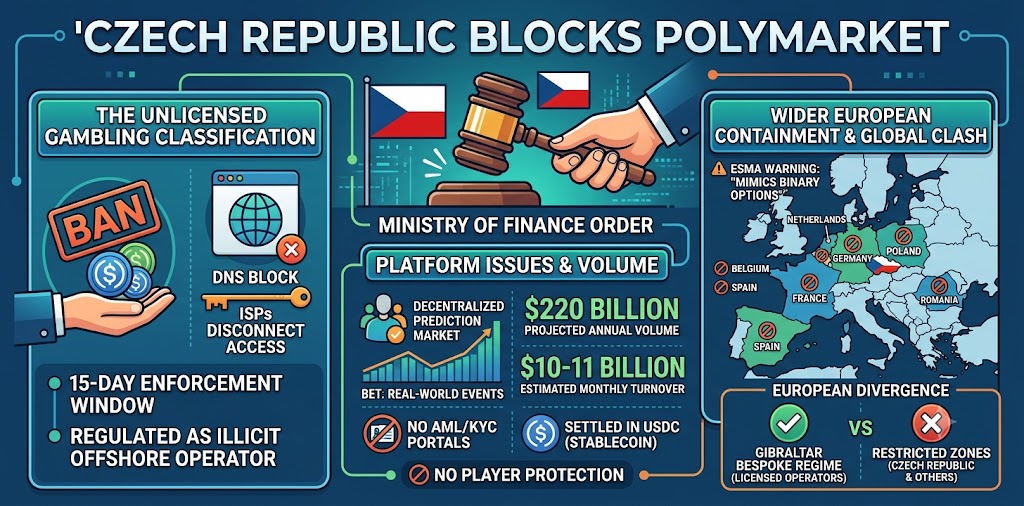
On July 13, 2026, the Czech Ministry of Finance pulled the trigger on the decentralized prediction network, officially appending Polymarket to its national “List of Unauthorized Internet Games”. Under the country’s stringent Gambling Act, the publication of this listing sets off an immutable compliance timer. Local internet service providers (ISPs) across the Czech Republic are now legally obligated to implement hardware- and DNS-level blocks against the website within 15 days.
The action moves Polymarket from a legally gray market innovation to a explicitly banned portal alongside thousands of illicit offshore domains already targeted by the Ministry. Regulators made it clear that changing the semantic wrapper of an operation does not insulate it from sovereign oversight. If a web service accepts capital based on the outcome of a future, volatile, real-world occurrence, it must operate with a domestic license.
“If It Looks Like a Bet” — The Regulatory Logic
The legal strategy deployed by Czech authorities seeks to dismantle the financial terminology popularized by decentralized information markets. Polymarket historically markets its system as an investment framework where users buy and sell event-driven “contracts” and clear “returns on investment”.
The Czech government rejects this narrative outright. Jan Řehola, director of the Czech Institute for Gambling Regulation, has stepped forward to articulate the enforcement rationale:
“Prediction markets are not harmless technological novelties. They involve betting on real-world events, often without clear accountability to the state, without standardized player-protection measures, and without the rules that apply to legal gambling. If something looks like a bet, functions like a bet, and allows people to win or lose money depending on the outcome of an uncertain event, we cannot stop treating it as gambling simply because it is called a contract.”
Beyond the absence of standard domestic tax contributions and local operational auditing, the Institute for Gambling Regulation highlighted severe structural anxieties inherent to decentralized betting spaces. Chief among them is the absolute vulnerability to outcome manipulation and the clear potential for insider trading—where market participants trade heavily on non-public, asymmetric information regarding political choices, corporate decisions, or security developments before they manifest.
Also read:
- Tips to Win 2026 World Cup Final Predictions in Polymarket & Kalshi
- How to Trade Esports on Polymarket (And Jump the Waitlist with a $50 Promo Code)
- Prediction Markets and the New Attention Economy: Polymarket, Kalshi, and the $300 Billion Boom
Exploding Volumes Clash with Sovereign Frameworks
The immediate catalyst for state-level intervention appears to be the sheer scale of Polymarket’s global liquidity footprint. During its enforcement review, the Ministry of Finance cited internal and third-party research showing that Polymarket’s annualized transaction volume is on pace to process a staggering $220 billion in 2025, buoyed by a consistent monthly turnover ranging between $10 billion and $11 billion.
This massive velocity of capital bypasses conventional financial safeguards entirely. Because Polymarket is built directly on top of permissionless blockchain networks, every single market contract settles autonomously via smart contracts using Circle’s dollar-pegged stablecoin, USDC.
| Metric | Metric Details & Regulatory Value |
| Enforcement Trigger Date | July 13, 2026 |
| ISP Compliance Window | Strict 15-day implementation deadline |
| Projected Annual Platform Volume | Approximately $220 Billion |
| Estimated Monthly Turnover | $10 Billion to $11 Billion |
| Settlement Asset Class | Decentralized USD Coin (USDC) stablecoin |
By utilizing automated on-chain settlements, the platform avoids maintaining conventional consumer databases, standard corporate anti-money laundering (AML) tracking setups, or standardized KYC (Know Your Customer) portals required by localized, state-licensed gambling operators. For sovereign states, this design undercuts centuries of evolving public framework structures built specifically to guarantee player protection, check systemic financial exploitation, and offer explicit resources for responsible gaming.
The Widening European Containment Wave
The Czech Republic’s ISP blocking order is not an isolated regulatory incident; it is part of a structural containment strategy sweeping across international gaming authorities. Within Western and Central Europe, access to the platform has shrunk continuously. France, Germany, Belgium, Spain, Poland, Romania, and the Netherlands have already put forward severe operational restrictions or outright domain bans. Just this month, Italy re-added Polymarket to its official ADM blackjack list for the second consecutive time, while Dutch regulators decisively rejected a formal appeal from the platform.
The domestic bans align closely with supranational guidelines. On July 3, 2026, the European Securities and Markets Authority (ESMA) broadcasted a direct warning across the Eurozone. The continental watchdog noted that event contracts mimicking binary configurations qualify directly as financial instruments and are inherently subject to Europe’s historic 2018 retail binary options ban. ESMA warned developers that marketing products under alternative branding like “event contracts” does not bypass MiFID II compliance duties.
Globally, the pushback expands. Regulators in Australia, New Zealand, Brazil, Singapore, and Indonesia have initiated comparable enforcement proceedings. Concurrently, India’s Ministry of Electronics and Information Technology, along with courts in Buenos Aires, Argentina, mandated sweeping nationwide network blocks on prediction markets earlier this summer, citing severe holes in consumer protection.
Yet, as Central Europe fortifies its borders, a stark regulatory divergence is opening up. While major EU members treat prediction markets as illicit gambling, smaller jurisdictions are attempting to monetize the regulatory void. Gibraltar recently unveiled the world’s first bespoke prediction-market regime, immediately granting operational licenses to operators like ADI Predictstreet and Wire Market. This bifurcation suggests that while Polymarket’s unchecked, decentralized access model is coming to an end across traditional European hubs, the global fight over the legal definition of an event contract is only just beginning.
Sources Quoted
- Jan Řehola, Director of the Czech Institute for Gambling Regulation.
- The Czech Republic Ministry of Finance (Official statements, regulatory registry updates, and the List of Unauthorized Internet Games).
- European Securities and Markets Authority (ESMA) (July 2026 regulatory guidance documentation).
- Data metrics and geographic context sourced via specialized coverage from CoinCentral, Crypto News, KuCoin Flash, and Cointelegraph.
Leo Falsafi is a digital marketing veteran and senior journalist at Virlan.co, where he covers the intersection of digital marketing, gaming, and breaking US trending news. With nearly two decades of hands-on experience in SEO and digital strategy, Leo has consulted for and scaled hundreds of companies. His deep industry roots allow him to deliver sharp, fact-checked insights and analysis on the trends shaping today's digital landscape.