
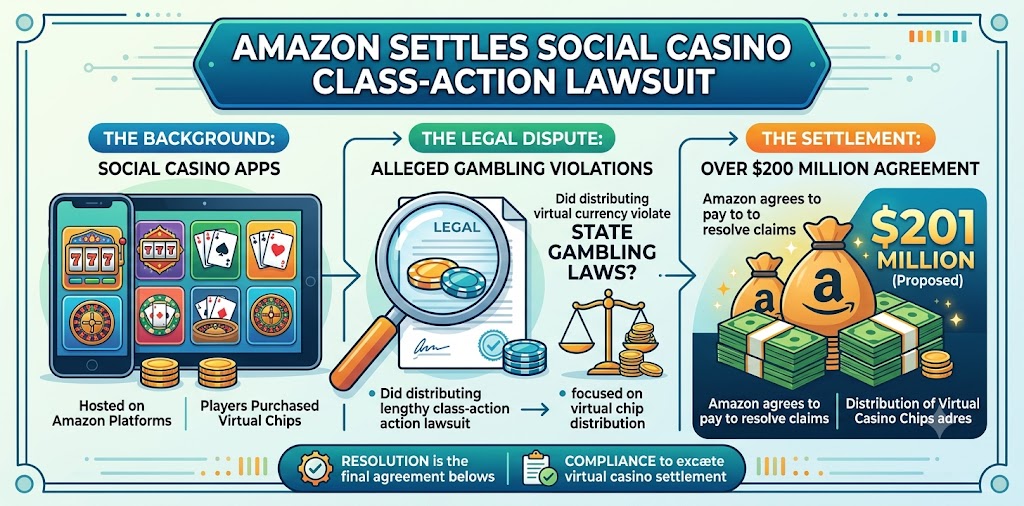
In a landmark legal maneuver that will undoubtedly send shockwaves through the tech and mobile gaming sectors, Amazon has agreed to resolve a bitter class-action dispute regarding its distribution of virtual casino chips.
The headline figure is staggering: a $201 million judgment against the e-commerce giant. However, the mechanics of this proposed settlement—currently awaiting approval in the U.S. District Court for the Western District of Washington in Seattle—reveal a brilliant, unprecedented legal shield. Amazon isn’t paying the players. Instead, it is handing the plaintiffs the legal weaponry to hunt down the app developers directly.
The $201 Million Trojan Horse: How the Settlement Actually Works
The lawsuit, originally filed in November 2023 by Nevada resident Steven Horn, accused Amazon of acting as an unlicensed broker for illegal gambling. Horn’s complaint argued that Amazon violated Washington State’s Consumer Protection Act and strict gambling statutes by distributing social casino apps through the Amazon Appstore.
Because Amazon served as the exclusive payment processor for in-app virtual chip purchases, the company took a standard 30% cut of every transaction.
Rather than dragging out a costly trial, Amazon has opted for a settlement that fundamentally shifts the financial fallout. Under the proposed agreement, Amazon consents to a $201 million judgment against itself. But there is a massive caveat: the class members agree not to collect a single dime of that judgment from Amazon.
Instead, Amazon is transferring its own contractual indemnification rights to the plaintiffs. The settlement establishes the “Edelson PC Amazon Social Casino Litigation Trust,” making the class members its sole beneficiaries. Armed with Amazon’s legal rights, the plaintiffs will now pursue reimbursement directly from 32 third-party gaming developers responsible for the apps.
“Under this framework, the class stands to recover from the developers themselves a significant percentage of the class’s damages in an amount that falls directly in line with the prior developer settlements,” stated the unopposed motion for preliminary approval.
Amazon’s only direct financial output in this arrangement is a $2.5 million contribution to cover the upfront costs of settlement administration and class notice.
Washington State Law vs. The “Free-to-Play” Illusion
To understand why a retail behemoth was facing hundreds of millions in liability over digital poker chips, you have to look at the unique mechanics of the social casino industry.
These applications allow users to play digital slots and table games through the purchase of virtual currency (like gold coins). Players cannot cash out their winnings. For years, tech platforms viewed this as a harmless “free-to-play” model. Critics, however, argue that these platforms purposely leverage addictive gameplay loops to encourage continuous in-app purchases without offering any tangible reward.
Washington State maintains some of the strictest gambling regulations in the United States. Courts in the state have repeatedly ruled that virtual casino chips constitute “things of value,” effectively classifying these social casino transactions as illegal gambling. This strict legal interpretation has already forced the industry to pay out over $650 million in various social casino litigations.
The 30% Formula
The $201 million figure wasn’t pulled from thin air. It represents approximately 30% of every dollar the class members spent inside these social casino apps during the contested period. Plaintiffs utilized transaction data explicitly provided by Amazon to calculate the scale of the in-app chip sales. Conveniently, this matches the exact 30% commission Amazon collected for processing the payments.
Amazon’s Stance and the Future of App Store Liability
Despite agreeing to the $201 million judgment, Amazon has firmly denied any wrongdoing.
The company insists that it operates as a neutral marketplace. Following the settlement filing, Amazon released a statement pledging compliance while maintaining its business model. The company noted it will “continue offering choice,” but firmly stated it will require apps to “comply with applicable laws,” reserving the ultimate right to remove any offending application at its discretion.
If the federal judge approves this preliminary agreement, it establishes a fascinating precedent for Silicon Valley. By successfully weaponizing its own developer agreements to shield its balance sheet, Amazon has written a new playbook for platform liability—leaving 32 game developers squarely in the legal crosshairs.
Sources Quoted:
This article directly sourced legal filings from the U.S. District Court for the Western District of Washington, quotes from the unopposed motion for preliminary approval, and official corporate statements from Amazon as reported by iGamingToday, SBC Americas, and Covers.com.
Leo Falsafi is a digital marketing veteran and senior journalist at Virlan.co, where he covers the intersection of digital marketing, gaming, and breaking US trending news. With nearly two decades of hands-on experience in SEO and digital strategy, Leo has consulted for and scaled hundreds of companies. His deep industry roots allow him to deliver sharp, fact-checked insights and analysis on the trends shaping today's digital landscape.