
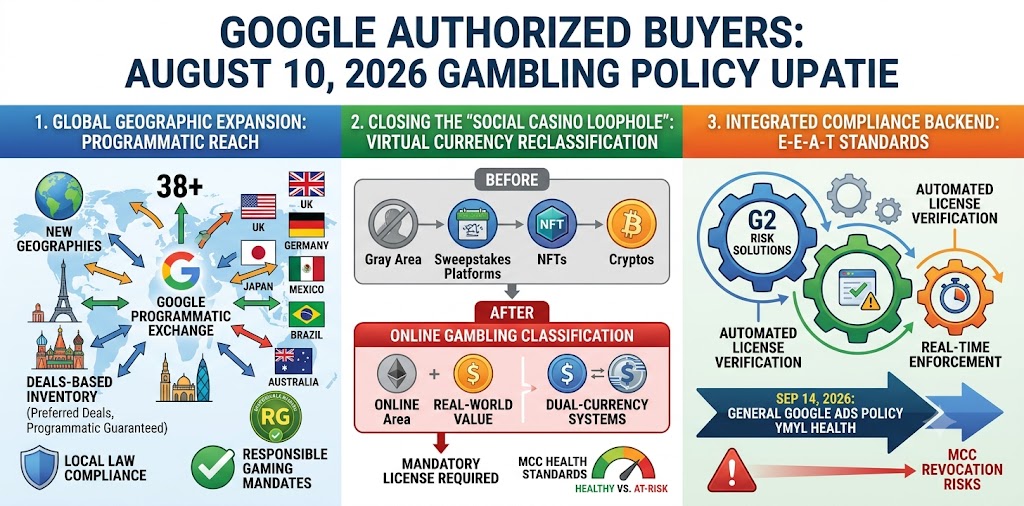
The programmatic advertising landscape for real-money and social gaming is undergoing a massive structural shift. On August 10, 2026, Google will officially update its Gambling and games policy for Authorized Buyers, opening the floodgates for compliant operators to run campaigns in an expanded list of over 38 global geographies.
Crucially, this update removes the requirement for Authorized Buyers to certify end advertisers directly with Google for this specific content, provided the campaigns operate strictly in accordance with local laws, regulations, and established industry standards.
However, operators scaling their media buying under this new framework face a complex reality. While the Authorized Buyers policy is expanding programmatic reach, Google’s broader ecosystem is simultaneously executing its most aggressive compliance crackdown in history, particularly concerning virtual currencies, manager account (MCC) health, and real-time license verification.
Expanded Geographies: A 38-Country Programmatic Shift
Historically, the programmatic promotion of high-risk gaming categories through Google’s Authorized Buyers faced severe geographic throttling. The August 10 update fundamentally alters this baseline.
According to Google’s official policy release, gambling creatives—including online casinos, sportsbooks, bingo apps, lottery platforms, and online sports betting—will now be able to serve beyond select US states. The expansion includes major, highly regulated markets such as Argentina, Australia, Brazil, Canada, France, Germany, Japan, Mexico, the United Kingdom, and nearly 30 other territories.
Update to Google Gambling and Social Casino Gaming Policy:
In accordance with local laws, regulations, and industry standards, Gambling creatives, e.g.,
- Online casinos and sport books
- Bingo and slot machine sites or apps
- Online lottery ticket and scratch card purchases
- Online sports betting
- Games using virtual currencies with real-world value
will be able to serve beyond select US states only including in Argentina, Australia, Austria, Belgium, Brazil, Canada, Taiwan, Czechia, Denmark, Finland, France, Germany, Greece, Hong Kong, Hungary, Ireland, Israel, Japan, Korea (the Republic of), Latvia, Mexico, Netherlands, New Zealand, Norway, Peru, Philippines, Portugal, Romania, Russian Federation, Serbia, Slovenia, South Africa, Spain, Sweden, Switzerland, Taiwan, Turkey, and United Kingdom.
This operational shift relies heavily on the mechanics of programmatic Deals. In these newly approved countries, campaigns must generally be executed through Preferred Deals or Programmatic Guaranteed pipelines where a publisher has enabled a block override, rather than the Open Auction network which remains largely restricted to certified US domains.
Virtual Currencies and the Closing of the “Social Loophole”
One of the most consequential lines in the August 10 Authorized Buyers update explicitly allows the promotion of “games using virtual currencies with real-world value.” While this opens new inventory for crypto-native platforms, it signals a definitive end to the regulatory gray areas that previously sheltered sweepstakes and dual-currency operators.
Industry analysts emphasize that this reclassification is part of a broader 2025–2026 clampdown on hybrid gaming models. According to industry publication Blockchain-Ads, Google’s modern definition of gambling now explicitly captures NFT-based gaming platforms and skin gambling sites.
The publication notes that the enforcement of these definitions “effectively ended the ‘social casino loophole’ that previously allowed sweepstakes platforms to advertise without traditional gambling licenses.” Consequently, any platform operating a dual-currency system (e.g., free “Gold Coins” alongside redeemable “Sweeps Coins”) is now strictly categorized as Real Money Gambling and heavily monitored across all Google networks.
The YMYL Reality: Expanding Access vs. Tightening Compliance
Because gambling advertising falls strictly under Google’s “Your Money or Your Life” (YMYL) content standards, the loosening of Authorized Buyers geo-restrictions does not equate to a relaxation of operational oversight. In fact, Google is concurrently launching a massive compliance net across its primary ad infrastructure.
While the August 10 update strictly impacts the Authorized Buyers policy, advertisers must navigate the impending September 14, 2026, update to the general Google Ads Gambling and games policy. According to La Fleur’s Lottery World, this upcoming policy applies a rigorous “policy-health standard” to all gambling categories.
The stakes for media buyers have never been higher. As reported by 15M, “Manager Accounts (MCCs) with repeated online gambling certificate revocations, as well as managed accounts repeatedly flagged for gambling violations… may lose eligibility to apply for new certificates.” This means an agency running one non-compliant offshore casino could permanently tank the Google Ads eligibility of its entire legal sportsbook portfolio.
Furthermore, the technological backend of this compliance is now fully automated. According to an operational audit by the YeezyPay Blog, Google’s integration with third-party verification frameworks like G2 Risk Solutions means manual self-certification is dead. The reality of programmatic gambling media buying in 2026 is immediate: “If a state commission pauses your license at 2:00 PM, your ads are usually dark by 2:05 PM.”
Navigating the Domain Ecosystem and Responsible Gaming
Advertisers looking to capitalize on the August 10 geo-expansion must also ensure their technical infrastructure is flawless. The era of running regional subdomains on rented platforms is over.
Google’s 2026 policy reiterations strictly mandate that domains must be directly owned and controlled by the operating business; websites hosted on free subdomains are entirely ineligible for certification across the network.
Finally, consumer protection remains the core pillar of these updates. The expansion of programmatic reach mandates that all landing pages and creatives prominently feature responsible gambling resources. Campaigns must rigidly deploy geofenced access restrictions, parental-gate overlays, and verifiable age-screen prompts to ensure minors are fundamentally excluded from the targeting pool. As the regulatory frameworks adapt to borderless digital currencies, long-term account health will depend entirely on prioritizing compliance over aggressive acquisition tactics.
Sources Quoted
- Authors & Publications: Blockchain-Ads (analysis on virtual currency and the social casino loophole), La Fleur’s Lottery World (reporting on the September 14 YMYL policy-health standard), 15M (analysis of MCC revocation risks), and YeezyPay Blog (data regarding G2 Risk Solutions and automated license enforcement).
- Regulatory & Official Sources: Google Authorized Buyers Help Center (Gambling and games policy update parameters), Google Ads Policy updates (March–September 2026 timelines).
Related:
- The Toxic Link Trap: Why Google’s Gambling Vetting Spells Trouble for iGaming Outreach
- Google’s 2026 Gambling Crackdown: The Death of iGaming Silos
- Google Tightens Gambling Ads Policy: Stricter Vetting Rules Hit Advertisers
- The 2026 Blueprint: US Sports Prediction Laws and Google’s New Search Squeeze
Leo Falsafi is a digital marketing veteran and senior journalist at Virlan.co, where he covers the intersection of digital marketing, gaming, and breaking US trending news. With nearly two decades of hands-on experience in SEO and digital strategy, Leo has consulted for and scaled hundreds of companies. His deep industry roots allow him to deliver sharp, fact-checked insights and analysis on the trends shaping today's digital landscape.