
For years, the multi-billion-dollar iGaming sector has operated on a razor’s edge. The industry’s search strategy has historically been divided into two distinct, highly aggressive camps: organic SEOs chasing authority through leased subfolders and “parasite” directories, and paid search specialists constantly testing the limits of cloaking, quick-fire landing pages, and aggressive bidding.
Also read: Google Tightens Gambling Ads Policy: Stricter Vetting Rules Hit Advertisers
But in 2026, Google is systematically dismantling the loopholes.
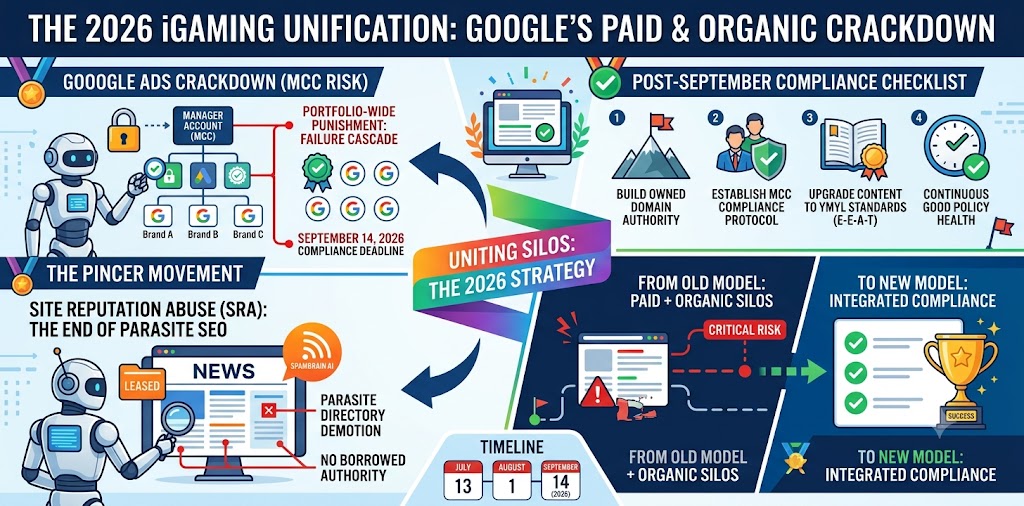
The search giant’s latest maneuver—announced on July 13, 2026, and set to take effect on September 14, 2026—is a sweeping update to its Google Ads Gambling and Games certification policy. It is not merely an administrative tweak; it represents a fundamental, dual-front pincer movement that mirrors Google’s organic crusade against Site Reputation Abuse (SRA).
If your marketing organization still treats Paid and Organic teams as isolated silos, the upcoming September deadline is a countdown to a complete marketing blackout.
The New Google Ads Rulebook: What Happens on September 14, 2026?
Starting September 14, 2026, Google will extend the strict certification requirements it introduced in March 2026 to every single category covered under its Gambling and Games advertising policy.
To run or even maintain gambling-related advertisements, operators must now demonstrate continuous “good policy health”. Google is shifting from a passive “approve-and-forget” licensing check to an active, algorithmic monitoring system that looks deeply at your compliance history.
The policy update introduces two devastating changes that target systemic abuse:
1. Portfolio-Wide Punishments for Manager Accounts (MCCs)
Agencies and multi-brand operators can no longer afford “sacrificial” ad accounts. Under the updated policy, if a Manager Account (MCC) repeatedly oversees accounts that lose their gambling certifications—or if managed accounts commit repeated violations while utilizing a certificate—the entire MCC will forfeit eligibility to apply for future certificates. Google also reserves the right to revoke all existing certifications managed under that MCC.
2. Strict, Uncompromising Domain Integrity
Google has drawn a hard boundary around domain structures, explicitly reiterating several domain-level rules that will now be strictly enforced at the gate:
- No Free Subdomains: Websites hosted on free hosting platforms or third-party subdomain hosts are entirely ineligible for certification.
- Direct Control and Ownership: The domain must be directly owned and controlled by the specific business applying for the certification.
- Standalone Ineligibility: Domains that have no core relation to gambling cannot be certified solely to run gambling advertisements.
(Note: In a parallel clampdown on fringe gambling vectors, Google also announced that the Chrome Web Store will begin banning any browser extensions that facilitate or enable real-money transactions based on prediction markets starting August 1, 2026).
The Algorithmic Mirror: Paid Ad Crackdowns Meet Site Reputation Abuse
Google’s ad tightening is not happening in a vacuum. It is the direct paid-media equivalent of the algorithmic warfare Google has been waging against Site Reputation Abuse (SRA)—commonly known as Parasite SEO.
For years, gambling affiliates leased out sections of highly trusted, unrelated domains (such as major newspapers or educational sites) to publish commercial “best online casino” reviews. Because the host site had massive, established authority, these leased directories ranked instantly.
Google’s SRA spam policy—launched with manual actions in March 2024 and supercharged with SpamBrain-powered algorithmic demotions in late 2025 and March 2026—targets this exact behavior. Google’s systems can now algorithmically analyze whether a section of a website is independent or “starkly different” from the parent domain’s core topic. When identified, Google isolates that section, stripping its borrowed authority and rendering the parasite directory useless.
The connection between the organic SRA updates and the September 14 Google Ads policy is undeniable:
| Organic SEO (Site Reputation Abuse Policy) | Paid Search (September 14, 2026 Policy) |
| Targets third-party parasite directories leased on high-authority, unrelated domains. | Prohibits certification for domains unrelated to gambling solely to run gambling ads. |
| Strips ranking signals from subdomains or subfolders that aren’t under direct editorial control of the host. | Disallows certification for free subdomains or domains not directly owned/controlled by the applying business. |
| Algorithmic filters (SpamBrain) flag and demote domains with a pattern of hosting deceptive, low-quality commercial content. | Automated systems evaluate the aggregate “good policy health” and compliance history of the account and its managing MCC. |
By implementing these mirror rules, Google is closing the loop. You can no longer run paid ads on a leased subdomain, and you can no longer rank organically using someone else’s domain authority.
Also read:
- Master Prediction Search Intent: US & UK SEO Strategy
- The Ultimate Guide to the Best Casino and iGaming SEO Agencies in 2026
- Casino & Gambling SEO in 2026: How AI Optimization Tools Are Rewriting the Rules
Why Paid and Organic Teams Can No Longer Work in Silos
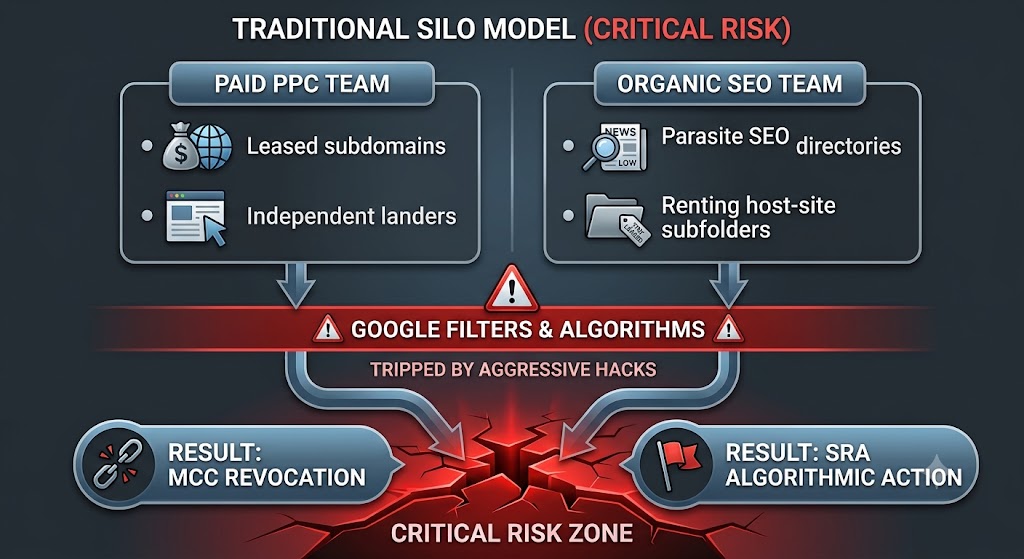
Historically, Paid Search and Organic SEO teams operated in distinct, comfortable silos. SEO teams focused on long-term link building, content clusters, and technical domain health. PPC teams focused on short-term conversions, bidding structures, and rapid lander testing.
This disconnected model is now a liability.
If your SEO team is still utilizing aggressive, legacy “grey hat” tactics—like spinning up low-quality affiliate content on subdomains or participating in unchecked link networks—they risk triggering a site-wide manual spam action. Under the new Google Ads paradigm, any drop in domain integrity or organic “trust” can severely damage your domain’s overall “good policy health” score, placing your paid ad certifications in immediate jeopardy.
Conversely, if your PPC team is utilizing unverified third-party landing page tools hosted on loose subdomains, those subdomains can be flagged as unauthorized third-party content. A single certification revocation on the paid side cascades up to the brand’s MCC, potentially getting the parent company blacklisted from advertising globally.
With Google’s automated compliance checkers evaluating your brand’s digital footprint holistically, a compliance failure in one department will instantly trigger an algorithmic or manual penalty in the other.
Pivoting Your iGaming SEO Strategy for Post-September Compliance
To survive the post-September landscape, iGaming operators must abandon short-term, borrowed-authority hacks and transition to an integrated, compliance-first marketing framework.
1. Rebuild Around First-Party Domain Authority
If your traffic generation relies on leasing subfolders from newspaper partners, start winding down those contracts immediately. Invest aggressively in building long-term, sustainable authority on your own second-level, brand-owned domains.
2. Elevate Content to Hard YMYL Standards
Google evaluates online gambling with the exact same rigor and scientific objectivity it applies to medical and financial niches (Your Money or Your Life). Ensure your content is written or reviewed by verified industry experts. Prioritize deep-dive guides, transparent comparison tables, and clearly visible responsible gambling and player protection resources.
3. Establish an MCC Compliance Protocol
Perform a strict audit of your agencies and the Manager Accounts (MCCs) handling your campaigns. If your agency manages other, more reckless gambling brands under the same MCC, their violations could end up blacklisting your brand. Demand dedicated, clean MCC setups or migrate your ad management to secure, in-house accounts.
Sources Quoted:
This article cross-references official Google policy documentation and industry journalism, including:
- Official Google Ads Policy Help documents on “Gambling and games Certification Eligibility Update” (published July 13, 2026, and January 22, 2026).
- Google Search Central Blog’s “Updating our site reputation abuse policy”.
- Reporting and expert insights from iGamingToday, European Gaming, PPC.Land, and TheGamblest.
Leo Falsafi is a digital marketing veteran and senior journalist at Virlan.co, where he covers the intersection of digital marketing, gaming, and breaking US trending news. With nearly two decades of hands-on experience in SEO and digital strategy, Leo has consulted for and scaled hundreds of companies. His deep industry roots allow him to deliver sharp, fact-checked insights and analysis on the trends shaping today's digital landscape.