
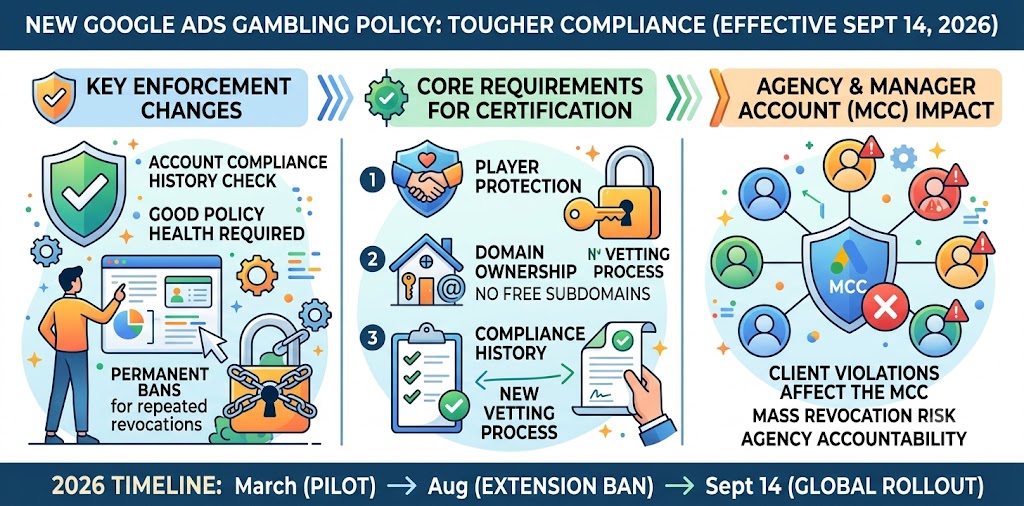
Google is fundamentally restructuring how real-money gaming platforms acquire players on the world’s most valuable search network. Starting September 14, 2026, the search giant will enforce an aggressive update to its Google Ads Gambling and Games policy. The shift signals a transition from a reactive, campaign-by-campaign policing model to a proactive, systemic accountability framework.
Under the new directives, holding local gaming licenses and submitting standard paperwork will no longer guarantee ad delivery. Instead, advertisers must demonstrate sustained compliance—coined by Google as “good policy health”—or risk losing their advertising privileges permanently.
The visual above highlights the user-facing side of online gambling, where real-time engagement relies heavily on continuous search visibility. This visibility is precisely what is now at risk for non-compliant brands.
Google’s New “Good Policy Health” Vetting Protocols
For years, bad actors have exploited gaps in the verification process to run brief, misleading campaigns before Google’s automated systems could flag them. To close these loopholes, Google is expanding a certification framework initially trialed in March 2026 to encompass every single advertising category under the Gambling and Games policy. This includes online casinos, sports betting, lotteries, social casinos, and skill-based games that offer prizes of real-world value.
Rather than just reviewing individual ad assets, Google will now evaluate the historical compliance of the entire advertising account. Persistent flags, temporary suspension warnings, or minor policy infractions will accumulate against an advertiser’s rating. If an account fails to maintain “good policy health,” Google reserves the right to deny new gambling certifications outright or revoke existing active certifications.
Also read: Google’s 2026 Gambling Crackdown: The Death of iGaming Silos
Crackdown on Manager Accounts (MCCs) and Agencies
Perhaps the most disruptive change targets the infrastructure of advertising agencies. Many large-scale gaming operators and digital marketing firms use Manager Accounts (MCCs) to run dozens of client campaigns simultaneously.
Under the revised guidelines, if an MCC account oversees client profiles that repeatedly trigger gambling policy violations, or if the MCC itself sees multiple certificate revocations, the entire manager account may be penalized. Consequences include:
- Total loss of eligibility to apply for new online gambling certifications across any linked account.
- Mass revocation of existing active certifications, effectively paralyzing an agency’s ability to run ads for its entire gaming roster.
This policy forces marketing agencies to act as strict compliance filters, heavily vetting their clients to protect their own agency-wide MCC privileges.
Eliminating the Subdomain Loopholes
In tandem with account health checks, Google is reiterating and strictly enforcing its domain authority rules. Many illicit or unregulated operators have historically bypassed bans by hosting affiliate and betting pages on free, third-party subdomains or redirecting users to uncertified auxiliary sites.
From September 14, 2026, the domain guidelines are absolute:
- No Free Subdomains: Websites hosted on free-of-charge subdomains (such as those provided by blog networks or free web builders) are permanently ineligible for gambling certification.
- Direct Control and Ownership: The domain must be owned, operated, and directly controlled by the specific business applying for the certification.
- Relevance Isolation: Domains that have no direct, clear connection to gambling cannot be certified to run gambling promotions, putting an end to “cloaked” redirection domains.
“Google’s changes reflect a tightening of its compliance, certification, vetting, and verification protocols after unlicensed/illegal operators had been exploiting to gain ad access via subdomains,” noted Michael Clohisy, sports attorney and adviser at Quintel Intelligence.
These changes come at a time of heightened global pressure from regulators, particularly in Europe, where illegal offshore gambling platforms cost governments billions of euros in tax revenue every year.
Timeline of Google’s 2026 Gambling Ad Crackdown
Google’s tightening of gambling advertisements is part of a broader, phased strategy to clean up high-risk sectors on its network throughout the year.
First-Phase Certification Rules
March 2026
Google introduces the concept of “good policy health” checks, applying them initially to select online gambling segments.
Prediction Market Web Extension Ban
August 1, 2026
The Chrome Web Store modifies its developer policies to outright ban browser extensions that enable or promote real-money prediction markets.
Global Rollout Across All Gaming Categories
September 14, 2026
The updated Google Ads policy takes full effect globally, enforcing domain rules and Manager Account tracking across all gaming and casino advertising formats.
How the New Google Ads Gambling Guidelines Impact Affiliate Marketers
The shockwaves of Google’s September 14, 2026, policy overhaul extend far beyond direct tier-one operators. For affiliate marketers and third-party review sites—the primary traffic-delivery engines of the global online gaming economy—the new rules represent a profound, existential shift in search engine marketing (SEM) strategy.
Historically, affiliate networks operated in a highly fluid, decentralized environment. Many relied on aggressive, short-term arbitrage plays, leveraging multi-site promotional structures, redirecting domains, and third-party hosting to capture intent-driven search traffic. Google’s new “good policy health” criteria and strict domain verification processes effectively build a fortress around the search ads ecosystem, locking out traditional, low-overhead affiliate maneuvers.
Eliminating the “Domain Rental” and Free Subdomain Exploits
For years, a standard strategy for rapid-fire affiliate launches involved leasing subdomains of authoritative, non-gambling root domains or utilizing free web-hosting platforms to bypass the initial hurdles of Google’s domain age and trust algorithms.
Under the new rules, this loophole is definitively closed. Affiliates can no longer run campaigns using:
- Free-of-charge subdomains hosted on third-party site builders or shared blog networks.
- Second-level domains that are not explicitly owned, operated, and legally tied to the registered business entity applying for the advertising certification.
- Unrelated root domains attempting to run isolated gambling landers (e.g., placing sports betting reviews on a lifestyle blog domain).
This means affiliates must now secure individual, standalone gambling certifications for every single unique domain they operate. Because Google now demands a transparent, documented relationship between the advertiser, the actual product, and the domain name, the ability to generate leads across a vast web of loosely connected domains is effectively dead.
High-Stakes MCC Risks for Aggregator Networks and Performance Agencies
Affiliate marketing networks and media buying agencies frequently utilize central Manager Accounts (MCCs) to manage and fund multiple promotional campaigns. This consolidated setup is now a critical point of vulnerability.
If a single rogue campaign under a manager account triggers repeated certification revocations or severe policy violations, the entire MCC faces systemic blacklisting. This “collective punishment” means a single non-compliant sub-affiliate or test offer could permanently compromise an agency’s capability to serve ads for its entire portfolio of legitimate clients.
| Operational Metric | The Old Affiliate Playbook | The New 2026 Compliance Reality |
| Domain Strategy | Use of leased subdomains and redirection webs to bypass domain authority delays. | Requires full domain ownership and verified connection to gambling products. |
| Enforcement Tolerance | Treating ad disapprovals as temporary “slaps on the wrist” and simply resubmitting. | Infractions accumulate as negative equity against the account’s permanent “policy health” score. |
| Agency/MCC Structure | Isolated account suspensions do not affect the umbrella manager account (MCC). | Risk of MCC blacklisting, leading to mass revocations across all client accounts. |
| Verification Barrier | Standard licensing and document submission was a one-time approval hurdle. | Continuous, automated compliance checks evaluating long-term operational integrity. |
“For affiliates, treating Google Ads policy flags as a minor nuisance is no longer a viable business model,” notes a leading traffic acquisition manager at an iGaming affiliate network. “If you do not build a localized, transparent, and completely clean domain infrastructure, you are one violation away from having your entire search engine marketing footprint wiped out permanently.”
Sources Quoted
- Michael Clohisy, sports attorney and adviser at Quintel Intelligence, quoted in European Gaming.
- Angel Hristov, industry reporter, from Gambling News.
- Reporting compiled from iGamingToday.com, CDC Gaming Reports, and SiGMA World.
- iGamingToday.com, detailing the specific operational impacts on Manager Accounts (MCCs) and domains.
- SiGMA World, tracking the impact on gaming firms, affiliates, and the transition to continuous compliance.
- Google Ads Advertising Policies Help Center, confirming the strict timeline and domain ownership requirements.
Leo Falsafi is a digital marketing veteran and senior journalist at Virlan.co, where he covers the intersection of digital marketing, gaming, and breaking US trending news. With nearly two decades of hands-on experience in SEO and digital strategy, Leo has consulted for and scaled hundreds of companies. His deep industry roots allow him to deliver sharp, fact-checked insights and analysis on the trends shaping today's digital landscape.