
The US commercial gaming industry is booming, hitting a record $78.61 billion in gross revenue in 2025. But operating parallel to this tightly regulated, heavily taxed ecosystem is a shadow market that reached an estimated $4.6 billion in 2025, up from just $3 billion three years prior. Sweepstakes casinos and social gaming platforms utilizing virtual currencies with real-world value have exploded in popularity, often operating in over 35 states without traditional gambling licenses.
Now, state regulators, class-action attorneys, and lawmakers are aggressively closing the gap.
The Mechanics of the Dual-Currency Loophole
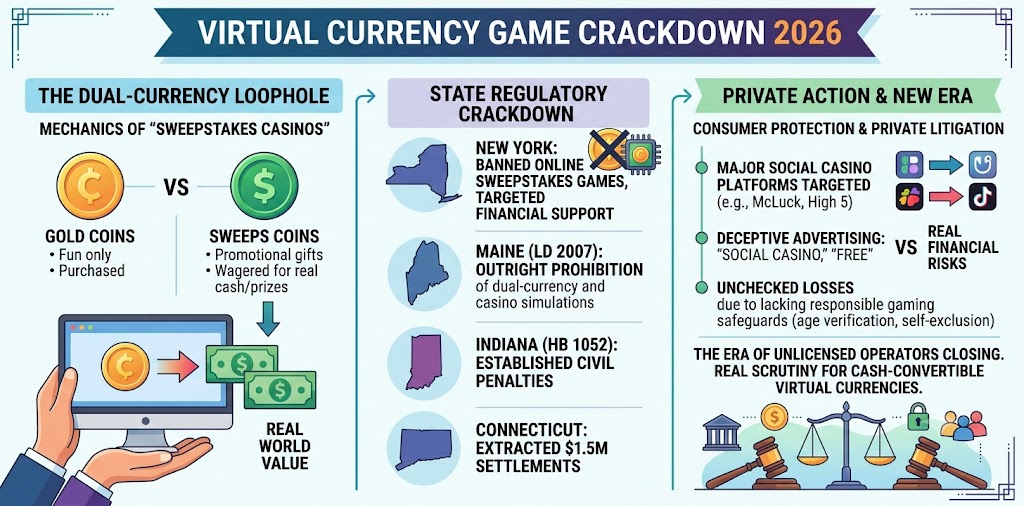
Sweepstakes casinos rely on a distinct legal structure to avoid being classified as standard gambling operations. Instead of direct cash deposits, they employ a “dual-currency” system. Players can purchase an entertainment-only virtual currency—frequently dubbed “Gold Coins”—which holds absolutely no real-world monetary value. However, platforms bundle these purchases with a secondary currency, often called “Sweeps Coins,” which are strictly awarded as promotional gifts rather than bought directly.
This secondary currency is where the real-world value materializes. Players wager Sweeps Coins on casino-style digital games. If they win, those virtual coins can be redeemed for actual cash or prizes. In many platform structures, a single Sweeps Coin directly correlates to one US dollar.
For years, this model provided frictionless entry into the iGaming space. The illusion of “free-to-play” entertainment was highly profitable. But lawmakers are rapidly tearing down the promotional sweepstakes defense.
The Regulatory Hammer Falls
State gaming commissions and attorneys general are no longer accepting the premise that dual-currency platforms are harmless social apps. The momentum shifted significantly in 2025 and has accelerated through the 2026 legislative cycle.
In May 2025, the Connecticut Department of Consumer Protection’s Gaming Division extracted a $1.5 million settlement from a major online sweepstakes operator. Weeks later, New York Attorney General Letitia James issued cease-and-desist orders to 26 different operators. James established a hardline stance, asserting that betting cash-redeemable virtual coins constitutes gambling, completely regardless of how the operator claims players obtained them.
Legislators are now weaponizing the financial supply chain against these platforms. New York passed legislation not only banning online sweepstakes games but expressly prohibiting financial institutions, payment processors, and gaming content suppliers from supporting them. This legislative blueprint is spreading. In the 2026 legislative cycle alone, Indiana established strict civil penalties (HB 1052), while Maine enacted LD 2007, an outright prohibition on dual-currency systems and casino-style simulations.
Class-Action Pressure and Consumer Protection
Beyond state enforcement, private litigation is putting severe financial pressure on the virtual currency gaming sector. Law firms working alongside consumer protection groups are targeting major platforms including McLuck, Modo Casino, and High 5 Casino.
The core allegation across these 2026 investigations is consumer deception. Attorneys suspect these platforms advertise as harmless “social casinos” where users can play “without spending a dime,” deliberately obscuring the real financial risks. Plaintiffs argue that the dual-currency mechanism is merely a smokescreen used to operate unlicensed gambling hubs where players can lose vast sums of real money.
This lack of strict licensing carries heavy responsible gaming implications. State-regulated operators—who generated $17.9 billion in tax revenue last year—are bound by rigid regulatory mandates. This includes mandatory age verification, stringent self-exclusion programs, and deposit limits. Sweepstakes casinos, operating outside this framework, are accused of lacking these vital safeguards, potentially exposing vulnerable individuals to unchecked financial losses disguised as virtual coin play.
Taxing and Tracking the Virtual Economy
As the broader crypto and virtual asset space matures, federal authorities are also tightening the net. The PwC Global Crypto Regulation Report 2026 highlights a pivotal global shift from basic policy design to strict, active implementation. Domestically, the IRS has rolled out rigid basis reporting requirements for digital assets (Form 1099-DA) that take full effect for transactions occurring in 2025 and reported in 2026.
While the Department of Justice shifted its strategy away from “regulation by prosecution” in early 2025 to let specialized agencies handle digital assets, state-level patience has clearly evaporated.
The message from 2026 lawmakers is unambiguous. Virtual currencies that translate into real-world cash are subject to real-world scrutiny. The era of operating a multi-billion dollar casino enterprise under the guise of an internet sweepstakes is rapidly coming to a close.
Sources Quoted
- Regulatory/Government: Connecticut Department of Consumer Protection Gaming Division, New York Attorney General Letitia James, Internal Revenue Service (IRS), American Gaming Association (AGA), US Department of Justice.
- Legal/Corporate Reports: PwC Global Crypto Regulation Report 2026, Venable LLP, WilmerHale, ClassAction.org.
- Industry Data: Casino.org, My Gaming License.
Leo Falsafi is a digital marketing veteran and senior journalist at Virlan.co, where he covers the intersection of digital marketing, gaming, and breaking US trending news. With nearly two decades of hands-on experience in SEO and digital strategy, Leo has consulted for and scaled hundreds of companies. His deep industry roots allow him to deliver sharp, fact-checked insights and analysis on the trends shaping today's digital landscape.